

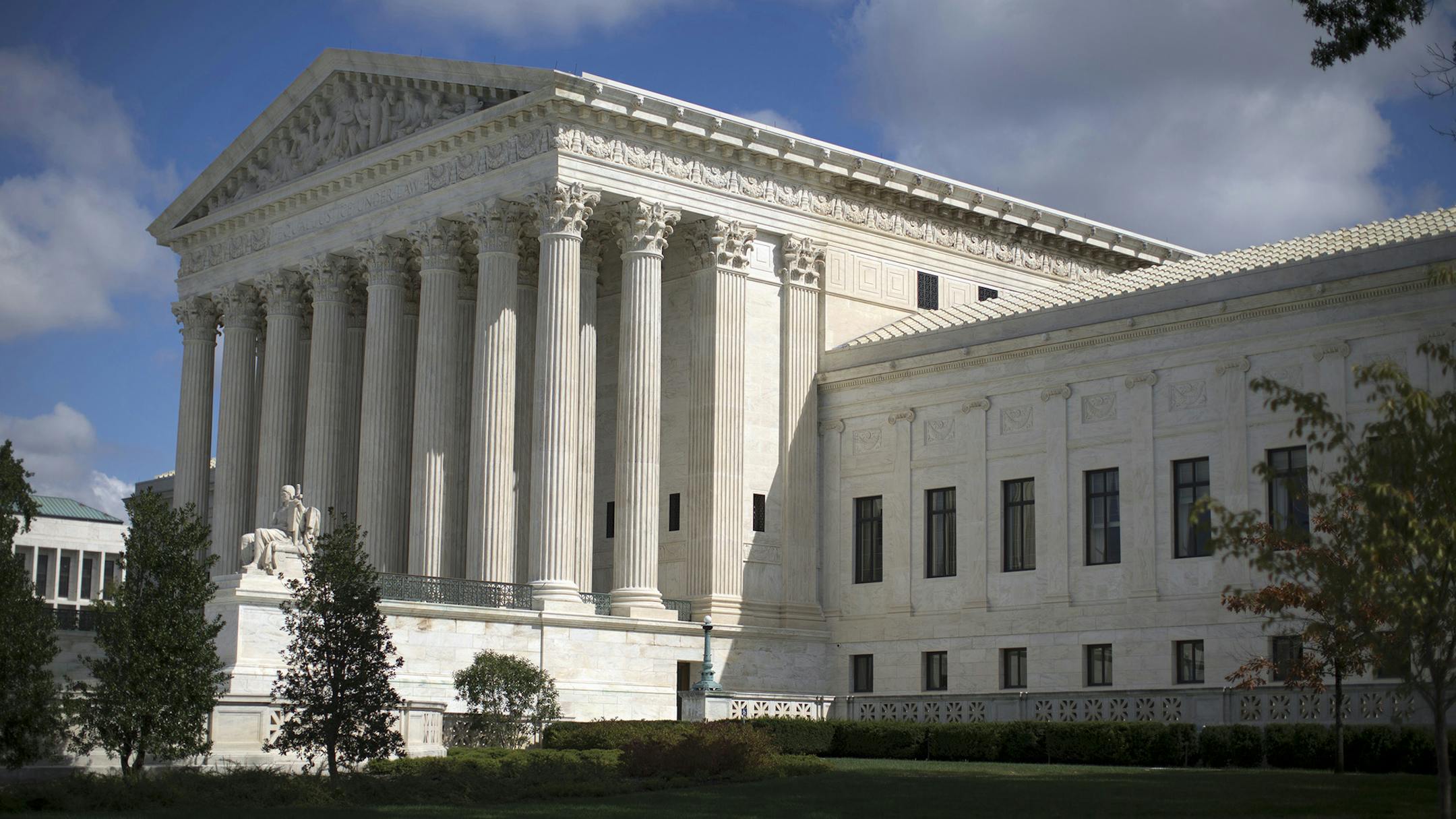
Every Supreme Court term has a theme. For the term that began on Monday, the theme looks as if it may be the achievement of longtime conservative aspirations using traditionally liberal constitutional tools. The court may finally prohibit government affirmative action, and it may effectively cripple unions by stripping them of the power to collect fees from nonmembers. The common thread in both cases is that precedent from the 1970s could be overturned by flipping a favorite liberal principle, one that progressives believe underpins the very practice at issue. Affirmative action could die in the name of equality. And unions could lose in the name of free association.
Affirmative action has survived judicial death longer than many court-watchers predicted. The basic constitutional challenge to the practice has always been the same. Affirmative action is designed to produce equality in a society with a legacy of racial discrimination. In order to do that, it treats individuals differently on the basis of race. To opponents, therefore, affirmative action violates the equal protection of the laws.
In 1978, affirmative action was saved from the equal protection attack by Justice Lewis Powell, a Virginia gentleman who had run the Richmond school board during the end of segregation. Powell embraced the idea that racial quotas were problematic constitutionally. But he adopted the view that holistic admission practices that accounted for the overall diversity of the student body were permissible. In particular, Powell was influenced by the model of Harvard college admissions, which treated every student as unique and the admitted class as a finely tuned orchestra composed to achieve a harmonious sound.
Whatever the merits of this conception, the Supreme Court has been loath to abandon it. Justice Sandra Day O'Connor upheld the same model in 2003, in a case involving the University of Michigan. At the time, O'Connor declared pragmatically that affirmative action might be needed for 25 more years.
After O'Connor retired and was replaced by Justice Samuel Alito Jr., Anthony Kennedy became the court's swing vote. He has repeatedly hinted that the diversity rationale might not be satisfactory, and urged a lower appellate court to scrutinize it carefully.
If Kennedy wills it, the end of affirmative action may come this term in the case of Fisher vs. Texas. It would be the culmination of a lengthy process of conservative constitutional argumentation. You may think it's brilliant to use the goal of equality to invalidate a practice devoted to equality. Or you may think it's perverse. But either way, the reversal would be dramatic and noteworthy.
The parallel to the conservative legal assault on unions is striking. Unions depend on the right to free association. If a group of corporations banded together to set the price of wages, that would be an antitrust violation. But for individual workers to do so has been treated differently in the modern era. Some of this is the result of solicitude for worker's rights. But some of it derives from the basic notion that individuals should be free to group together to pursue their common interests.
So it may come as a surprise that the conservative assault on unions has focused on free speech and association. In the 1977 case Abood vs. Detroit Board of Education, conservatives argued that if membership in the union was a matter of freely associating, then choosing not to be in the union must also be a basic right not to associate. At the time, the court wasn't willing to devastate unions by saying that workers who benefited from collective bargaining could opt out of paying any form of support to the union. The court compromised, holding that nonmembers couldn't be made to pay for a union's political speech, but could be required to pay fees equivalent to the members' dues to support collective bargaining.


