

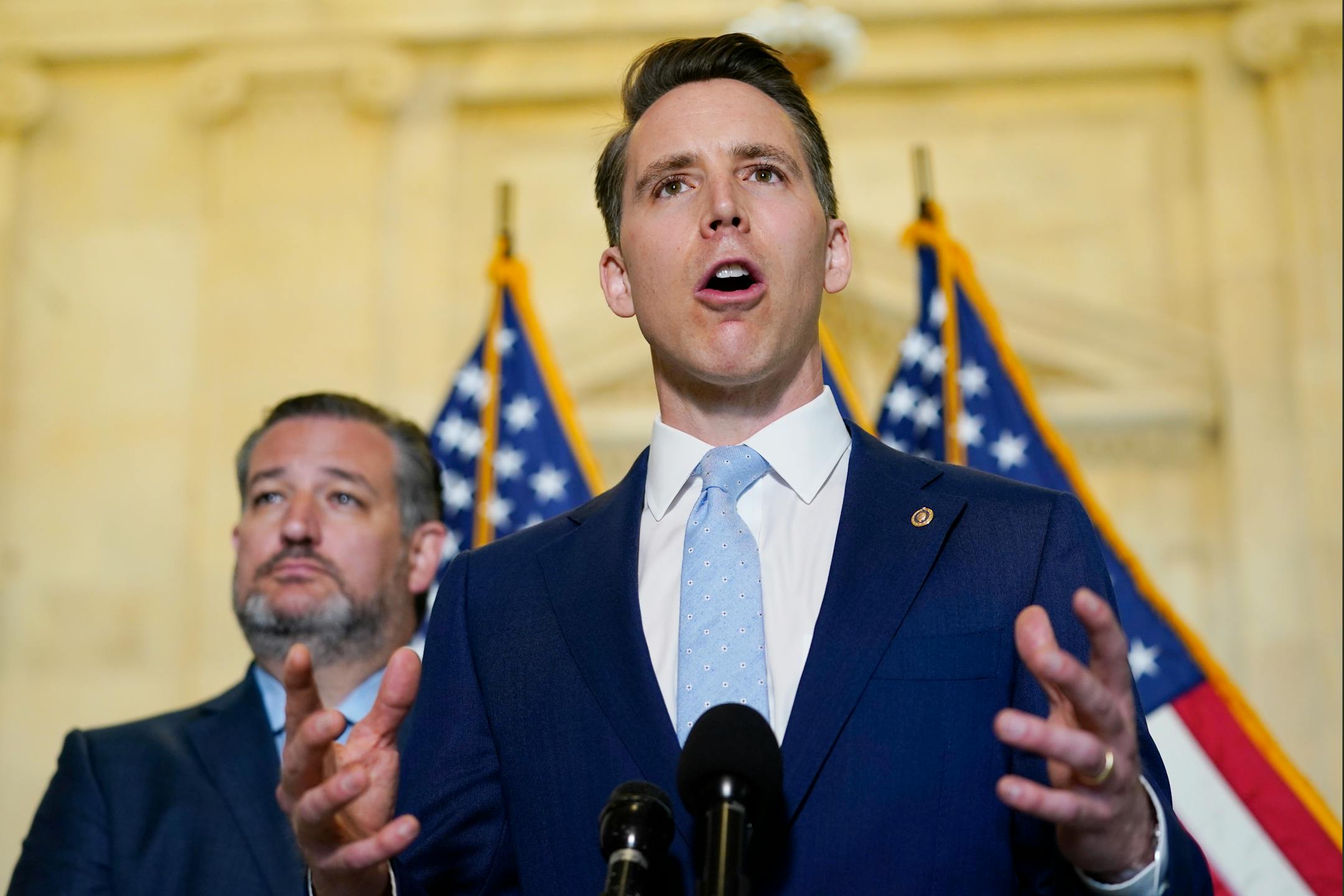
I was on my iPhone the other day when I heard the first furtive whispers about Big Tech's silencing of Sen. Josh Hawley. Since Jan. 6, when the Missouri Republican was photographed fist-pumping his support for some of the very fine people who would later storm the U.S. Capitol, Hawley has been all but banished from the media. Other than his frequent appearances on some of the most popular cable news shows in the country, his biting Twitter account, the Instagram account where he posts family snapshots and clips from cable hits, and his YouTube page collecting his nearly every utterance on the Senate floor, Hawley has suffered the worst fate known to a modern American politician: cancellation.
But as Nelson Mandela wrote while imprisoned on Robben Island, "Difficulties break some men but make others." Hawley, in that spirit, has only been stiffened by his battle with what he calls "the titans of woke capital."
When Simon & Schuster dropped plans to publish Hawley's book, "The Tyranny of Big Tech," in the wake of the Capitol riot, the senator was undeterred. He bravely weathered nearly two weeks of uncertainty before another large publisher, Regnery, picked it up.
And so what if, in marketing his uncanceled book, Hawley has recently been posting links on Twitter and Facebook to Amazon.com, where his book is on the best-seller list? A cynic may see hypocrisy in Hawley's relying on Big Tech to sell a book about the supposed censorious evils of Big Tech, but perhaps it is a kind of creative culture-jamming — no less ingenious, really, than the way associates of Soviet dissident Alexander Solzhenitsyn smuggled to the West microfilmed manuscripts of "The Gulag Archipelago" and other works in film canisters, book bindings and phonograph lids, right under the authorities' noses.
I am dunking on Josh Hawley because it is irresistible and very easy to do so but also to make an important, often overlooked point: When we talk about ideas like free speech, censorship, tyranny, "woke mobs" and especially "cancellation" in the American digital discourse, we are rarely talking about eliminating a speaker's opportunity to be heard.
Although he has suffered widespread opprobrium for his actions on Jan. 6, Hawley has hardly been silenced. Neither, of course, has former President Donald Trump, who was kicked off Twitter and Facebook for multiple posts that stoked the Jan. 6 riot — but who also, on Tuesday, released to great fanfare a new website that describes itself as a "beacon of freedom" in a "time of silence and lies."
Hawley and Trump's very noisy cancellations point to a central complication in America's endless fights about how and whether to police speech online. Outside of truly repressive regimes, no one, in the digital age, is ever really "silenced." What we are fighting about when we fight about cancellation is not an erasure, exactly, but instead a quieting — not who gets to speak, but whose speech gets to be amplified by recommendation algorithms, shared and echoed across the viral social-media-cable-news axis until it becomes loud enough to blanket the entire media landscape. As misinformation scholar Renée DiResta has put it, it is the difference between "freedom of speech" and "freedom of reach."
In America we have well-established traditions regarding censorship — it's bad. But amplification presents another question entirely, one for which no one seems to have any ready answers, not least technology companies and politicians. The difficulty does not bode well. I worry that we're stuck in a cultural cul-de-sac, an unending circular argument about cancellation that works to all sides' advantage. Social networks like Facebook keep getting bigger and more profitable; politicians get to constantly work the media refs, playing silenced victims punished for their brave truth-telling; and all the while the citizenry burrows ever deeper into an overwhelming information hellscape where little can be trusted.


