

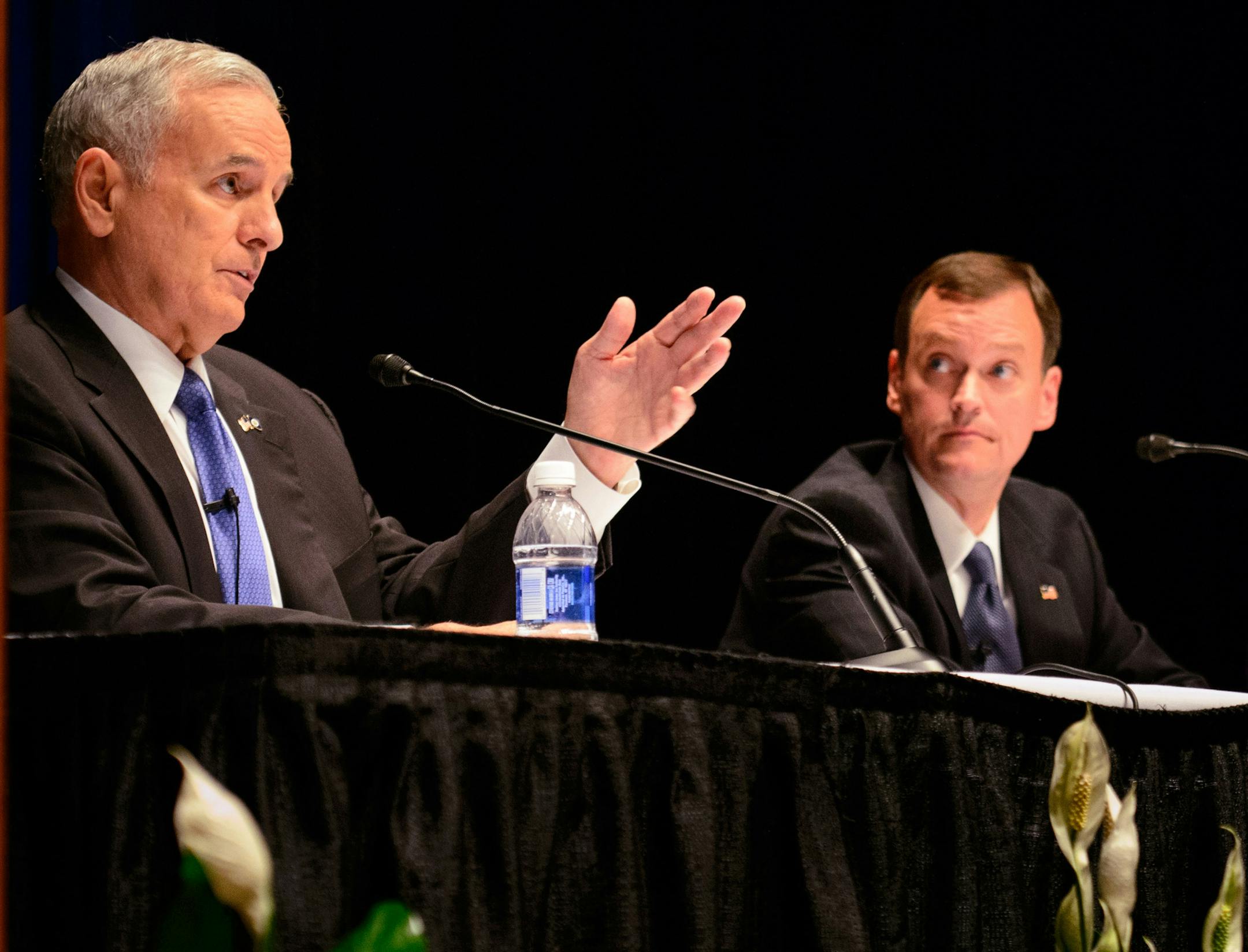
Not a single hurricane has struck Minnesota since Mark Dayton became governor. No chief executive in our history has done a better job protecting this state from tropical storms.
On the other hand, the Twins and Vikings haven't played very well under the Dayton administration.
And while the governor has stood idly by as that ISIL situation got out of hand in the Middle East, the boom that Dayton's tenure has brought in domestic U.S. oil and natural gas production encourages hopes for energy independence.
Meanwhile, look around — Minnesota's tradition of vivid fall colors is clearly secure under Dayton's steady leadership.
Rigidly logical readers may protest that matters such as these are not fully under the governor's control — that even though they unfolded on his watch he deserves neither blame for the Twins' pitching woes nor credit for the Bakken oil boom.
But saluting a governor's management of the weather, or faulting his handling of Mideast terrorism, is only by degree more nonsensical than the economic debate in the gubernatorial race between Democrat Dayton and his GOP challenger Jeff Johnson.
Dayton partisans credit him as being the mastermind behind Minnesota's comparatively healthy economic recovery since the Great Recession (it's the main theme of the governor's ubiquitous "Darn good coach" ad campaign). Meanwhile, Johnson and company jump on every disappointing twist in economic statistics to claim that Dayton has actually stunted Minnesota's growth.
Comparisons between Minnesota and Wisconsin are especially popular, on either side of the aisle and the border. Wisconsin Gov. Scott Walker is the Republican anti-Dayton — a tax-slashing, union-bashing, "open-for-business" conservative who made trouble for himself by invoking coach-like powers four years ago and vowing to create 250,000 jobs in his state. Hasn't happened. Wisconsin's recovery has been sluggish, not least compared with Minnesota's, as Walker's detractors apparently never tire of noting.


