

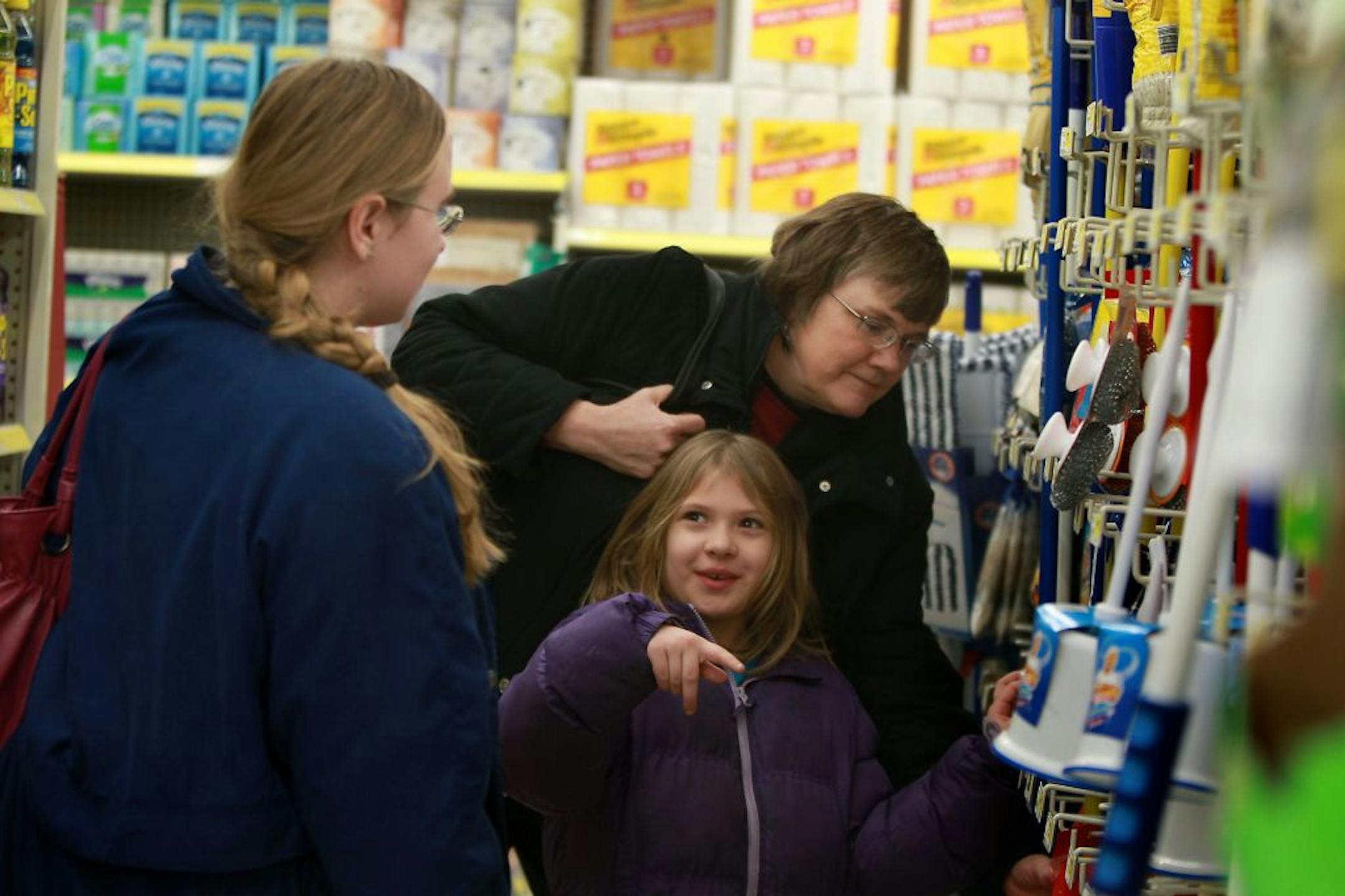
A few days after the New Year's holiday, clerks at the Dollar Tree store in St. Paul's Midway neighborhood were busily setting up new displays celebrating Valentine's Day and Super Bowl Sunday. Any remnants of the Christmas holiday season were long stowed away, and the bright new merchandise enticed shoppers anew.
No longer dusty, out-of-the-way haunts, dollar stores have grown into a $56 billion industry, a 43 percent increase since 1998, according to the industry research firm IBISWorld.
One of the few niches of retail expanding in a dim economy, the dollar store industry's four top players -- three of which are Fortune 500 companies -- are no longer snubbed by developers, landlords, investors and consumers because of their perceived working-class customer. Publicly traded Dollar General, Dollar Tree, Family Dollar and 99¢ Only Stores are expanding rapidly -- so much so, a recent report by Colliers International found, that there are more dollar stores nationwide than drugstores, a profound conclusion given the nation's aging population.
Dollar stores have responded to the new value-obsessed consumer by providing a brighter, cleaner retail experience with a dependable, well-edited selection of goods, including many food items, some perishable like milk and eggs.
Dollar chains are opening hundreds of new locations. The big ones -- Dollar General, Dollar Tree and Family Dollar -- now only have 153 stores in Minnesota (compared with the biggest dollar state, Texas, with 2,243 stores). So there's presumably room to grow.
This is a fortuitous development for commercial real estate brokers in the Twin Cities. As national retailers such as Borders, Linens 'n Things, Ultimate Electronics and others shut their doors, landlords have struggled to fill empty space in their shopping centers. Dollar stores often fill the void.
While the dollar chains won't say how many new outlets will open in Minnesota, local brokers expect many more to move into the state and the Twin Cities.
"When the recession first hit and retailers closed stores, landlords were sitting there with obviously no new retailers coming in," said Jen Helm, vice president of brokerage services for Cushman & Wakefield/NorthMarq Real Estate Services. "Dollar stores were saying, 'I want to be here,' and they got to go into markets that had previously kept them out."



