
Advertisement

The people who broke the House

You can tell the players — maybe — with this scorecard.

The New York Times
October 24, 2023 at 10:08PM
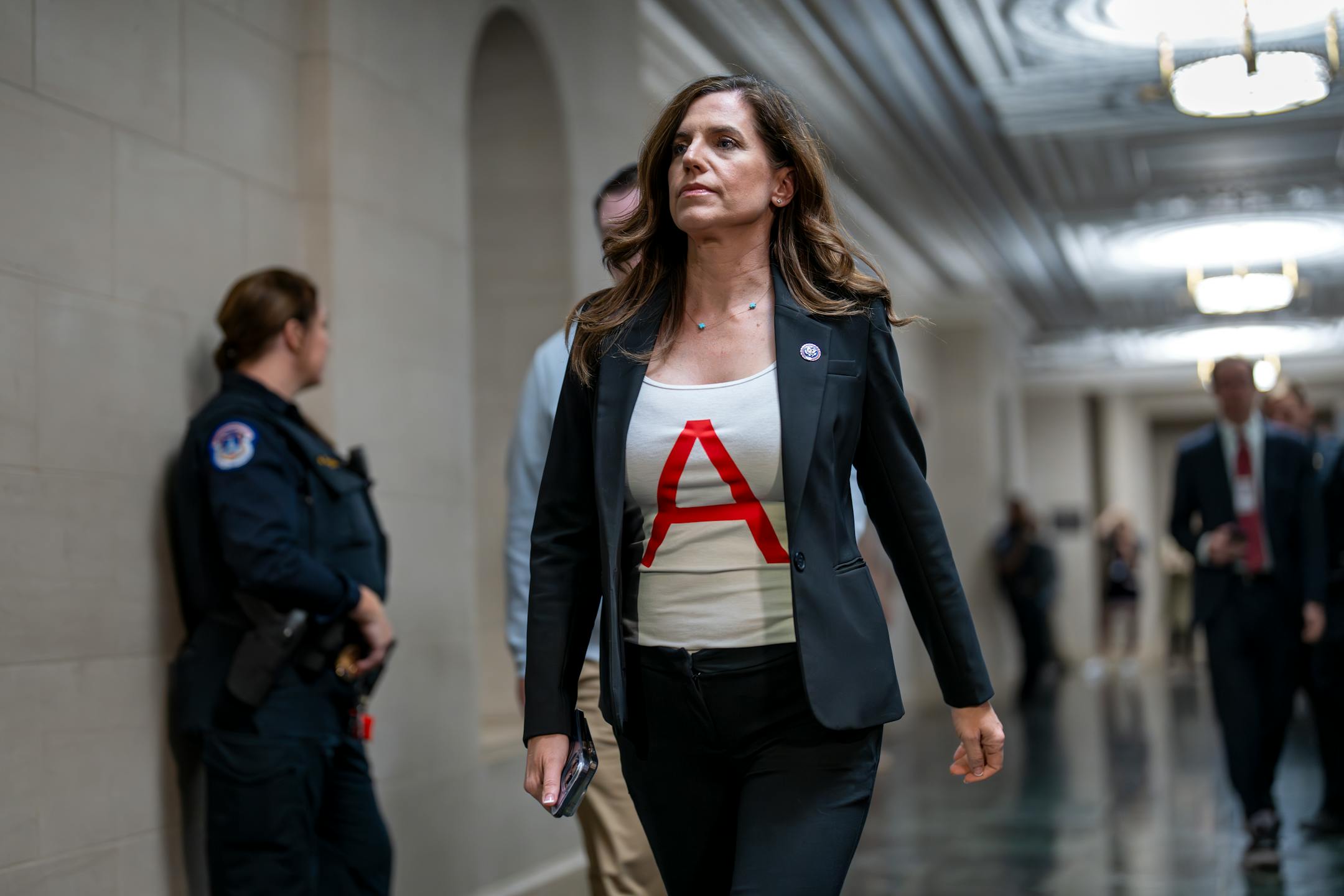
Rep. Nancy Mace, R-S.C., arrives as House Republicans hold a closed-door forum to hear from the contenders for speaker of the House, at the Capitol in Washington, Tuesday, Oct. 10, 2023. (J. Scott Applewhite, Associated Press/The Minnesota Star Tribune)
Advertisement

Opinion editor's note: Star Tribune Opinion publishes a mix of national and local commentaries online and in print each day. To contribute, click here.

•••

When it comes to Congress, Americans have come to expect a certain baseline of dysfunction. But I think most of us can agree that the current House Republican majority is something special. Overthrowing a speaker for the first time in history. Rejecting multiple nominees to replace him. Members publicly trashing one another. One faction's supporters threatening opposing members.

And so here we languish, with the government's most basic functions held hostage by a conference divided over everything from ideological differences to petty personal slights: Candidate X broke his promise! Candidate Y ignores me! Candidate Z never votes for my bills! It's like watching a pack of middle schoolers hopped up on hormones and Skittles.

To help make sense of this dark farce, it is useful to dig into the warring factions that have destroyed the speaker dreams of multiple colleagues. Boiling down the action so far: A tiny gaggle of eight Republicans, mostly hard-right extremists, took down Kevin McCarthy. Then a larger group of hard-liners quashed the candidacy of Steve Scalise, the majority leader, before it even came up for a floor vote, with an eye toward elevating one of their own, the chronically belligerent Jim Jordan. But a coalition of moderates, institutionalists and members who just can't stomach Jordan struck back, voting him down again and again and again — and again, if you count Friday's closed-conference ballot effectively stripping him of the nomination.

These were not — are not — sharply delineated factions. The rings overlap and include outliers with more particular grievances. And don't even try to suss out actual versus professed motives. That way lies madness.

But as this crisis drags on into a fourth week, we should pause to appreciate some of the people and forces that have mired us in this mess.

Matt Gaetz: The man who started it all. Since the January speaker's battle, this Florida Man has been the face of the anti-establishment, slash-and-burn hard-liners looking to upend how the House operates, devolve power to the rank-and-file — and maximize their faction's influence, of course. On Oct. 2, Gaetz filed the motion to vacate the speaker's chair against McCarthy, just two days after McCarthy worked with Democrats to pass a stopgap bill to keep the government running through mid-November. For the coup crew, this was the final, unpardonable sin.

Advertisement

Nancy Mace: A relatively moderate Republican representing a relatively moderate district in South Carolina, she was the striking outlier among the anti-McCarthy eight. Why did she posse up with the wingers? She says Kev broke his word. "I made deals with Kevin McCarthy, with the speaker, that he has not kept to help women in this country. And we have done nothing for them," she told reporters after the vote. And she complained on social media that he had "not lived up to his word on how the House would operate" and failed to take "action on many issues we care about and were promised."

From there, things just got weird. The following week, Mace showed up on Capitol Hill in a white shirt emblazoned with a giant scarlet "A" — which, as she told it, symbolized her "being a woman up here" who had been "demonized" for her "vote" and her "voice." Mace also announced that she would oppose Scalise for speaker because, during his time as a Louisiana state legislator, he appeared at an event sponsored by white supremacists. (The details of the 2002 episode remain a bit murky.) Fair enough. Wouldn't want people to think the GOP condoned racist nonsense from anyone other than Donald Trump!

But Mace's decision to jump on the Jordan bandwagon seemed odd on both political grounds — she has warned that moderate Republicans will lose in 2024 if bullied into taking conservative positions, which is what Jordan & Company live for — and personal ones. She is an advocate for victims of sexual assault, and Jordan has been credibly accused of turning a blind eye to sexual assaults by a team doctor during his stint as an assistant wrestling coach at Ohio State in the 1980s and 1990s. (He has denied any wrongdoing.) Asked about this on "Face the Nation," Mace claimed to be unfamiliar with the allegations, though they have been the focus of news accounts for years. Whatever. Her behavior thus far has been a head-scratcher.

Scott Perry: Most members of the anti-Scalise voting bloc were allies or members of the House Freedom Caucus, of which Perry, of Pennsylvania, is the chair. These hard-liners made clear Scalise was too establishment for their taste. "No matter what happens, I will never vote for the status quo," Perry wrote, explaining his preference for Jordan.

Ken Buck: The Colorado conservative helped boot McCarthy. But he then refused, publicly and proudly, to back his fellow Freedom Caucuser, Jordan. He instead repeatedly voted for Tom Emmer, the majority whip, though he says he doesn't even like the guy. Buck may have a host of problems with Jordan — which would speak well of him — but he has specifically called out his colleague's election denialism. "I also want to make sure that we don't have somebody who was involved in the activities surrounding Jan. 6," he told CNN. Giving aid and comfort to insurrectionists is apparently a red line for Buck. How refreshing!

Don Bacon: The Nebraska lawmaker hails from a district Joe Biden won in 2020, so it makes sense that he might not be cuckoo for Jordan. He also takes issue with the bullying behavior of the hard-liners. "You can't have a minority of the majority run the House, and that's what's going on," he told the Nebraska Examiner. And he was among those who spoke up about the threats lawmakers and their families were receiving from pro-Jordan nutters.

Advertisement

Drew Ferguson: The Georgia conservative supported Jordan in his first round of voting. But the pro-Jordan thuggery ticked him off, so he went anti-Jordan in Rounds 2 and 3. "When the pressure campaigns and attacks on fellow members ramped up, it became clear to me that the House Republican Conference does not need a bully as the speaker," he said in a statement.

Carlos Giménez: Incensed at what had been done to McCarthy, Giménez, who represents the southernmost tip of Florida, is among those to proclaim themselves OK — that is, Only Kevin — until the bitter end. "I will not partake in this despicable coup," he wrote last week. "Speaker McCarthy should have never been removed to begin with."

George Santos: This one was personal. Congress' most notorious fabulist declared himself an "Anyone but Scalise" voter. Why? He has groused that Scalise has ignored him all year and so did not deserve his support. Forget ideology or policy or politics — or the 23-count indictment against him. Hell hath no fury like a House member with hurt fee-fees.

Anthony D'Esposito: The New York freshman is among the half-dozen Jordan opponents representing districts Biden won. More specifically, he objected to Jordan's history of opposing funding vital to New Yorkers, and he voiced concerns about Jordan's approach to the current funding battle. The "people that I represent back home — they don't want our government to shut down and neither do I," he told the Wall Street Journal.

Kay Granger: Jordan was opposed by more than a half-dozen Republican members of the powerful Appropriations Committee, of which Granger is the chair. Tasked with getting the government funded, appropriators are known as a fairly pragmatic bunch. Jordan's antagonistic, block-everything approach was of concern to several. "This was a vote of conscience and I stayed true to my principles," Granger wrote, explaining why she stuck with Scalise over Jordan. "Intimidation and threats will not change my position."

Steve Womack: The Arkansas lawmaker was among the appropriators to oppose Jordan. He said he voted against Jordan at least in part "on principle" because of how badly Scalise had been treated. "He defeated Jordan in our conference vote and then was promptly kneecapped before he could win over his opponents," Womack said in a statement.

Advertisement

•••

By no means is this a comprehensive list of the players and their concerns. And, as efforts proceed, who knows what fresh divisions may surface? Don't look away, America — no matter how tempted you may be. This is your House majority in action.

Michelle Cottle is a domestic correspondent for New York Times Opinion. She has covered Washington and politics since the Clinton administration.

about the writer

about the writer

Michelle Cottle

More from Commentaries

See More
card image
card image
Advertisement