

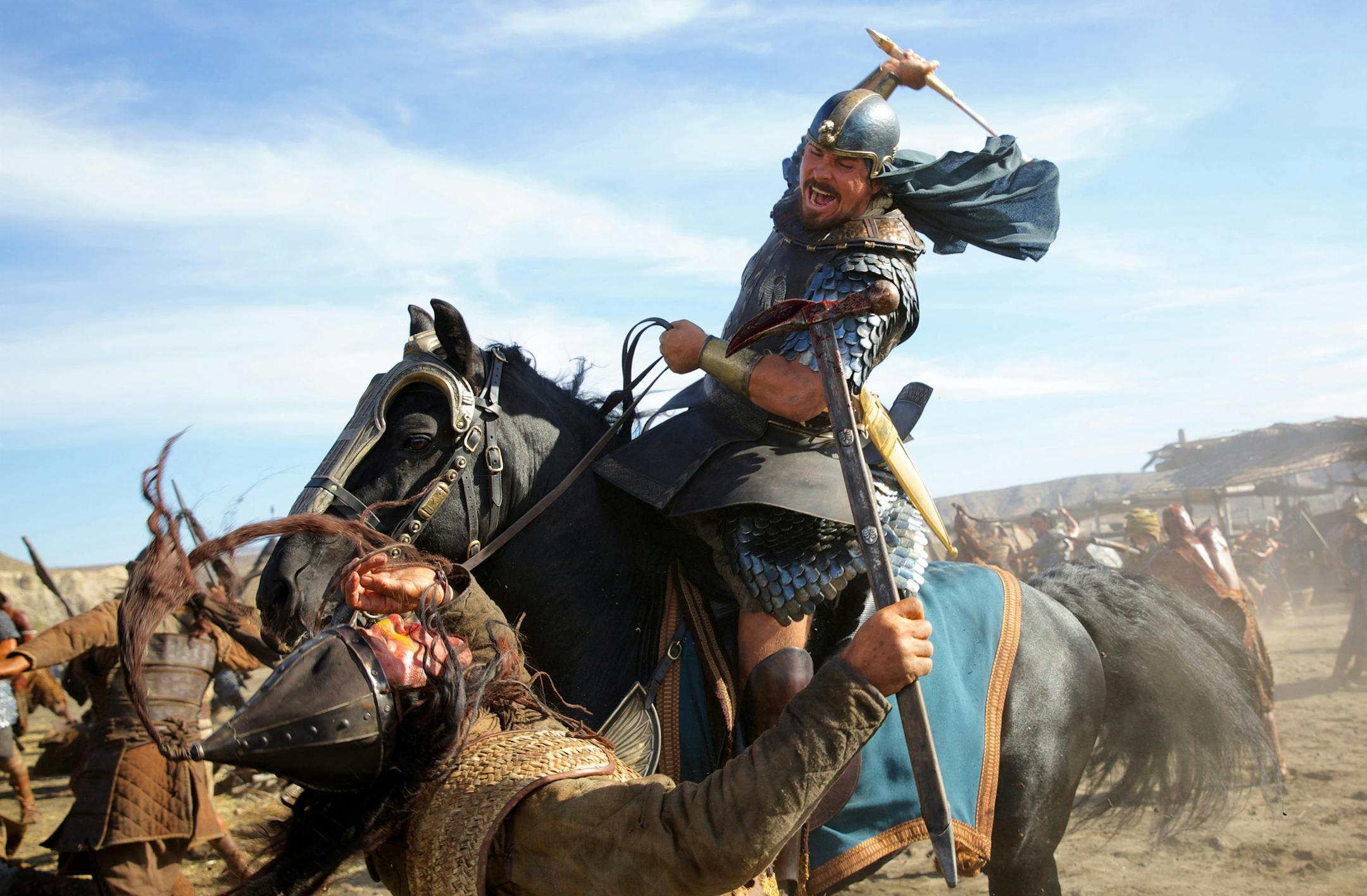
If Moses existed today, muses Christian Bale, the actor who plays the biblical figure in Ridley Scott's upcoming blockbuster, "drones would be sent after him." According to Bale, the champion of ancient Egypt's enslaved Israelites was a dangerous revolutionary. "He was absolutely seen as a freedom fighter for the Hebrews, but a terrorist in terms of the Egyptian empire," the actor told ABC's Nightline last month.
This silliness is probably in keeping with the film — just take a look at the trailer for "Exodus: Gods and Kings," which opened Friday in the United States. It's also compounded by Scott's cringe-worthy justification for casting white actors in lead roles, rather than people who would look more like those who live in modern-day Egypt and the Levant. (Scott insisted his Moses could not be played by "Mohammad so-and-so from such-and-such" because then nobody would finance his film.)
The figure of Moses is well-known: He's the subject of generations of Hollywood spectacle and a holy man revered by all three faiths of the Book. In his legend's wake are a bunch of commandments, rivers of blood, plagues of frogs and a sea that parts.
Yet, outside of biblical scripture, there is next to no evidence in the archaeological and historical record of Moses's existence. There is no exact time frame for when the events of Exodus may have occurred — with scholarly conjecture spanning more than half a millennium. Nor do we know the identity of the villainous Pharaoh in the Bible, cast in films repeatedly as Ramesses II. That pharaoh is famed for his conquests and building projects. But in their digs and readings of inscriptions and papyrus, historians have found no trace of Moses under Ramesses' reign.
They also puzzle over the seismic environmental event that is the parting of the Red Sea. There are various scientific theories over what could have happened. The Washington Post's Chris Mooney looked into one model that saw strong winds sweep through a brackish lagoon in the Nile Delta (not the actual Red Sea), creating a channel through which runaway Israelites could flee.
Still, there are myriad other doubts over the story of Moses, including whether he was even an Israelite. As Joel S. Baden, an associate professor at the Yale Divinity School, writes, the biblical figure's name is "a common element in the names of many pharaohs, such as Tuthmoses and, most famously, Ramesses." Baden elaborates, speculating on the tale of the birth of Moses, who was floated down the Nile as an infant:
That well-known narrative in which Moses' mother hides him in the Nile until he is found and raised by the pharaoh's daughter looks a lot like a heavy-handed attempt to explain that despite all the indications that Moses was Egyptian — especially his name — he was actually Israelite.
To understand Moses, you have to peer into that foggy dark in between the realms of myth and history. For much of antiquity, Egypt was an imperious superpower straddling the eastern Mediterranean, its armies ranging far and wide. There were quite likely communities of subjugated peoples from the area that is now Israel and the Levant living closer to the heart of the empire. The myth of exodus, suggests Cambridge archaeologist Cyprian Broodbank, was "at best a refracted folk memory of earlier expulsions of Levantine people."


