

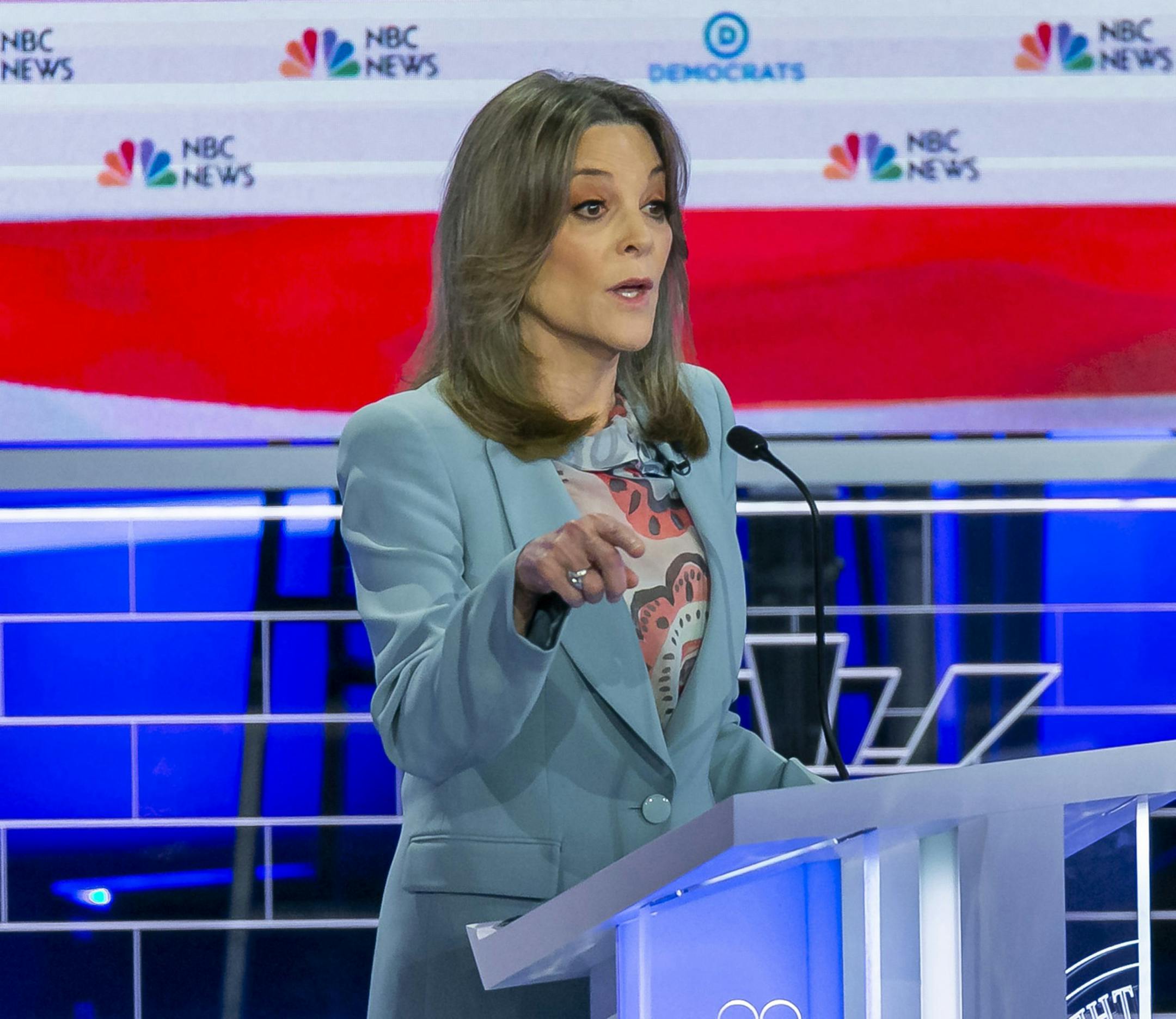
One of the pleasures of the Democratic primary season so far has been watching some of my colleagues in the press have their first exposure to Marianne Williamson, a figure who has occupied an important role in the American religious landscape since my own mysticism-shadowed youth, without always getting the credit for cultural influence that she deserves.
That influence, well-described by Sam Kestenbaum in Friday's New York Times, centers on her role as a popularizer for "A Course in Miracles," a book that has long been ubiquitous in the borderlands between charismatic Christianity and New Age spirituality. Since her first encounter with its message, Williamson has played the Apostle Paul for the book's author, Helen Schucman, carrying the Course's Mary Baker Eddy-esque promise of healing and harmony through a long career as a celebrity whisperer, Oprah-endorsed personality, author and spiritual guru — a career that has now finally led her into politics, as a kind of New Age answer to Pat Robertson or Al Sharpton's ministerial campaigns.
A recurring question in American politics since the rise of the Moral Majority and the Christian Coalition has been "where is the religious left?" One possible version has been hiding in plain sight since the 1970s, in the form of Williamson's style of mysticism, the revivalism of the Oprah circuit, the soul craft of the wellness movement, the pantheistic-gnostic-occultish territory at the edges of American Christianity's fraying map. We don't necessarily see it as a "left" only because it has acted indirectly on politics, reshaping liberalism and the wider culture from within and below, rather than acting through mass movements and political campaigns.
In which case the Williamson candidacy is an interesting milestone, a moment when an important cultural reality enters into politics explicitly, inspiring initial bafflement and mockery (in this case, via journalists digging up Williamson's most Moonbeam-y old tweets) but also exposing something important about America that normal, official media coverage ignores.
Certainly in the eternal pundit's quest to figure out what a "Donald Trump of the left" would look like, a figure like Williamson is an interesting contender. If Trumpism spoke to an underground, often-conspiratorial populism unacknowledged by the official GOP, Williamson speaks to a low-on-data, long-on-feelings spirit that simmers just below the We Are on the Side of Science and Reason surface of the contemporary liberal project. As Alex Pareene wrote for the New Republic after her weird but weirdly compelling debate performance:
"If the superficial version of 'Democratic Trump' resembles him aesthetically, the proper version would be closer to his opposite: Not just female but powerfully and unabashedly feminine, aiming her message not at the raging car dealer dad but the anxious Wellness Mom. … And while it is fun to scoff at her hokey spiritual woo and self-help bromides, it is easy to forget that hokey spiritual woo and self-help bromides are extremely powerful and popular among a massive subset of Americans, many of whom represent the exact sort of voters who decide Democratic primaries."
The post-debate polling, however, shows no Williamson surge — and my sense is that the path to a New Age answer to Trump would require a candidate who crosses racial boundaries more easily than Williamson (meaning, basically, Oprah), and a Democratic rank-and-file more alienated from their party leaders than today's Democratic voters seem to be. Trump arose in the aftermath of both a failed establishment-Republican presidency and then the failed Tea Party insurgency; by comparison the Democratic Party still regards its last president fondly and regards itself as the country's natural governing coalition, requiring no gambles on the power of Pure Love.
But Trump had his forerunners (from Pat Buchanan onward), and if we aren't likely to get President Marianne in 2020, in the long run her fusion of spiritual celebrity and political activism might be imitated and amplified, even as her distance from the technocratic norm points to a potential schism in the mind of liberalism.


