San Francisco, Los Angeles, New York and Washington have long failed to build enough housing to keep up with everyone trying to live there. And for nearly as long, other parts of the country have mostly been able to shrug off the housing shortage as a condition particular to big coastal cities.
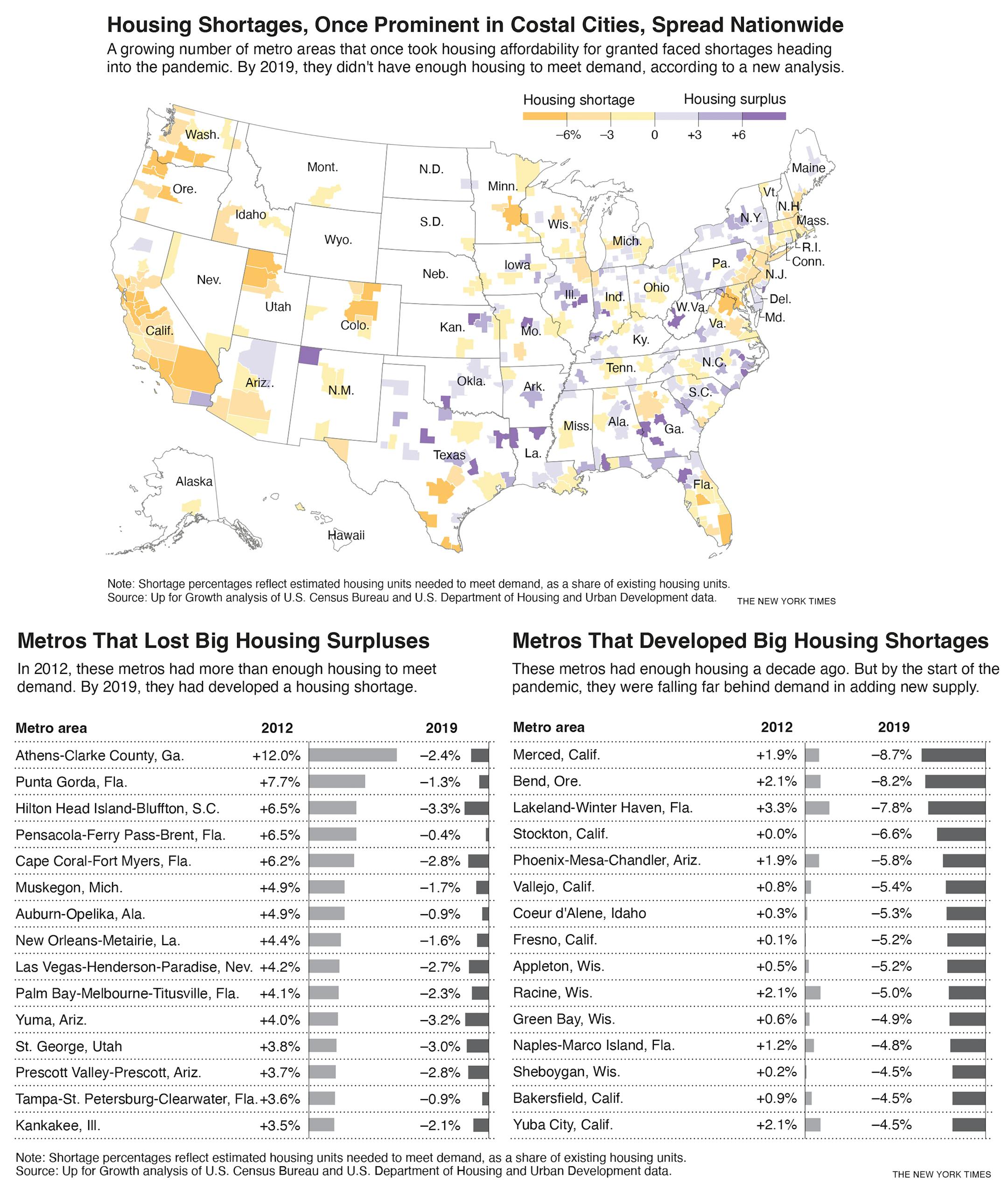
But in the years leading up to the pandemic, that condition advanced around the country: Springfield, Missouri, stopped having enough housing. And the same with Appleton, Wisconsin, and Naples, Florida.
What once seemed a blue-state coastal problem has increasingly become a national one, with consequences for the quality of life of American families, the health of the national economy and the politics of housing construction.
Today more families in the middle of the U.S. who could once count on becoming homeowners can't be so confident anymore. And communities that long relied on their relatively affordable housing to draw new residents can no longer be so sure of that advantage.
"It's like the cancer was limited to certain parts of our economic body," said Sam Khater, chief economist at Freddie Mac. "And now it's spreading."
Freddie Mac has estimated that the nation is short 3.8 million housing units to keep up with household formation. Up For Growth, a Washington-based policy and research group focused on the housing shortage, says that deficit doubled from 2012 to 2019. In that time, supply worsened in 47 states and the District of Columbia, according to an Up For Growth report published Thursday. Among 310 metropolitan areas nationwide, supply was dwindling or shortages were growing worse in three-quarters of them heading into the pandemic.
One consequence has been clear during the pandemic: Home prices and rents have soared nationwide, including in places where housing affordability had long been taken for granted.
That's in large part because demand surged, as households were looking for more space, and as remote work enabled some people to change cities. Historically low interest rates fed the homebuying fever, at a time when millennials were at their peak homebuying years and when investors were expanding their reach in the market.