

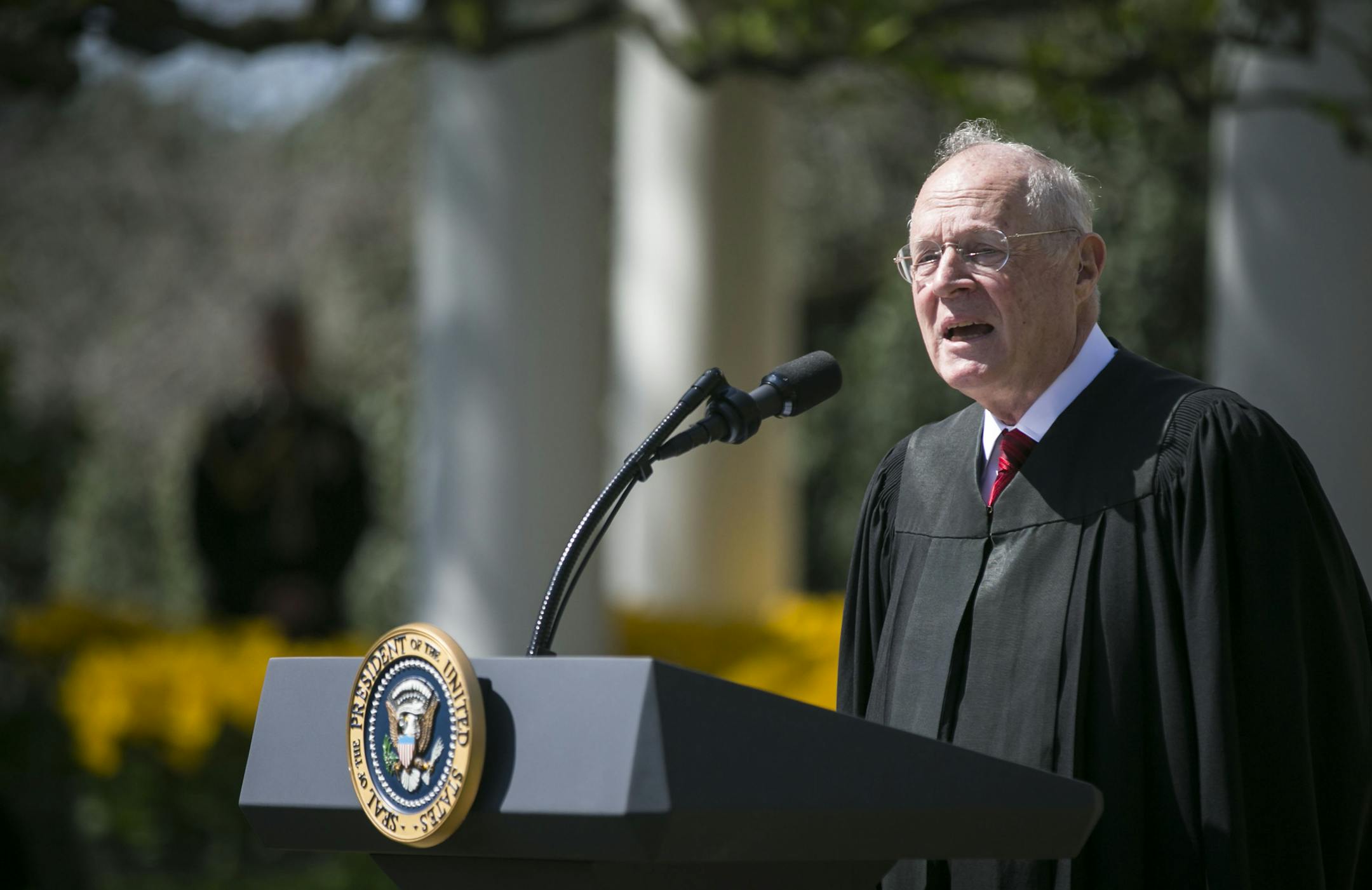
The retirement of Justice Anthony Kennedy had prompted speculation and fear among supporters of reproductive rights even before President Donald Trump nominated D.C. Circuit Judge Brett Kavanaugh to replace him. In the Supreme Court's decision in Casey vs. Planned Parenthood, Kennedy joined with several colleagues to protect the "core holding" of Roe vs. Wade, and he had remained a supporter — if not exactly an ardent one — of a precedent-based right to abortion. If the Senate confirms Kavanaugh, many supporters of reproductive rights fear that a five-justice majority will then stand prepared either to overrule Roe outright or else to chip away until Roe is reduced to an empty husk.
Kavanaugh has not commented publicly on the scope of abortion rights, although he is well known to hold socially conservative views and has described himself as an originalist — a method of constitutional interpretation associated with the late Justice Antonin Scalia and Justice Clarence Thomas, both of whom believe that Roe was incorrectly decided and dissented in Casey. Legal commentators might reasonably infer that Kavanaugh would share those views.
Given that the Supreme Court will likely limit the right to reproductive choice, meaningful access to abortion would become contingent on the will of state legislatures.
Forceful advocacy for reproductive choice at both the national and state levels has seldom been more important. And it's time for men to join the front lines of the fight.
Abortion is usually framed as a women's issue. In some ways, this makes sense: Reproductive choice — and its absence — affects what happens within women's bodies. And for the 1 in 4 women who have had an abortion, the issue is particularly personal. But it is important to remember that men also benefit greatly from safe and legal abortions. A partner's abortion has enabled men to finish school, allowed men to pursue their chosen careers, saved men from the loss of a spouse because of medical complications, kept men from economic hardship and spared men the emotional burden of unwanted parenthood. Men should be deeply invested in reproductive freedom, too.
Yet in the face of the current threat to reproductive freedom, calls to action have been disproportionately directed toward women. Consider the strategy of sharing personal stories, which is designed to destigmatize abortion and to emphasize its importance. Following upon a Supreme Court amicus brief in which women lawyers recounted the importance of abortion to their professional and personal well-being, a recent New York Times opinion piece suggests that more women who have had abortions should speak up and tell their stories. While this nuanced essay makes clear that no one is obligated to tell her story, others — including many men — have called upon women to tell their stories more forcefully.
What we too seldom hear is that men should also tell their abortion stories. We need to hear from the man who was able to stay in college, the man who did not become a single parent to two daughters after his wife died during a complicated pregnancy, the man whose uninterrupted research while a graduate student yielded a lifesaving cancer treatment and the man whose family did not become homeless during a stretch of unemployment — all because their partners had access to safe and legal abortion. Mathematically speaking, millions of men have such stories. The 1 in 4 women who have had an abortion did not get pregnant on their own.
These stories are powerful. Yet we rarely hear these perspectives, and more rarely still do we hear calls for men to describe how abortion has affected them personally. This needs to change.


