

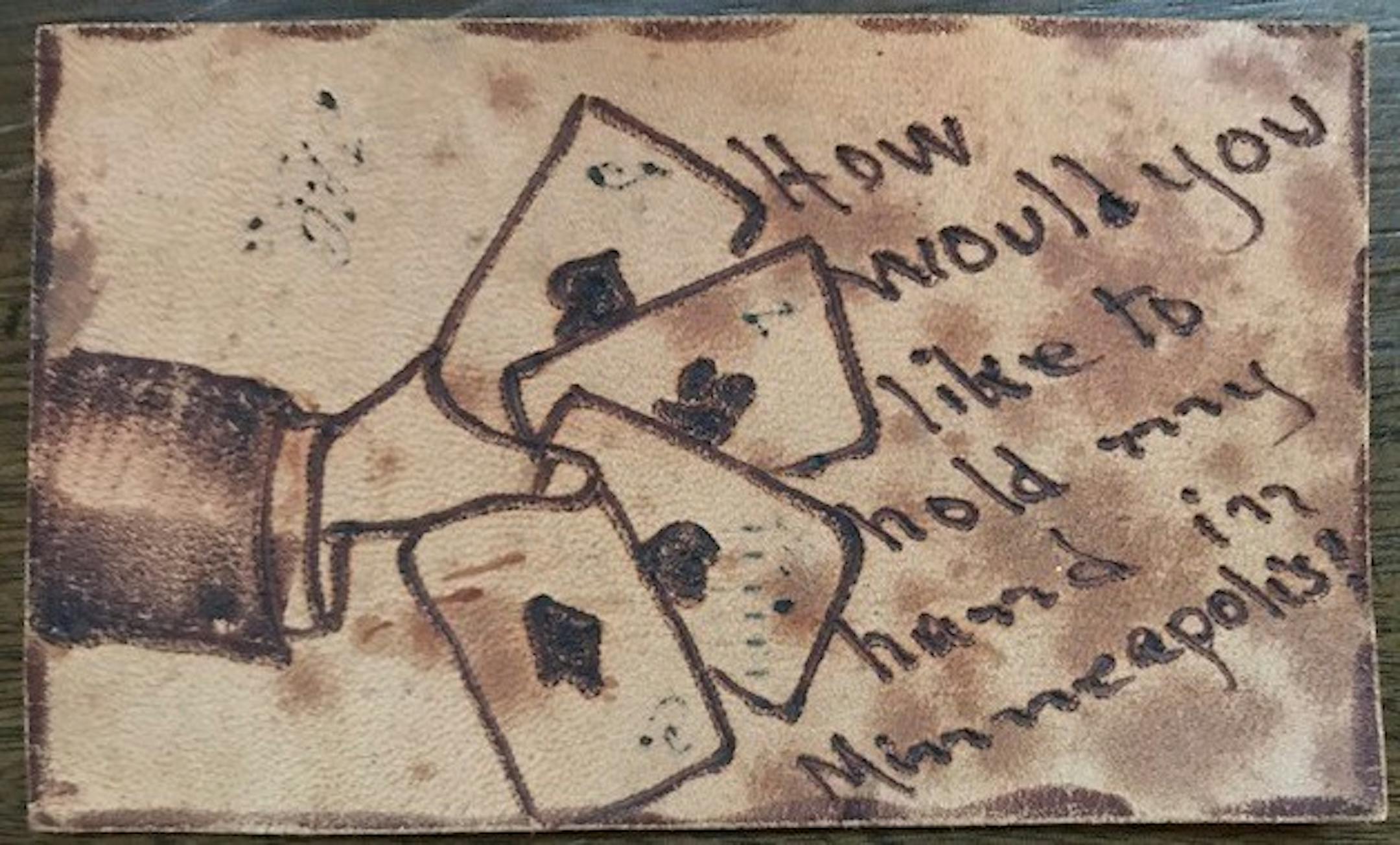
In the reams of paper ephemera at my house are buried postcards sent in the early 1900s from farm relatives who lived near Madelia, Minn. They read thus: "Stopped by to see you. You weren't home. Where were you? We'll try again next month when we go to town again."
Imagine a world of interpersonal communication where it took a month to get an answer. Where you sent a postcard, which likely took a week to arrive, to let someone know you had stopped by. Postcards were big then; some of mine are leather with burned-in designs sporting catchy phrases such as, "How would you like to hold my hand in Minneapolis?" A human hand, holding a hand of cards, is drawn neatly by the type. This communication took effort. It likely led to many misunderstandings or delayed responses to timely concerns.
But today, our answers are too quick and moderated by machines. I sometimes begin a conversation with someone based on information I got about them on social media. I know something about them they never told me directly. They sometimes look startled, but then relieved when I explain the origin of the knowledge. I only know because they told a machine and then the machine told me.
Communication today becomes a road rally. Think of bad news, the race that families face to deliver bad news of illness or death before it gets out on social media. The human need is to convey such information person to person. To hear the gasp and offer the words of consolation. The deepest news demands that we face each other.
I watch people pushing children in strollers, phones in hand. I think back a couple of decades to stroller rides I gave that involved constant communication with the person in the stroller. "Look at the leaves!" "Did you see the doggy?" "Do you want a snack?" "Let's go fast." "Let's get out." "Sit down." "I love you." A patter of words with gurgles and coos as response. But I've read that we now need to teach children to treat home assistant devices with respect. Children should not be allowed to yell at them, as it might lead them to yell at real people. It's a chilly communication that is moderated by a machine.
Then there was the time I attempted to use the smartphone as a natural consequence, telling my teen that due to some infraction now forgotten, the cellphone would be in my possession for a full day. The look on his face revealed all I needed to know. I had gone too far; the punishment didn't fit the crime. I realized then that the phone was part of the relationship. It was woven into that teen web of friendships and it was simply a bad idea to interfere in that all-important teen support system.
I also noticed the speed that teen plans, based on cellphone speed, would morph and shape-shift until I had no idea where the kids were and what they were doing. So the rule of "let me know when you are changing location" was put in place at our house. The parental scrambling we did in those early days of the ascendancy of the phone.
The frantic speed of communication by machine. The words are out before we have filtered them or looked someone in the eye to see how our words are affecting them. The speed bypasses empathy, circumvents the natural consequences of the fall of a human face and enables us to rage, rant, hurt with no thought at all. The push of a flat, nonclicking key — it's like a silent ambush.


