

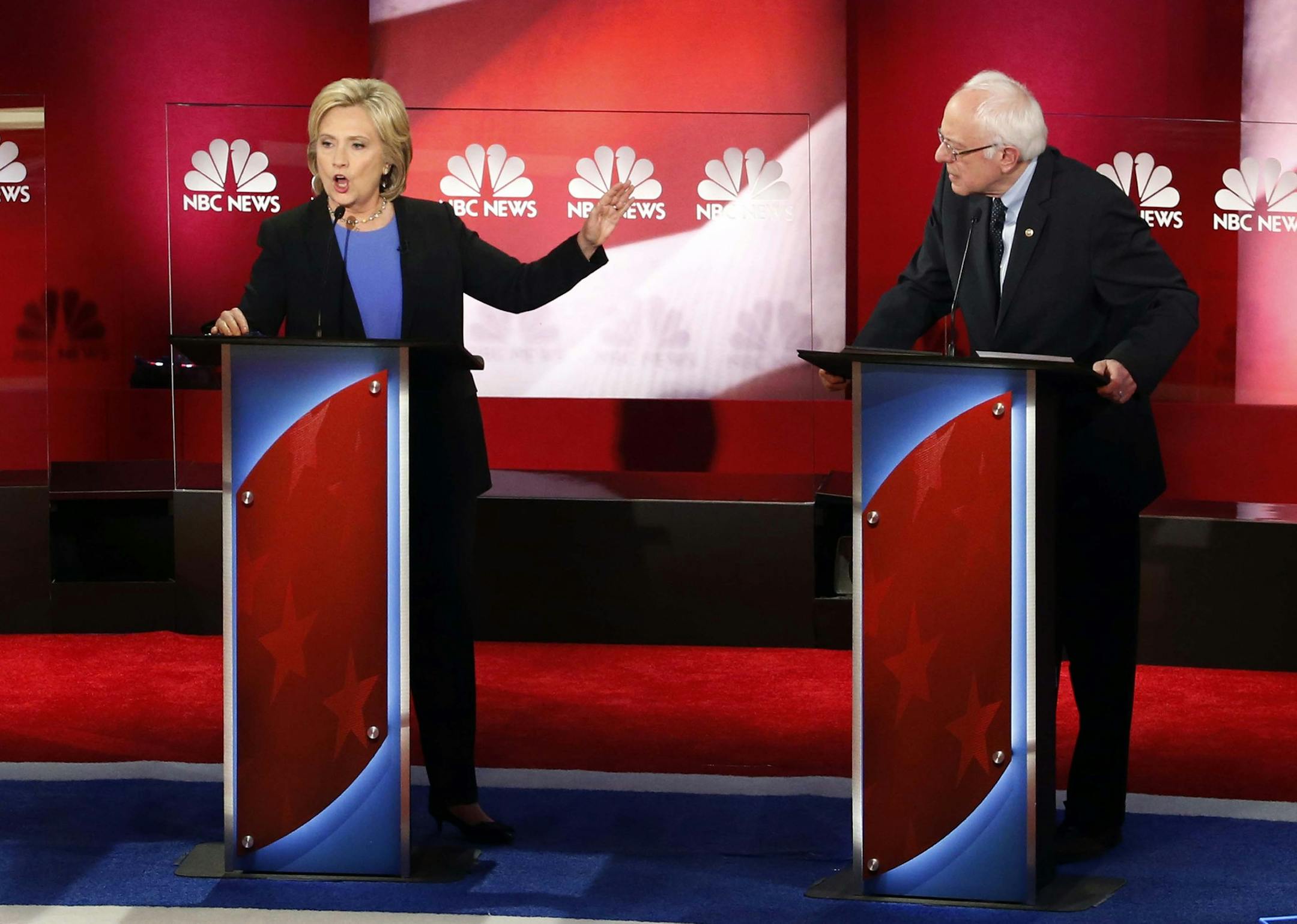
Hillary Clinton, Bernie Sanders and Martin O'Malley held their final pre-Iowa, pre-New Hampshire debate Sunday night. It was surprisingly illuminating.
Their debates have generally been less interesting than those for the Republican nomination. After all, while the Republican nomination remains up for grabs, the Democratic nod has been safely in Clinton's grasp for a year now. The only thing at stake appears to be whether Sanders can win in enough places early on that contested primaries will continue into the spring. If Clinton wins closely fought battles in Iowa and New Hampshire — states in which Sanders has a demographic advantage — the rest of the calendar will be symbolic at best.
And yet, Sunday really showed two directions the party could go after Barack Obama — its options wide open because the broken Republican Party has found it difficult to formulate policy.
Clinton and O'Malley say: More of the same. It's not just that Clinton ties herself as closely as possible to both Obama and to Bill Clinton. After all, both of those Democrats remain wildly popular with Democratic voters. It's that both Hillary Clinton and O'Malley formulate their campaigns exactly the same way most leading Democratic candidates have for generations. Here's my five-point plan, they say. Here's my program for that. Here's why bills Democrats have passed have helped working and middle-class people and here's how I intend do more and better.
Sanders — who, to be fair, did put out a new single-payer health care plan — is quite different. Again and again Sunday, Sanders basically said: None of anything any of us says makes any difference at all unless we end the influence of what he calls "millionaires and billionaires." Regardless of the question, for Sanders the real answer is campaign finance reform and a "political revolution."
Sanders himself is not substance-free. He debated details of health care, guns, Wall Street regulation and more. But Sandersism could easily become a path for becoming as substance-free as where the Republicans are. The Vermont senator doesn't accuse Obama, Nancy Pelosi or Harry Reid of selling out the Democrats the way that Ted Cruz accuses Republican leaders of being RINOs, or "Republicans in name only." He is, however, the candidate for those who believe that. Or, more to the point: Given what Sanders says about big money and political change, it's simply impossible to also claim that the accomplishments of Obama and the 111th Congress in 2009-10 — the Affordable Care Act, Dodd-Frank, the economic stimulus bill and more — could possibly be meaningful change.
Both Clinton and O'Malley support campaign finance reform. They support it, however, as one item on the list of specific, programmatic reforms they believe are needed. For Sanders, on the other hand, what he considers "corruption" really does take precedence over everything else.
The clearest example of the two approaches was at the very end of the debate, when the candidates were asked if there was anything they had wanted to say but didn't get a chance. O'Malley (who had the least time to speak) had several issues. Clinton raised the tainted water in Flint, Mich. And Sanders? He simply repeated what he had said all night: "Very little is going to be done to transform our economy and to create the kind of middle class we need unless we end a corrupt campaign finance system which is undermining American democracy."


