

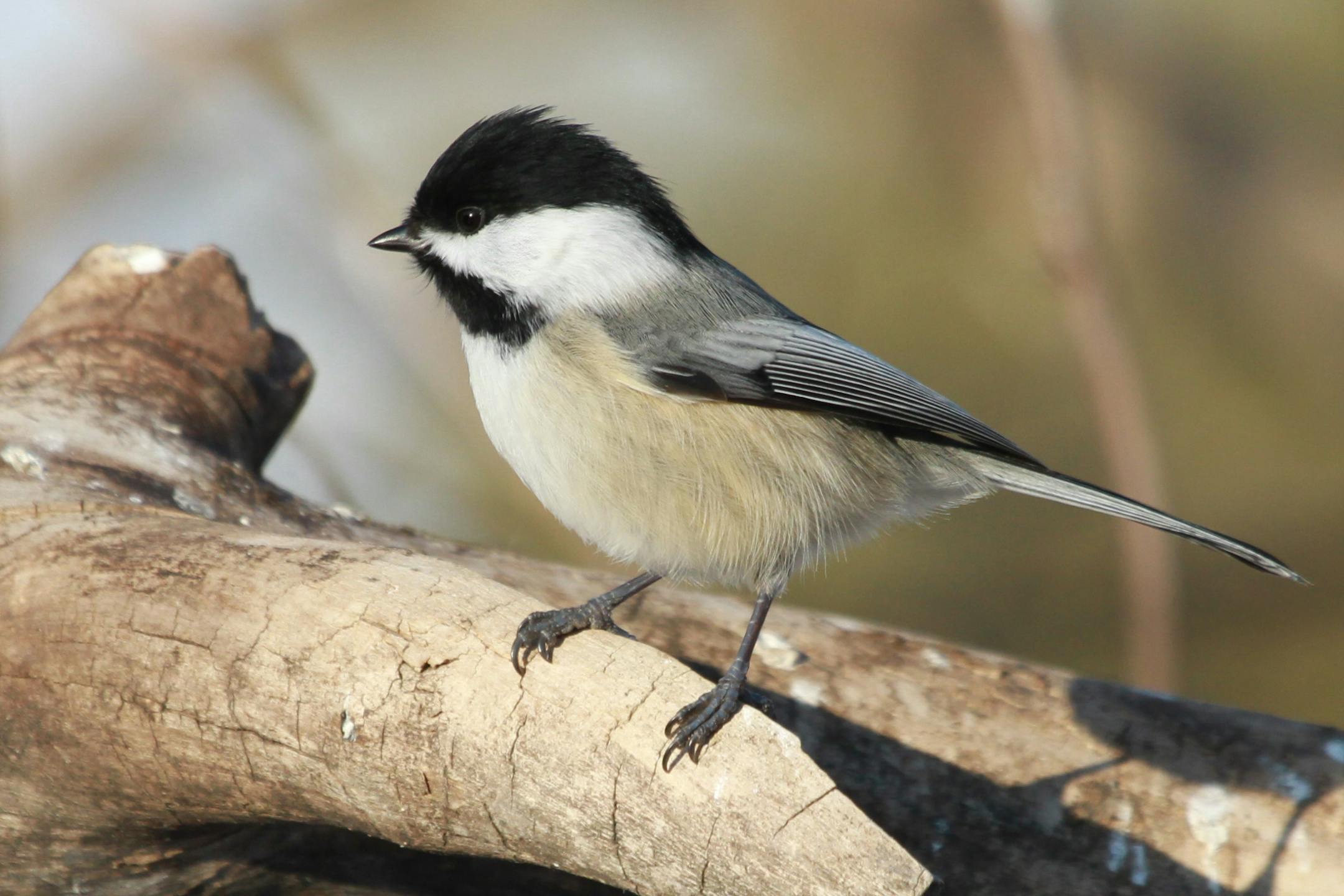
Ask just about anyone to list their five favorite birds and black-capped chickadees invariably make the cut. We all love chickadees for their acrobatic activity, devil-may-care attitude and funny little ’dee calls.
In winter, their cleverness is also a key attribute. Small birds — and chickadees weigh only a third of an ounce — must work harder to stay warm than larger birds. Chickadees generally spend more time in winter foraging for food to support their high-energy lifestyles. While well-stocked feeders help reduce foraging time each day — and give them a spurt of energy at sunrise and dusk — chickadees use a number of other strategies to help in the survival sweepstakes.
A major one: ’Dees spend the fall hiding thousands of bits of seed, fruit and insects all around their territory. Then they do something unique in the bird world, they increase their spatial memory bank by about 30% to remember where they hid these mini-larders. And careful research has shown that they are finding the foods, not stumbling across them. (This dedicated brain capacity fades in spring.)
Living on the edge
Another survival tactic is to grow extra down feathers to hold in more body heat. On very cold nights chickadees can lower their metabolism, taking fewer breaths and slowing their heart rate to conserve energy.
Once chickadees wake up in the morning, they’re full of zip, giving no sign that they live their lives on the edge at night. Watch as they hang upside down at a bird feeder, grab a seed and rush off to a nearby tree to position it between their toes to hammer it into digestible bits. Chickadees have tiny beaks, so this foot-to-mouth system works well for them.
Chickadee curiosity and fearlessness are legendary, and chickadees are often the first birds to visit a new feeder, investigate changes in the backyard or woods, or scold a cat or other predator in their area. Other birds often take their cues from chickadees, sometimes following them to find food sources or try out a new backyard feeder. And when these tiny birds give their soft “chip” call, indicating a predator is near, all other birds in the area scatter for safety.
Chickadees often dash through the forest with an entourage that includes other ’dees, nuthatches and downy woodpeckers in a foraging flock. Such groups can be noisy as the birds call loudly to one another (“dee, dee, da-dee”) to keep in touch and report food finds.
They’re not especially strong flyers, with the average chickadee flight covering 40 feet or less as the zip between feeders and trees. Still, one seldom sees a chickadee in repose. They’re almost always in motion, and this is another part of their charm.


