

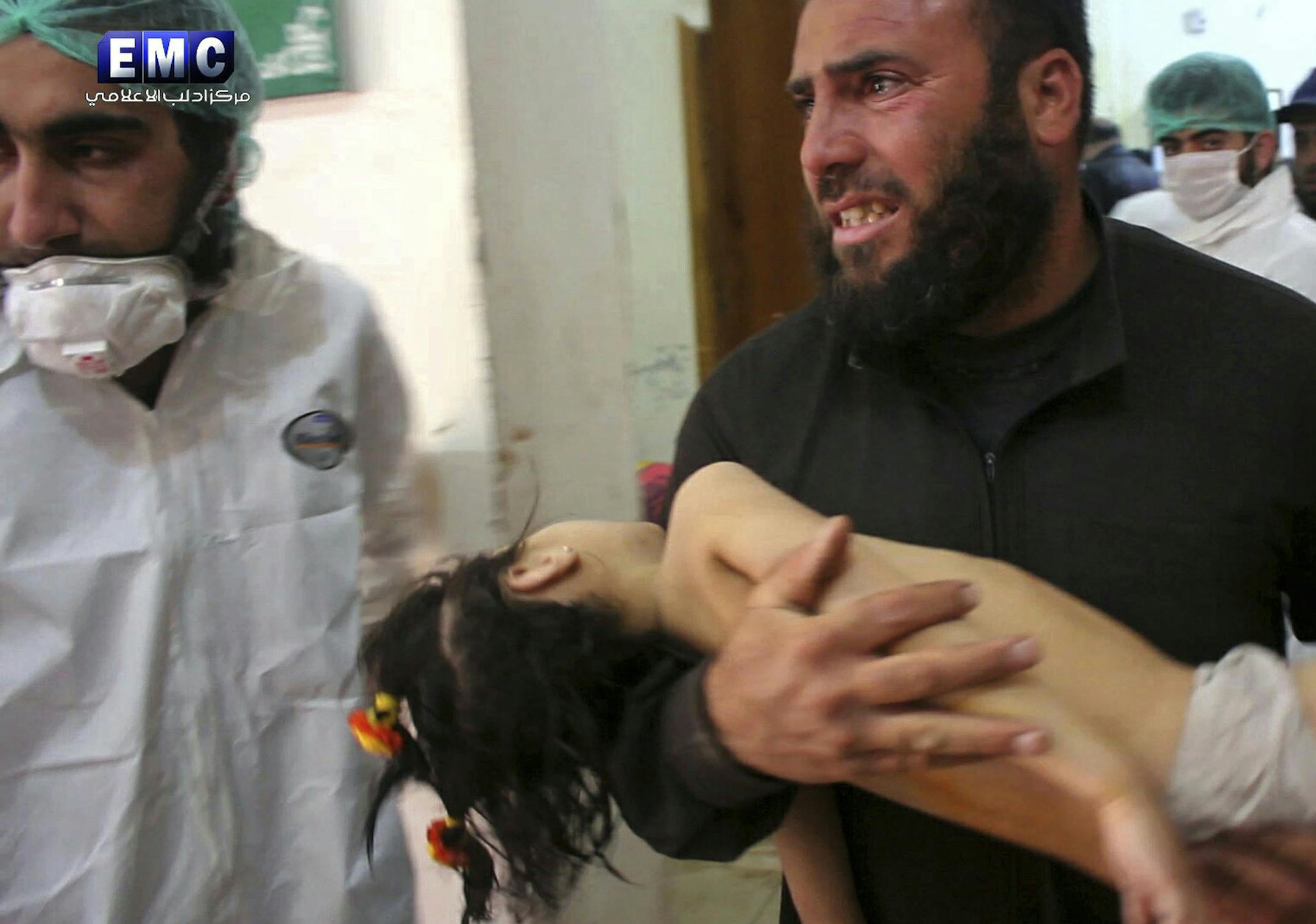
On Tuesday, the world awoke — again — to images of dead and dying Syrian children, their pale, listless bodies bearing no marks of traumatic injury. These were the innocent victims of a chemical weapons attack on the town of Khan Sheikhoun in Syria's Idlib Province — which, according to recent estimates, left at least 70 people dead and constituted the worst attack since that in the Damascus suburb of East Ghouta in August 2013, which claimed more than 1,200 lives.
Thursday night, President Trump ordered a cruise missle attack against the airbase from which the chemical attack was launched.
Tuesday's outrage was This is only the latest in scores of chemical munitions attacks either alleged or verified to have been conducted by the Syrian regime since 2014. Last year, the Organization for the Prohibition of Chemical Weapons (OPCW) and the U.N. Joint Investigative Mechanism (JIM) officially concluded that the Syrian Arab Armed Forces were responsible for three chemical weapons attacks in 2014 and 2015, in part because these attacks involved the use of helicopters to deliver chlorine-laden munitions. Human Rights Watch documented at least eight other chemical attacks in 2016 associated with the Syrian government's assault on Aleppo. Since January, the OPCW Fact-Finding Mission (FFM) in Syria has recorded eight alleged uses of chemical weapons.
Even so, on Feb. 28, Russia and China vetoed a U.N. Security Council Resolution designed to sanction parties verifiably assessed by the OPCW-JIM to have carried out chemical attacks. So is it any surprise that the Assad regime felt emboldened to continue using chemical weapons? Or that it has perhaps escalated to the use of even more toxic substances than chlorine, which has been its "go-to" chemical since the international community removed and destroyed its traditional military chemical arsenal in 2014?
This escalation in chemical weapons use fits a pattern observed during the past several years. When the international community, particularly the United States, seems distracted, the Syrian regime feels emboldened to seek battlefield gains through chemical attacks, particularly in areas where the regime's military progress through more conventional means has stalled.
Why does the Assad regime do this? Because it works.
It is insufficient to frame the casualties in these attacks solely in terms of those affected by chemical agents. The psychological effects of these chemical attacks, and the added risks they pose to children and the elderly, are devastating. Moreover, like many previous episodes, this one reportedly involved conventional targeting after the chemical attacks, which flush civilians out of sheltered areas and makes them vulnerable to conventional bombing. To then target hospitals receiving the injured compounds the psychological effects.
This two-pronged tactic ensures that besieged civilians feel they have no place to hide and no way to protect their children.


