
Stephen Breyer: Last of the pragmatists

With his departure, the court takes a final step toward ideology.

Bloomberg Opinion
January 30, 2022 at 12:00AM
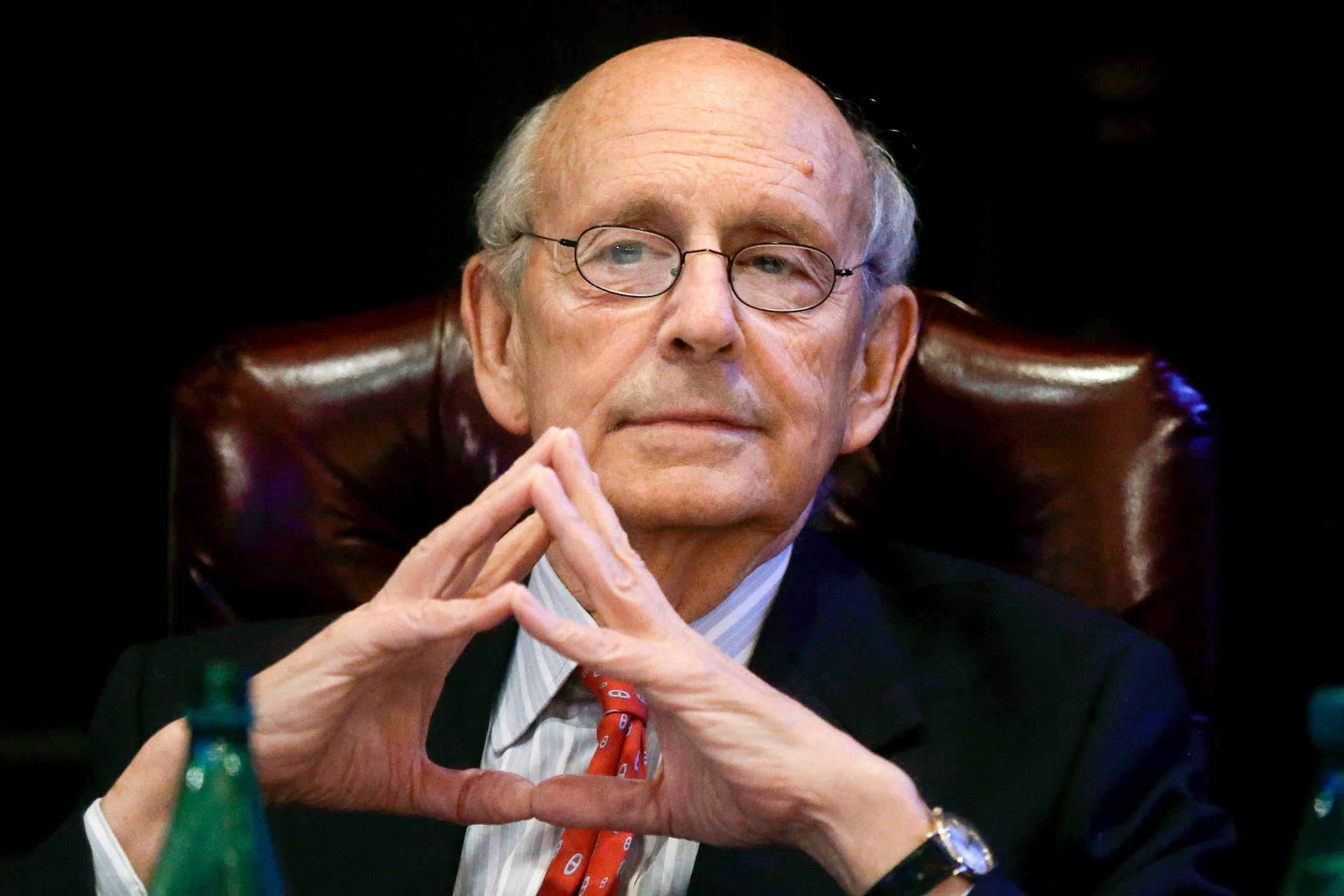
In this Feb. 13, 2017, file photo, Supreme Court Justice Stephen Breyer listens during a forum called From the Bench to the Sketchbook at the French Cultural Center in Boston. (Steven Senne, AP file/The Minnesota Star Tribune)

Justice Stephen Breyer's retirement from the Supreme Court marks a historical transition point.

One of the great pragmatists in the court's history, Breyer is the last of President Bill Clinton's appointees to still be serving. And only Justice Clarence Thomas now remains from the centrist court that sat together for longer than any other configuration of justices in history.

That court was called the Rehnquist court for its chief justice, William Rehnquist, but it really reflected the judicial temperament shared by Breyer and Justice Sandra Day O'Connor. It was a body of nine that decided almost all major cases by finding five votes for a pragmatic consensus that lay somewhere between the aggressive liberalism of 1950s and 1960s and the incipient right-wing ascendance that is in evidence today.

Breyer's impending retirement after 28 years embodies the demise of the court's pragmatic personality, every bit as much as the likely decision to overturn the abortion-rights precedent Roe v. Wade this spring will signify the end of pragmatic jurisprudence.

Breyer's pragmatism infused everything he did before becoming a justice. It infused his jurisprudence. And it is now infusing his decision to retire, which he took with care. Having recently published a powerful book arguing for the court's institutional authority to be protected, Breyer is stepping aside so that the bare Democratic Senate majority can ensure that he is replaced by a like-minded successor. Would that the late Justice Ruth Bader Ginsburg had acted similarly.

To understand Breyer's pragmatism, start with his pre-judicial career as a law professor and public servant. Breyer's specialty was administrative law, but that arid description can obscure how important his work was. Breyer's primary contribution was to help redefine his entire area of law into a study of regulation, defined broadly.

The recognition that the government, through regulation, exercises this tremendous power requires deciding how it should do so, and how the courts should supervise the process.

For Breyer, the answer was that government regulators should make reasoned decisions using the tools of cost-benefit analysis. He recognized that people make the best decisions when they take active steps to measure the possible effects of their actions, and consider where they might go wrong.

Breyer worked on deregulation as much as on regulation. As a lawyer for the Senate Judiciary Committee during the 1970s and 1980, he prized bipartisanship. He was, and is, proud of the bipartisan support he received when nominated for both the Court of Appeals and the Supreme Court.

From Breyer's philosophy of pragmatic cost-benefit analysis it followed that courts should defer to the expertise of regulators who did their jobs well. He was more than prepared to question regulators sharply about whether they had exercised reason. But if they did, he thought, the right result was to respect their decisions.

As a justice, Breyer followed the pragmatic line that went back to Justices Louis Brandeis and Oliver Wendell Holmes in the first third of the 20th century. Breyer never denied that the justices must make value judgments some of the time. His point was that justices should not be beholden to political parties or movements, but to their independent vision of the law.

In the Supreme Court's era of pragmatism, O'Connor often got to write the opinion that became law, but Breyer's fingerprints could frequently be seen on her centrist conclusions. Much of Breyer's greatest work came in his efforts to push the other justices to follow logic and reason, not intuition or ideology.

In countless oral arguments, Breyer posed complex hypothetical questions to all sides, demonstrating how his agile mind thought through hard problems. Not infrequently, he would answer his own questions as he went, displaying a rare kind of one-man-show, Socratic self-analysis. What was most salient in these moments was how seriously Breyer always took both sides of any challenging question. And that this brilliant man found the process of trying to ascertain the law to be lots of fun.

The end of the era of the pragmatic Supreme Court, and the rise of a court riven by ideology, is already affecting how the institution is seen. Breyer has always had a hard time getting inside the heads of people who reason from abstract first principles rather than experience. His case for the Supreme Court to be treated as legitimate depends on the implicit assumption that it will act in such a way as to sustain its legitimacy.

Breyer's opinions in the next six months are almost certainly going to include important dissents. But they are unlikely to be rhetorically scathing. His style is to make calm, dispassionate, reasonable arguments for reasonable results.

For those critics of the court who think that it is necessarily ideological, Breyer's career should stand as a challenge. The pragmatic Supreme Court really did exist, once. We would do well to remember that in the months and years ahead.

Noah Feldman is a professor of law at Harvard University.

about the writer

about the writer

Noah Feldman

More from Commentaries

See More
card image
Jehad Alshrafi/The Associated Press

Preserving the stories of others deepens our understanding of what it means to be human.

card image
The family of Harper Moyski, far right, poses with their Christmas tree at the Annunciation tree lot in December 2024.