
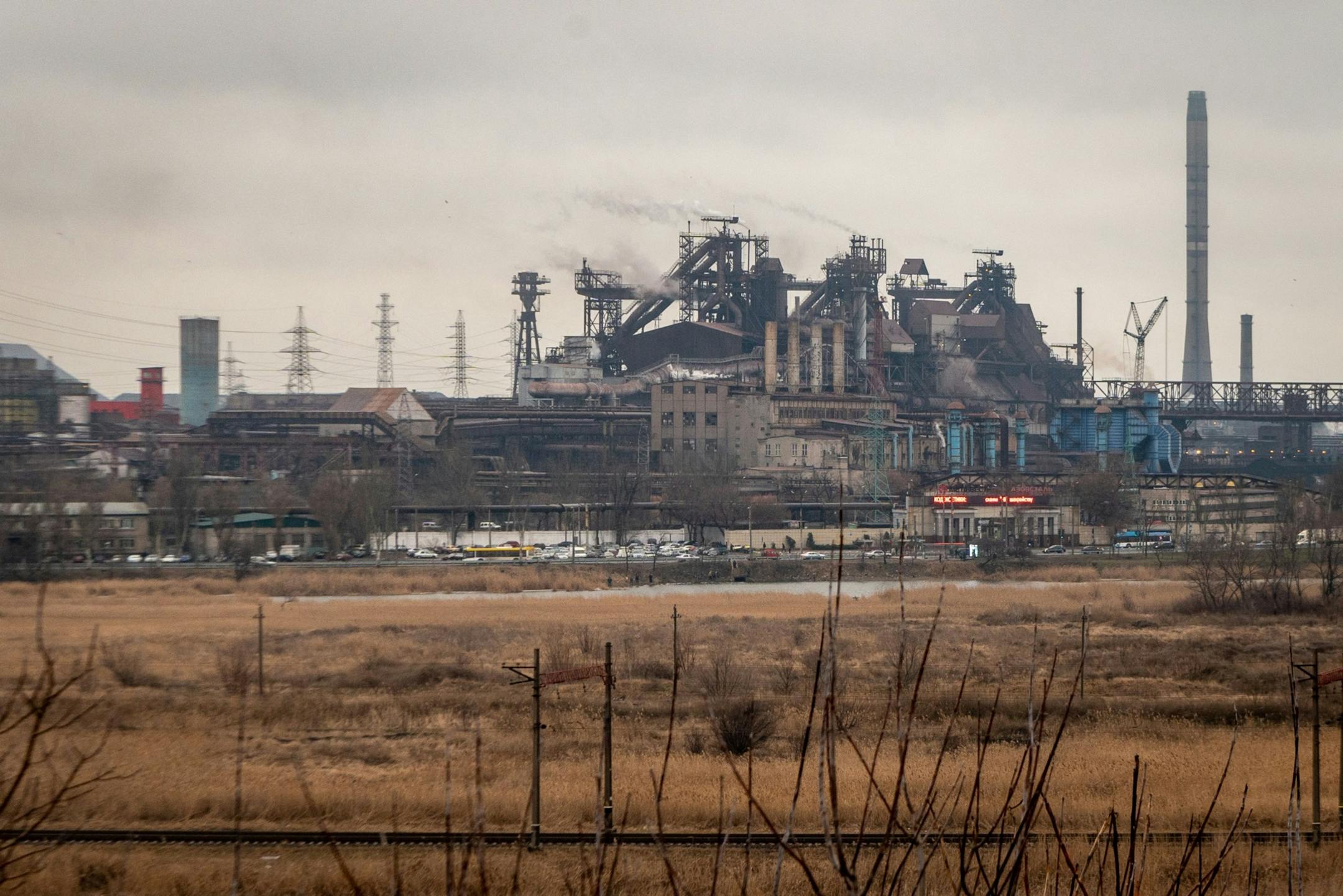
Steel industry is under enormous pressure after Russia's invasion of Ukraine

The war threatens to turn steel into a luxury item instead of a widely available commodity.

Bloomberg News
March 26, 2022 at 1:00PM
The Azovstal Steel and Iron Works facility in Mariupol, Ukraine, in January 2022. (Christopher Occhicone | Bloomberg/The Minnesota Star Tribune)

Josef Stalin ordered the construction of the Iron and Steel Works in Mariupol in 1930 — one of his mega-projects to industrialize the Soviet Union. For a time, the complex was one of the world's largest steel mills.

Nearly a century later, another Russian leader with a Stalinist bent, Vladimir Putin, ordered its destruction.

The bombs falling on the blast furnaces of Mariupol, the Ukrainian city under Russian siege, are a symbol of how the war has turned the steel market upside down.

The world is fixated on the war's impact on global energy markets. The surge in oil prices has dominated the headlines. But alongside oil, steel is a foundation of the modern economy.

Now Russia's invasion threatens to turn steel into a luxury commodity. Prices have surged, and the rally will be felt everywhere, adding to global inflationary pressures.

Consider the average car: About 60% of its weight comes from steel, according to the World Steel Association. In cash terms, the cost of that steel has gone up to more than 1,250 euros ($1,379) from about 400 euros in early 2019.

For central banks, the steel price boom is another inflation headache. Meanwhile, European governments may have to grapple with both price increases and the threat of potential shortages this summer. Rebar steel, the long and corrugated rods used to reinforce concrete in every construction project, may be in limited supply soon.

The European Union has already imposed sanctions on some Russian steel sales and has targeted most of the country's oligarchs who own large chunks of the Russian steel industry. And the war has all but stopped Ukrainian steel production.

The cost of rebar steel in Europe last week surged to a record of 1,140 euros per tonne (about 2,205 pounds), up 150% from late 2019. And the price of hot-rolled coil, a popular form of steel, has reached a record high of about 1,400 euros per tonne, up nearly 250% from just before the onset of the Covid-19 pandemic.

One reason for the price spike is the sheer size of the Russian and Ukrainian steel industries. Russia is the world's third-biggest steel exporter, behind China and Japan, while Ukraine is the eighth-largest.

Brussels and London need to wake up to the crisis. If the global economy has learned anything during the COVID-19 pandemic, it's that supply chain issues spread faster than expected and have a deeper impact than anticipated. And there are few commodities so crucial to so many industries as steel.

Blas is writer for Bloomberg News.

about the writer

about the writer

Javier Blas

More from Business

See More
Ten skids of loose peanut butter crackers wait to go to the land fill Saturday Feb. 7, 2009 as Gleaners Food Bank destroys products containing peanut butter as part of the nation wide recall of foods containing Salmonella tainted products from Peanut Corp. of America . (AP Photo/The Indianapolis Star,Michelle Pemberton)
The Minnesota Star Tribune

Gold Star Distribution, which supplies several Halal markets in the Twin Cities, is voluntarily recalling a list of food and merchandise products stretching 44 pages and including products from candy to medicine.

card image
card image