
Star Tribune analysis: Feds disobeying judicial orders on immigration detainees

The federal government cites a glut in cases and low staffing as reasons for violating court orders.

The Minnesota Star Tribune
January 28, 2026 at 8:31PM
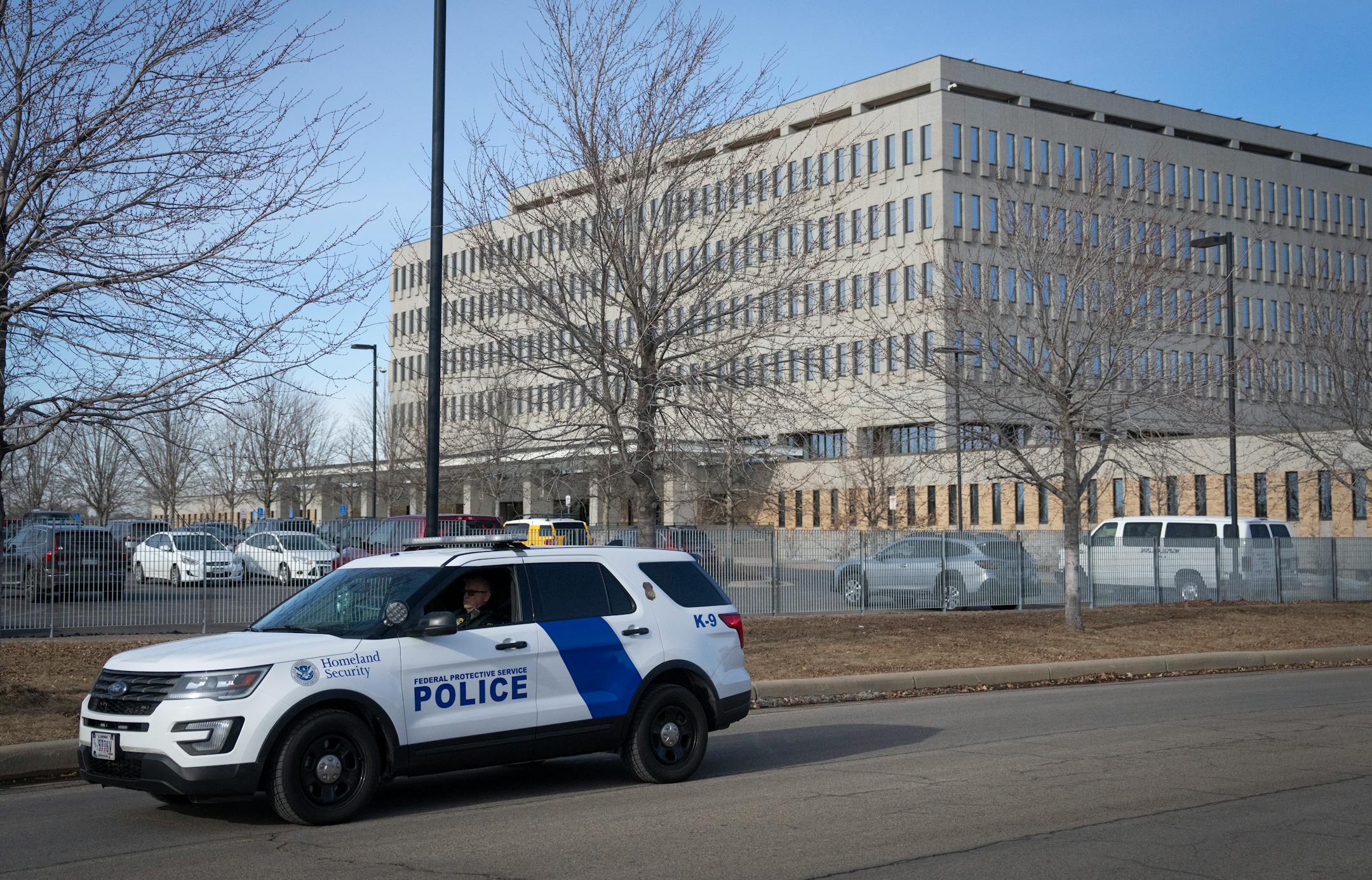
A homeland security officer drives past the Bishop Henry Whipple Federal Building in Minneapolis, Minn., on Wednesday, January 29, 2025
A homeland security officer drives past the Bishop Henry Whipple Federal Building at Fort Snelling on Jan. 29, 2025. (Renée Jones Schneider/The Minnesota Star Tribune)

A 16-year-old Osseo High School student was “lost in the system” after federal agents detained him when he went out to get dinner for his family, according to court records his attorney filed seeking his release.

Six days later, still unable to contact his family or his attorney, the boy, a refugee from Ecuador, was located at a shelter in Michigan. It took another four days, and two court orders, to force government officials to bring the boy home.

The January encounter is one of 17 cases uncovered by the Minnesota Star Tribune that shows federal officials violating judicial orders involving asylum seekers, undocumented immigrants and others with pending immigration cases.

The cases show that federal officials have been overwhelmed and sometimes incapable of handling the responsibilities that come with detaining the more than 3,000 immigrants it claims to have arrested in Minnesota as part of Operation Metro Surge.

In one instance Minnesota’s U.S. Attorney Daniel Rosen was forced to issue a rare apology to a judge, saying he “never intended to leave inaccurate information on the docket.”

Rosen also referenced his heavy workload, which has been compounded by the recent departure of at least seven assistant U.S. attorneys who left in protest of the government’s actions during the surge. Rosen’s office did not respond to questions for this story but in court filings government attorneys blamed shortcomings on high case volumes.

Federal judges have repeatedly chastised authorities for the Trump administration’s missteps. They include sending immigrants out of state after being ordered to keep them in Minnesota and for their inability to find and release detainees, leading to the possibility of contempt citations in multiple cases.

The situation has grown so fraught that Patrick Schiltz, the chief federal judge in Minnesota, ordered the head of Immigration and Customs Enforcement on Jan. 26 to personally appear in court this week to explain why the government has failed to comply with dozens of court orders. One of those cases involved an Ecuadorian immigrant who should have been released on Jan. 21.
That testimony was canceled because the detainee was released Jan. 27, but the man’s attorney has asked for the hearing to be rescheduled to address the “significant hardships” his client and others have endured because of the government’s allegedly abusive actions.

Since Dec. 1, when the surge began, a total of 380 immigrants have filed cases challenging their detentions through Jan. 21, according to a Minnesota Star Tribune review of federal district court filings in Minnesota. By comparison, 375 such cases were filed in the state between 2016 and 2024.

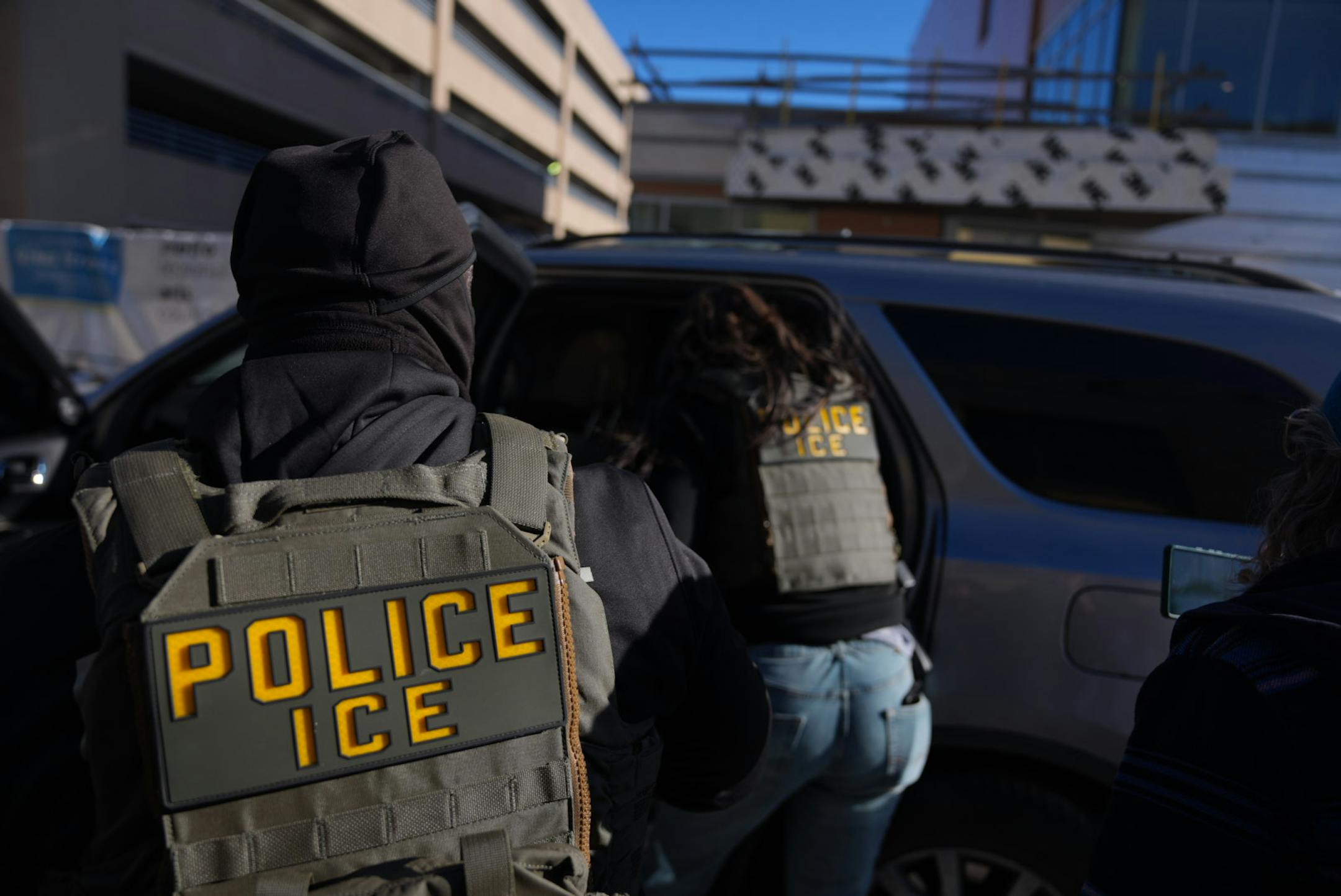
ICE agents put a man they recently detained into the back of a vehicle near the Midtown Global Market in Minneapolis on Jan. 14. (Alex Kormann/The Minnesota Star Tribune)

The Star Tribune analysis found the violations include 12 judicial reprimands for improperly taking detainees out of state and eight admonitions for taking too long to set someone free.

“In what is fast becoming a disturbing trend, the government has yet again violated (and is continuing to violate) this court’s show-cause order,” wrote Judge Laura Provinzino on Jan. 23, noting the order barred authorities from removing an Ecuadoran immigrant from Minnesota.

Instead, she wrote, government lawyers did not inform ICE of the order for three days, by which time the man had been relocated to Texas.

“That delay is unacceptable,” Provinzino wrote.

‘The gears grind in one direction’

Attorneys have accused the government of barring access to their clients and moving them to other states to sabotage their legal cases.

In most cases, attorneys noted, their clients had no criminal records and were detained despite ICE having no warrant for their arrest, making it likely that the government had no right to keep them.

Cameron Giebink, who represents a Nicaraguan refugee detained on Jan. 19, told court officials he was unable to communicate with his client for at least five days after the government violated a court order and sent the man to a detention center in El Paso, Texas.

Giebink documented his efforts to reach his client, which showed that his calls were repeatedly disconnected or redirected. When he finally reached a government lawyer, she directed him to another attorney with the Department of Homeland Security, who never responded to his calls, records show.

Giebink’s client, who worked at a St. Louis Park hotel that was housing ICE agents at the time of his detainment, told his attorney that government officials promised not to take him into custody if he came to work, records show.

A federal judge agreed that the man’s due process rights were violated, but he was not brought back to Minnesota and released until Jan. 24 — five days after the judge ordered him to be returned.

“They are targeting people on the sole basis that they are refugees,” said Giebink, who has handled dozens of detention cases in the past two months but declined to discuss any specific case. “This is not about criminality. And once people are moved out of state, it’s hard to get them back … because it’s a big machine and the gears grind in one direction.”

In one case, the government was late in releasing a family of six, including a 12-year-old. The family came to Minnesota from Venezuela in 2023 through a humanitarian program that grants temporary protected status to people facing unsafe conditions.

Court records show the entire family was detained on Jan. 15 after “bounty hunters” stormed their home in St. Paul with their “guns drawn.” Family members were later separated, with some sent to Texas and one kept in Minnesota.

Federal officials violated two deadlines for returning the family, whose out-of-state members were finally put on a plane on Jan. 25 — three days late.

That same day, Rosen apologized to the court for “the manner in which information has been shared in this case.”

For some detainees, the headaches continued even after they were released. In several cases, agents refused to turn over an immigrant’s passport, government-issued identification or work permit when they were released, leading their attorneys to file new claims against the government. Judges later ordered the release of those items.

The Advocates for Human Rights, a Minnesota nonprofit that advocates on behalf of immigrants, has filed two class-action lawsuits against the federal government claiming widespread abuses and constitutional violations related to the detentions.

In the lawsuits, the nonprofit claimed that attorneys have been deliberately blocked from talking to their clients to make it easier to deport them. They also claim detainees have been subjected to “harsh conditions,” with one young adult forced to sleep on the floor and share an open toilet with 40 other detainees.

Others have been released in Texas “with no means of returning home” because federal agents kept their money and their cellphones, one of the lawsuits claims.

U.S. Attorney’s mea culpa

In some cases, the government has given the courts false information that prompted judicial outrage.

On Jan. 19, for example, government attorneys claimed that a Guatamalan refugee was due to fly back to Minnesota from Texas the following day. But it turned out the man had been sent to a detention facility in New Mexico and wasn’t expected to return to Minnesota until Jan. 24.

In a letter to the court, Rosen apologized for the “factual inaccuracy.”

“I understand my duty of candor to the court, and I assure the court that I never intended to leave inaccurate information on the docket,” Rosen said in his written response to the judge overseeing the case. "

Rosen said he was waiting to “do a complete investigation of the facts” before getting back to the court and had hoped to obtain the man’s release sooner.

“I have spent considerable time on this and other cases related to transfer and return issues over the past three days, and I sincerely regret that petitioner was not moved as [the government] had represented,” Rosen said in the letter.

In some cases, the government has lost cases because it failed to respond in a timely manner. On Jan. 20, U.S. District Judge Jeffrey Bryan ruled in favor of an immigrant from El Salvador after government attorneys didn’t file a response to the lawsuit within three days, as required.

The government’s excuse: The “current glut of immigration” cases in Minnesota led to an “administrative oversight.”

“Administrative oversight usually does not suffice to constitute good cause,” Bryan wrote in his order, noting the burden placed on the immigrant who remained in custody.

‘Not a reasonable request’

The government also asked for more time in a case involving a Mexican immigrant who suffered a fractured skull, allegedly at the hands of federal agents.

The man was detained outside a St. Paul strip mall on Jan. 8, even though he is legally in the United States on a work visa and his only criminal offense is driving without a valid license, according to his petition.

His attorney, John Bruning, accused the government of focusing on him purely because of his skin color and “perceived ethnicity.”

Within four hours of being taken into custody, Bruning said in a court filing, his client suffered a skull fracture and other life-threatening injuries. The man told hospital workers that he was “dragged and mistreated by federal agents,” but U.S. District Judge Donovan Frank said in Jan 23. court order that the cause of the man’s injuries remains “unknown.”

“ICE agents have largely refused to provide information about the cause of petitioner’s condition to hospital staff and counsel for petitioner, stating only that ‘he got his shit rocked’ and that he ran headfirst into a brick wall,” Frank said in the order.

Despite the man’s severe injuries, Frank noted, at least two federal agents have stood guard in his room continuously since he was admitted to the hospital, and agents shackled his legs to the bed with handcuffs, despite objections from medical staff.

Government lawyers said the man was in the middle of the intake process to initiate his removal from the U.S. at the time of the incident, and they asked for more time to complete the paperwork. Frank rejected the request, saying that asking for more than the 15 days that had already transpired was “not a reasonable request.” He ordered the man’s immediate release.

about the writers

about the writers

Jeffrey Meitrodt

Reporter

Jeffrey Meitrodt is an investigative reporter for the Star Tribune who specializes in stories involving the collision of business and government regulation. 

See Moreicon

Sarah Nelson

Reporter

Sarah Nelson is a reporter for the Minnesota Star Tribune.

See Moreicon

More from News & Politics

See More
card image
Anthony Souffle/The Minnesota Star Tribune

After federal agents fatally shot Alex Pretti, Greg Ketter drove to the scene to “be in that spot.” Images of the 70-year-old emerging from tear gas and shouting his anger quickly went viral.

A homeland security officer drives past the Bishop Henry Whipple Federal Building in Minneapolis, Minn., on Wednesday, January 29, 2025
card image