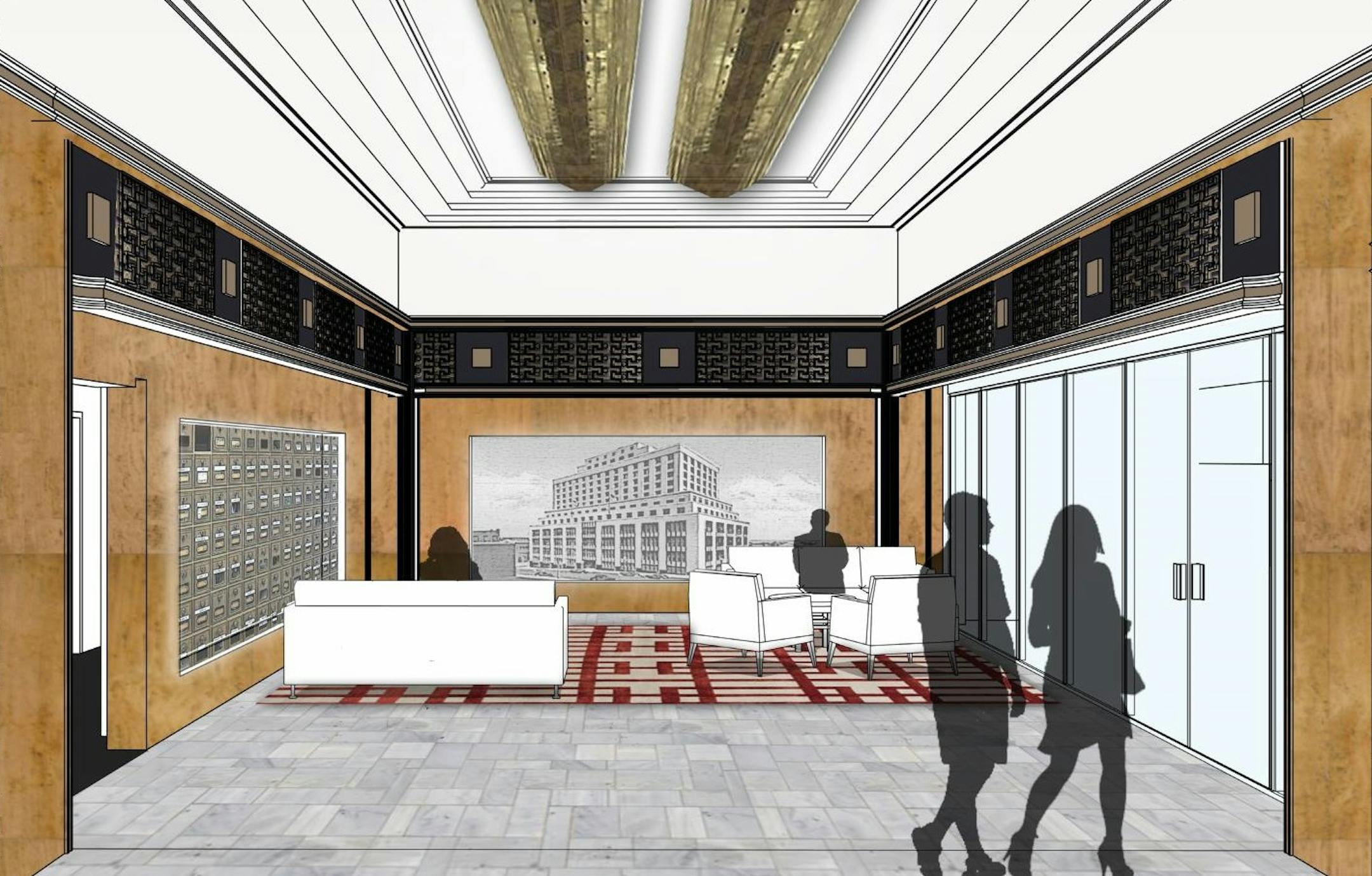
More details emerged this week of Exeter Realty's project to renovate the former downtown St. Paul post office into a combination of apartments, boutique hotel and storage space as the St. Paul City Council approved the developer's request for city assistance.
St. Paul-based Exeter Realty Co. unveiled its plans for the 17-story, Art Deco-style behemoth at 181 E. Kellogg Blvd. last October, two years after it was vacated by the U.S. Postal Service. The undertaking immediately became one of most ambitious and potentially costly private redevelopment projects ever undertaken in downtown St. Paul, adding 202 market-rate apartments, a 150-room hotel and 95,000-square-feet of storage space to the urban core.
Verified numbers on the total cost and scope of the "Custom House" rehab work have been lacking until Exeter's request for $5.8 million in tax-increment financing came before the City Council, along with a report by architects and engineers from LHB Inc. detailing the current substandard conditions of the former post office.
The cost of the rehab project — not including the hotel portion — is a lofty $76 million, documents a show, and Exeter has promised an Aug. 1 start date for construction; a Nov. 1, 2015, target for opening, and "stabilized occupancy" by a year after that.
The council unanimously approved the tax-increment financing agreement with no debate late Wednesday, reflecting its popularity among St. Paul leaders.
The St. Paul Post Office and Custom House was constructed between 1931 and 1934 using designs by St. Paul architecture firm Lambert Bassindale and the Chicago firm of Holabird and Root. It was originally 11 stories tall but received a four-story addition with a penthouse atop the building in 1939.
That's how it remained until 1961 when a six-story warehouse annex was built on the southeast side, which is now slated for storage spaces for residents and possibly public users.
The engineers' report, commissioned by the city to determine if the structure is indeed substandard enough to qualify for taxpayer subsidies, detailed a list of work needed for the historic structure.