
Short on money and volunteers, St. Paul DFL will skip mayoral endorsement

Rallying party volunteers has long been a challenge in St. Paul. This year it turned out to be impossible.

The Minnesota Star Tribune
September 14, 2025 at 1:03PM
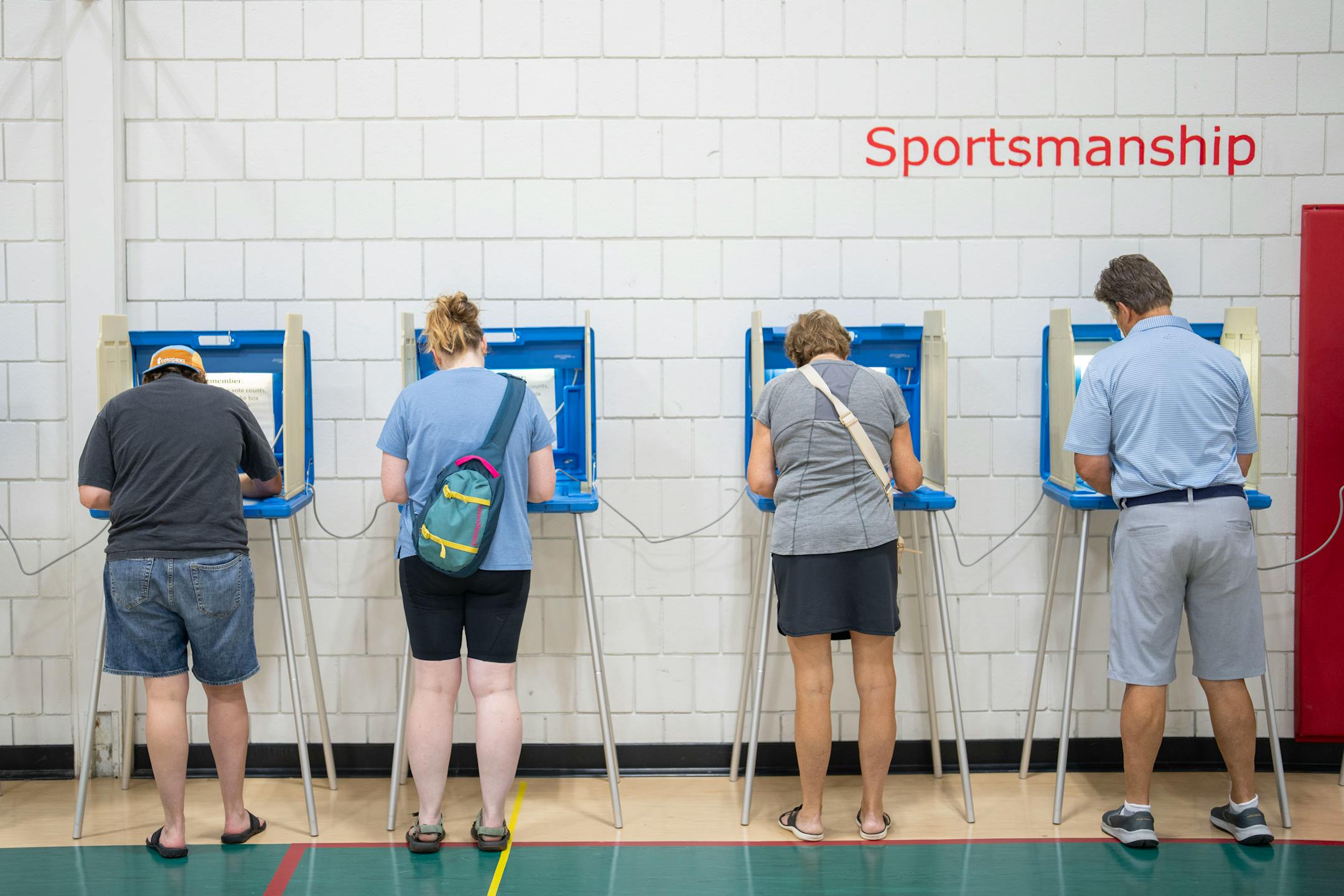
Michelle Wheeler, Lauren Wheeler, Jane Lewis and Kevin Lewis, left to right, fill out their ballots for the St. Paul Ward 4 special election at the Groveland Recreation Center in St. Paul in August. (Alex Kormann/The Minnesota Star Tribune)

In Minneapolis this summer, Democratic activists held a raucous convention to decide who should get the local party’s endorsements in the upcoming city election, a chaotic process that eventually saw the mayoral endorsement nullified by the state DFL.

Not so in St. Paul.

This year, none of the left-of-center candidates for mayor will get an endorsement from the local DFL. Short on money and committed volunteers and trying to reorganize around a changing election calendar, the St. Paul DFL will not hold precinct, ward and city conventions to endorse a candidate for mayor.

Instead, St. Paul’s Democrats and progressive voters are on their own in deciding which of the candidates should be their top choice to lead the capital city.

They will choose five candidates, four of them left-of-center: Mayor Melvin Carter, state Rep. Kaohly Her, Yan Chen, who sought a council seat in 2023, or Adam Dullinger, a political newcomer running to Carter’s left. Mike Hilborn, who ran as a Republican in a 2024 legislative race, will also appear on the ballot in the heavily Democratic city.

The big problem is people — a lack of them.

The local DFL unit does not have a chair or vice-chair, and few St. Paulites are currently involved at the local level.

Rick Varco, the sole board member of the St. Paul DFL, said there’s competition for the pool of DFL-aligned political volunteers in the capital city.

“St. Paul has always been many of the same people wearing different hats,” Varco said, particularly because the Minnesota DFL is based in St. Paul.

“People who are interested in engaging have lots of opportunity through the state party and other local party units,” Varco said, noting examples such as the Senate District DFL groups or county or state party units.

Rallying enough volunteers to organize a precinct caucus has been challenging for a long time in St. Paul, former City Council President Kathy Lantry said. She first sought a DFL endorsement in 1995 and remembered how hard it was to pull together conventions 30 years ago.

“It was onerous. People had to give up a lot of their time,” Lantry said.

Precinct and ward caucuses also cost money, Lantry added - something else the St. Paul DFL lacks.

After spending more than $34,000 on city elections in 2023, the party ended 2024 with just over $2,800 in the bank, according to campaign finance statements.

Garrison McMurtrey, a Ramsey County commissioner who chaired the St. Paul DFL in 2020 and 2021, said the work of running the party was time-consuming and came with heavy responsibilities for a volunteer.

“You are responsible for field organizing with your endorsed candidates, stakeholder management, organizing the caucus and convention process and fundraising to try to pay for it all,” McMurtrey wrote in an email. “At its peak I was putting in around 20-25 hours a week, on top of my regular full-time job.”

Lantry said she thinks a lot of the energy that people formerly put toward local politics is being channeled online now, or on national issues.

“Especially if you don’t have a candidate you are particularly excited about,” Lantry said.

Changes in St. Paul’s election structures are another factor.

Ranked-choice voting means candidates can file for office as late as mid-August, months after precinct and ward caucuses are typically held. Her, Carter’s most significant challenger, did not announce her run until Aug. 4.

But another major factor in the dormant DFL, Varco said, is the city’s shift to even-year elections beginning in 2028.

“We had to take some time to get our procedural ducks in a row‚" he said, working on the party’s constitution and other internal rules.

City voters approved the change with a 2024 ballot measure, with proponents arguing the shift will mean more participation in city-level elections.

Varco said even-year endorsing caucuses for state and federal offices will also endorse for city offices, bringing more DFL activists into city elections with less organizational strain.

“You don’t have to do the whole separate-year cycle of organizing all these extra meetings,” he said.

This year, though, some worry that the quiet around the mayoral election will mean fewer people voting. The endorsement process builds a buzz around candidates, Lantry said, and the meetings help campaigns recruit volunteers and get people signed up for yard signs.

“I would guess that a lot of people aren’t aware we have a mayoral election going on,” Lantry said.

about the writer

about the writer

Josie Albertson-Grove

Reporter

Josie Albertson-Grove covers politics and government for the Star Tribune.

See Moreicon

More from St. Paul

See More
card image
Sofia Barnett

The City Council will take another week to finalize resolution language. The city will also fund immigrants’ defense and naturalization in 2026 budget.

The setting sun illuminated the St. Paul skyline, with city hall on the left, as seen from Harriet Island Park.
card image