

By Brad Plumer • Washington Post
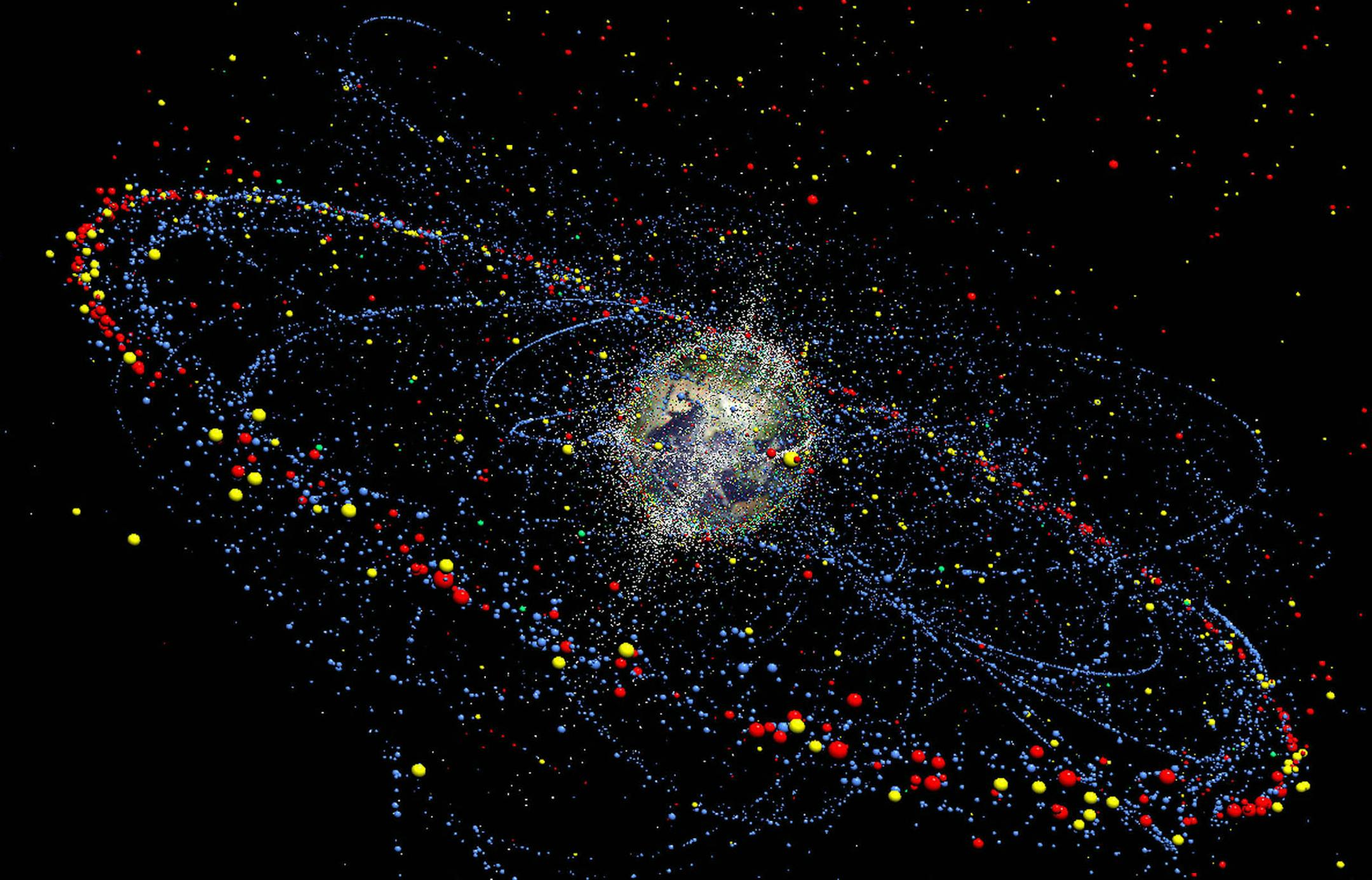
Space is getting messy. The debris in Earth's orbit keeps multiplying, damaging satellites and putting astronauts in harm's way. If the problem gets severe enough, it could eventually make low-Earth orbit unusable.
Scientists have known about the space trash problem since the 1970s. Humans have placed thousands of objects into orbit since Sputnik, and some of those old satellites and ejected rockets are breaking apart. As pieces collide with each other at high speeds and shatter, they create more debris. Repeat until space is saturated with high-flying junk.
Yet despite ample warning, the world's nations have never quite been able to agree how to solve the problem. The technology to clean up debris exists, but no one can decide how to pay for it. So that's where economists come in.
In a recent paper, three economists argue that orbital debris is a standard "tragedy of the commons" problem. Space is a resource, and people overuse it, since no one pays the price for creating waste. No one entity has enough incentive to clean up the mess alone. Economists typically solve this problem with what's known as a Pigouvian tax. Why not place a user fee on all orbital launches to pay for cleanup?
"User fees are a solution straight out of the Reagan era to deal with these environmental issues," says Peter J. Alexander, an economist at the Federal Communications Commission and a coauthor of the paper.
The orbits around Earth are undeniably valuable. Satellites are used for everything from communications to television to Earth monitoring and military surveillance. Roughly 49 percent of satellites are in low-Earth orbit, which is also where astronauts work. Another 41 percent are higher up, in geosynchronous orbit.
Yet those orbits are getting clogged. The U.S. Strategic Command is aware of more than 21,000 man-made objects in orbit larger than 10 centimeters, but there are hundreds of thousands of even smaller pieces circling the Earth that can't be tracked. Some of them are moving as fast as 22,000 miles per hour.


