

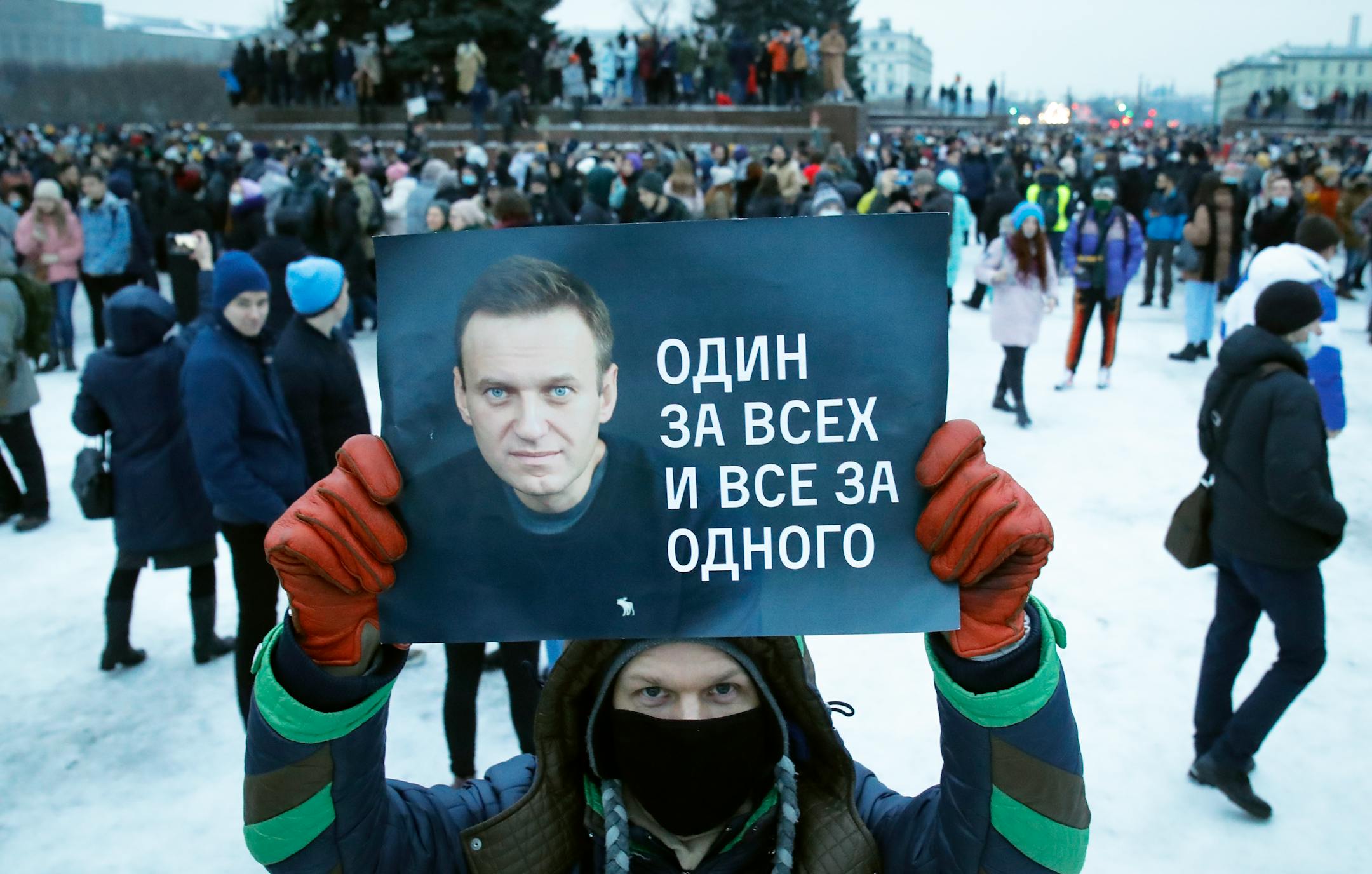
MOSCOW — It's hard to pin down the exact moment when it became clear the protests in Russia on Saturday — where tens of thousands of people, stretching across the country, called for the release of the jailed opposition leader Aleksei Navalny — were something special.
It definitely wasn't the violence doled out to protesters and even bystanders — like a woman in St. Petersburg being casually kicked in the gut by a riot cop — or the deliberate targeting of reporters. Such occurrences are sadly commonplace. It wasn't even the people coming out to protest in the unlikeliest corners of Russia, like Yakutsk, where the temperatures dipped to minus-60 Fahrenheit. Extreme cold and remoteness have never before stopped Russians from expressing their displeasure.
No, if there was one incident that suggested the significance of Saturday's protests, it was probably the footage of riot police in Moscow looking lost and disoriented as a crowd blitzed them with snowballs. Or perhaps another video of young men charging at the fully clad riot police so ferociously that the officers, who clearly didn't expect to meet such resistance, almost backed down.
These acts of defiance and escalation — in the past, people have been convicted of throwing plastic cups and bottles in the general direction of police officers — underscored the depth of popular dissatisfaction with life under President Vladimir Putin. These protests, summoned by an imprisoned opposition leader and undertaken against the government's warnings, are a significant development. After years of relative calm, Russia is restive once more.
To judge by the government's response, it knows it has trouble on its hands. The crackdown is breaking records. On July 27, 2019, in what was one of the largest roundups of protesters in decades, 1,373 people were detained. On Saturday, around 3,100 were hauled in. At times the process was almost mechanical: In one exchange caught on video, a protester, realizing that the police officer wants only to fulfill an arrest quota, offers himself in place of another — and is duly led away.
The calm manner of that arrest — far from common on Saturday, which saw many ugly displays of heavy-handed policing — harked back to the precursors of today's protest movements. During the Strategy 31 movement, named after the article of the Russian Constitution that guarantees freedom of assembly, from 2009 to late 2011, protesters gathered in Moscow on the last day of every 31-day month. Though never permitted by the authorities, the protests were orderly and pointedly legalistic.
The habit stuck. Before holding a demonstration, protesters over the past decade have tended to seek permission from the authorities. Some of the biggest rallies for fair elections in late 2011 and 2012 were sanctioned by Moscow's city government; so was the "Digital Resistance" protest in April 2018 against the government's attempt to ban Telegram, a popular messaging app.
Not this time. If, permit or not, you are at risk of being beaten, detained and forced to face absurd charges, why bother with the paperwork? The lack of central organization on Saturday — instead of confining themselves to one central square or street, crowds moved across cities and towns — is a notable feature. It also makes counting heads difficult. For Moscow alone, the number for those protesting varies from 4,000 to 10 times that.


