

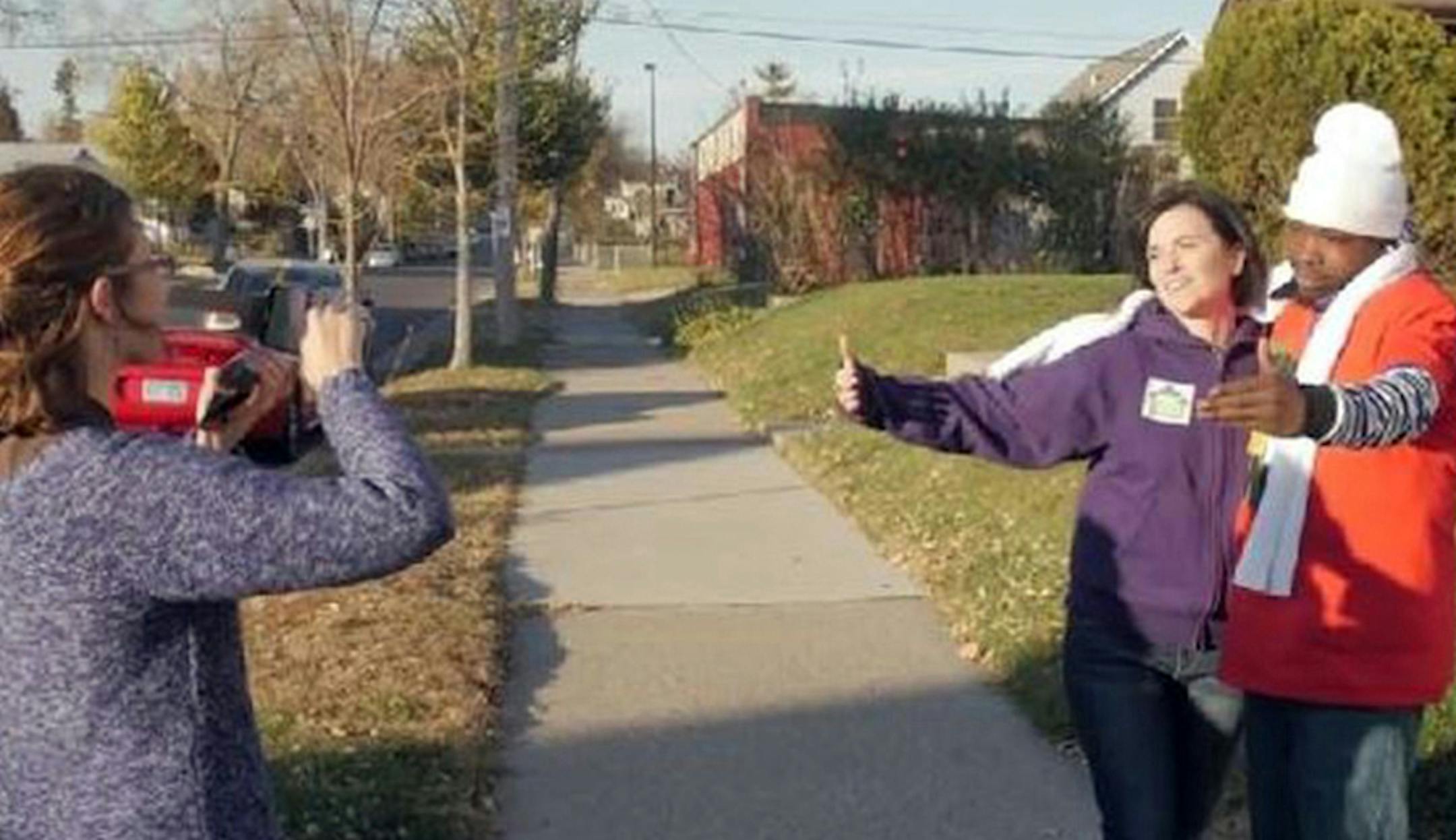
"It is a peculiar thing to be in the eye of a social media storm."
That comment could be attributed to many, including the general public, which is increasingly reading hashtag-headlined stories that originate or accelerate on social media. Or it could be the reflection of instant celebrities who were propelled to prominence via viral content. But the person caught in this particular storm was already publicly prominent — Minneapolis Mayor Betsy Hodges, who was referring to social media's role in #pointergate.
These days, social media is driving news narratives and, in the process, upending lives and livelihoods. But in Hodges' case, being in the eye of the storm was a safe place to be.
That's partly because #pointergate disrupted the normal course of the political-media industrial complex, in which a charge unanswered becomes a fact — and fast. Sure, a mayoral spokeswoman expedited an explanation to the alarming allegation that Hodges had flashed a gang sign during a photo-op (she was pointing, thus the Twitter term #pointergate). But it was about a week — an eon in the online era — before the mayor posted an online response and was interviewed by the Star Tribune and Minnesota Public Radio.
Why wait?
"The Internet was saying what needed saying. Or, I should say, the people of the Internet," Hodges said in a Nov. 14 interview.
The unintended conflation of the medium with the mass may be because media memes can seem so monolithic. In the case of #pointergate, the collective voice let Hodges keep quiet.
"I've been a little quieter on social media than I usually would have been, to give space for that conversation to happen and have it not be about whatever I was saying or not saying," Hodges said. "But I'm actually grateful for the space to have been able to continue doing my job while other people said what needed saying. That said, this is the work — the pushback and responding to the pushback — that's part and parcel of the work I'm doing if I'm doing it right."


