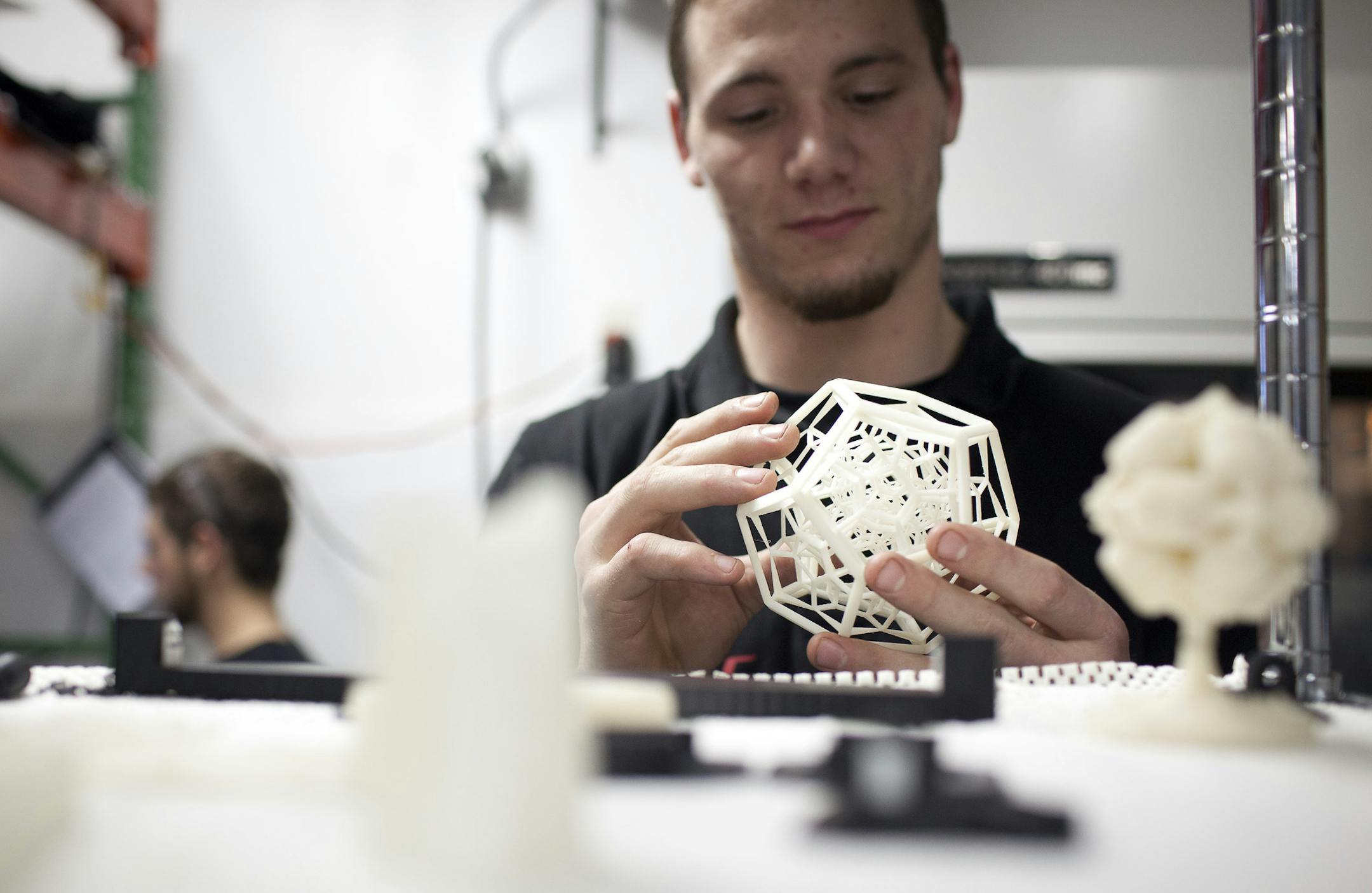
Matthew Doom texts a lot at work and is a whiz on the 3-D printer. Unlike most tech workers, his office is a wooden workbench next to a milling machine where he cuts metal for medical devices and other parts.
The 20-year-old is one of a dozen employees at Baklund R&D in Hutchinson, Minn., who are using Internet connections with far-flung customers, smartphone chats and the latest in computer equipment to squeeze more business out of traditional tool and die equipment. Eight months ago Doom was milking cows at a nearby dairy farm.
"We're taking an approach that is extremely nontraditional and we've even been able to beat prices offshore," said Jon Baklund, 44, a second-generation toolmaker who runs the small shop 60 miles west of Minneapolis. He estimates his factory doubled its business with the innovations, getting inquiries from companies in 37 states last month.
Baklund, which hired four people in the last year including Doom and is seeking two more, is among hundreds of shops nationwide that are leveraging technology to meet demand for low-volume, highly customizable products. Other companies, such as Etsy Inc. and TechShop Inc., serve as online marketplaces or starting grounds for tiny manufacturers to churn out new inventory in metal, wood and even fabric.
Makers of dies and machine tools have boosted employment about 18 percent since August 2009, compared with a 2.9 percent gain for overall manufacturing, according to Dan Luria, an independent manufacturing economist in Brighton, Mich.
Driven by 3-D printing
Specialty operations are finding new opportunities because of 3-D printers, said Patrick Hunter, senior vice president of marketplace operations for MFG.com in Atlanta. The technology allows three-dimensional designs created on computers to be sent digitally to industrial machines, which put down layers of materials ranging from plastic to metal in creating parts or products.
"It's opened the doors to smaller shops because people aren't tied to the large mass manufacturers," said Hunter, whose company has been matching customers with parts makers for about a dozen years.
Low volume typically means product runs of more than 1,000, which exceeds capacity of a home workshop, and less than 5,000 to 10,000, which is usually the minimum to get work done at a factory in China, he said.