

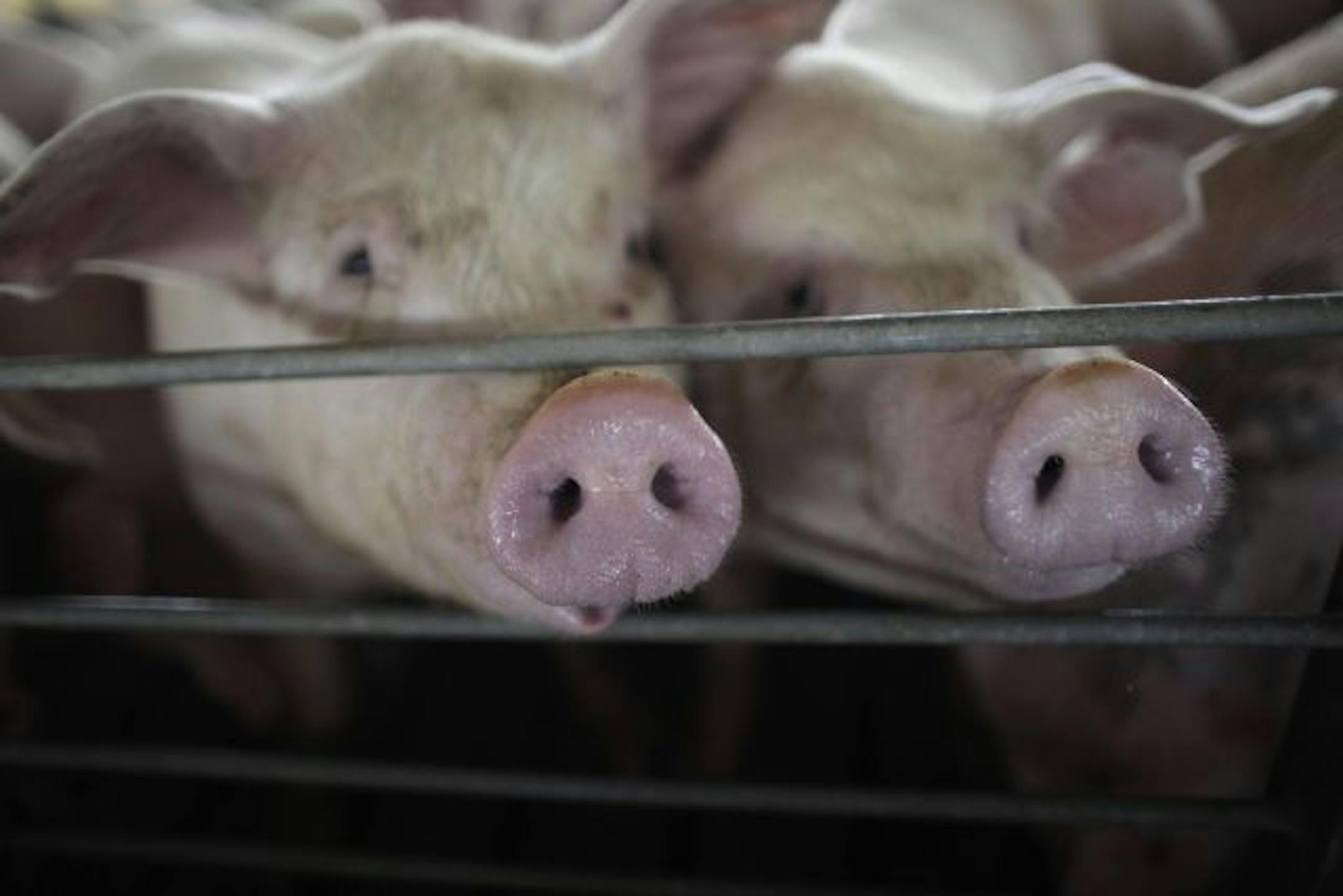
Imagine government bureaucrats telling livestock farmers how much space to allow for each of their animals.
Couldn't happen here, right? Maybe in China or the old Soviet Union, but not in Minnesota.
Don't be so sure. A bill introduced in Congress recently could lead to just that -- Washington literally dictating day-to-day practices on farms, right down to how much floor space to allot for each hog or cow.
HR3798, introduced Jan. 23, would write into federal law an agreement between an association of egg producers and an animal-rights group, the Humane Society of the United States. The agreement requires the egg industry over time to nearly double the size of the cages it uses for hens, from the current standard of 64 square inches to 124 square inches. The cost estimate for that change alone is $4 billion to $10 billion.
In addition, the bill dictates egg-labeling requirements and new air-quality standards for henhouses. In return, the Humane Society agreed not to seek state ballot initiatives mandating cage dimensions and to stop lawsuits and undercover investigations of the egg industry.
As a hog farmer, I have no argument with egg producers agreeing with the Humane Society on standards for hen housing. My concern is codifying the agreement in law, as HR3798 would do. That sets a precedent for allowing the federal government to dictate how all livestock producers operate.
As soon as the egg producers' agreement is written into law, pressure will mount to include pig farmers, dairy farmers and cattle ranchers. In the end, all corners of animal agriculture could be affected, irreparably damaging the livelihoods of family farmers across the country.
Europe already has gone this route, with disastrous results. The head of the European Egg Processors' Association said recently that a 2010 cage regulation in Germany has reduced production 20 percent. The story is similar in the United Kingdom, where housing requirements have increased operating costs by 8 percent.


