
Short take: Terror in Somalia

August 6, 2011 at 2:35AM
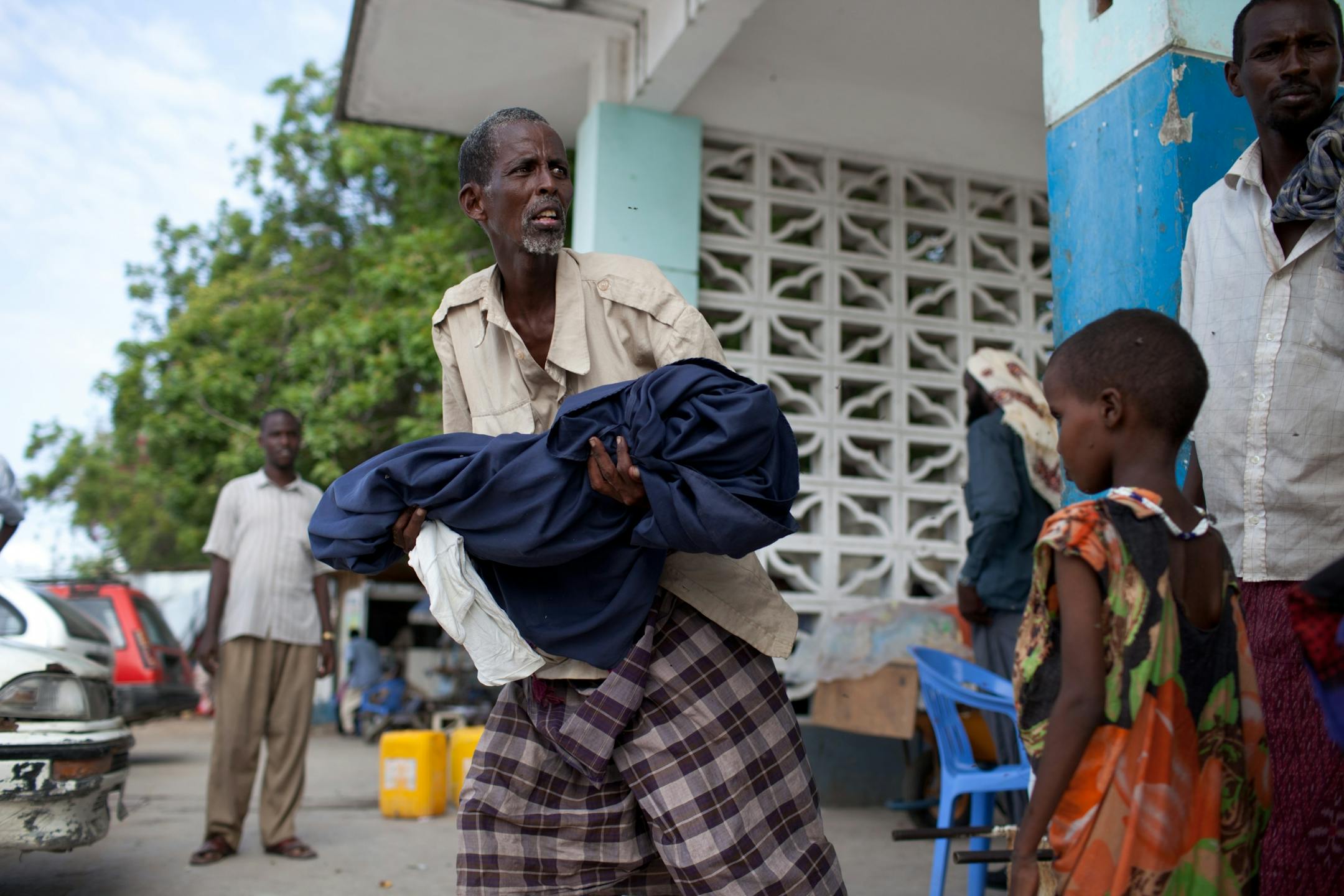
Kufow Ali Abdi carried the body of his 3-year-old daughter, Kadija, who had just died from measles at the hospital in Mogadishu, Somalia, on July 28. "I just hope they can save the others," he said, referring to his two remaining children, who were down to skin and bone. The al-Shabab Islamist insurgent group, which controls much of southern Somalia, is blocking starving people from fleeing the country and setting up a camp where it is imprisoning displaced people who were trying to escape al-Sh
Kufow Ali Abdi carried the body of his 3-year-old daughter, Kadija, who had just died from measles at the hospital in Mogadishu, Somalia, on July 28. "I just hope they can save the others," he said, referring to his two remaining children, who were down to skin and bone. The al-Shabab Islamist insurgent group, which controls much of southern Somalia, is blocking starving people from fleeing the country and setting up a camp where it is imprisoning displaced people who were trying to escape al-Shabab territory. (New York Times/The Minnesota Star Tribune)

Efforts are being made on several fronts to stop local Somali men from being recruited to return to their homeland in order to join Al-Shabab, the terrorist group with ties to Al-Qaida.

The Somali community has tried to intervene. The FBI is involved. U.S. Rep. Peter King, R-N.Y., the House Homeland Security chairman, even held hearings about Islamic radicalization that focused on Minnesota's Somali community.

To date, 40 Americans have been identified as Al-Shabab fighters in Somalia, according to the House committee. Some have reportedly been recruited with videos, complete with a hip-hop soundtrack, glorifying Al-Shabab.

An alternative visual image may make some Somalis rethink those recruitment pitches: The front-page photograph from the Aug. 2 edition of the New York Times.

The Somali boy in the photo is just one of the half-million children on the brink of starvation. Already more than 29,000 children have died. Overall, 11.3 million people are at risk in the Horn of Africa, according to the United Nations.

The emaciated boy may be one of the many Somalis Al-Shabab has blocked from fleeing to a refugee camp to avoid starvation. Many others, especially men, have been killed en route. And Al-Shabab has made it nearly impossible for most Western famine-relief organizations to enter the country in order to save lives.

If a powerful photo truly is worth more than words, the image of the boy from Mogadishu should speak volumes to any local Somalis tempted by Al-Shabab.

John Rash is a Star Tribune columnist and editorial writer.

about the writer

about the writer

John Rash

Editorial Writer

John Rash is an editorial writer and columnist. His Rash Report column analyzes media and politics, and his focus on foreign policy has taken him on international reporting trips to China, Japan, Rwanda, Kazakhstan, Turkey, Lithuania, Kuwait and Canada.

See Moreicon

More from Commentaries

See More
card image
Richard Tsong-Taatarii/The Minnesota Star Tribune

Calls for de-escalation and toning down the rhetoric in recent days is exactly what was needed, even if it might have felt like capitulation.

card image

Opinion | What happens after our shock fades?

card image