

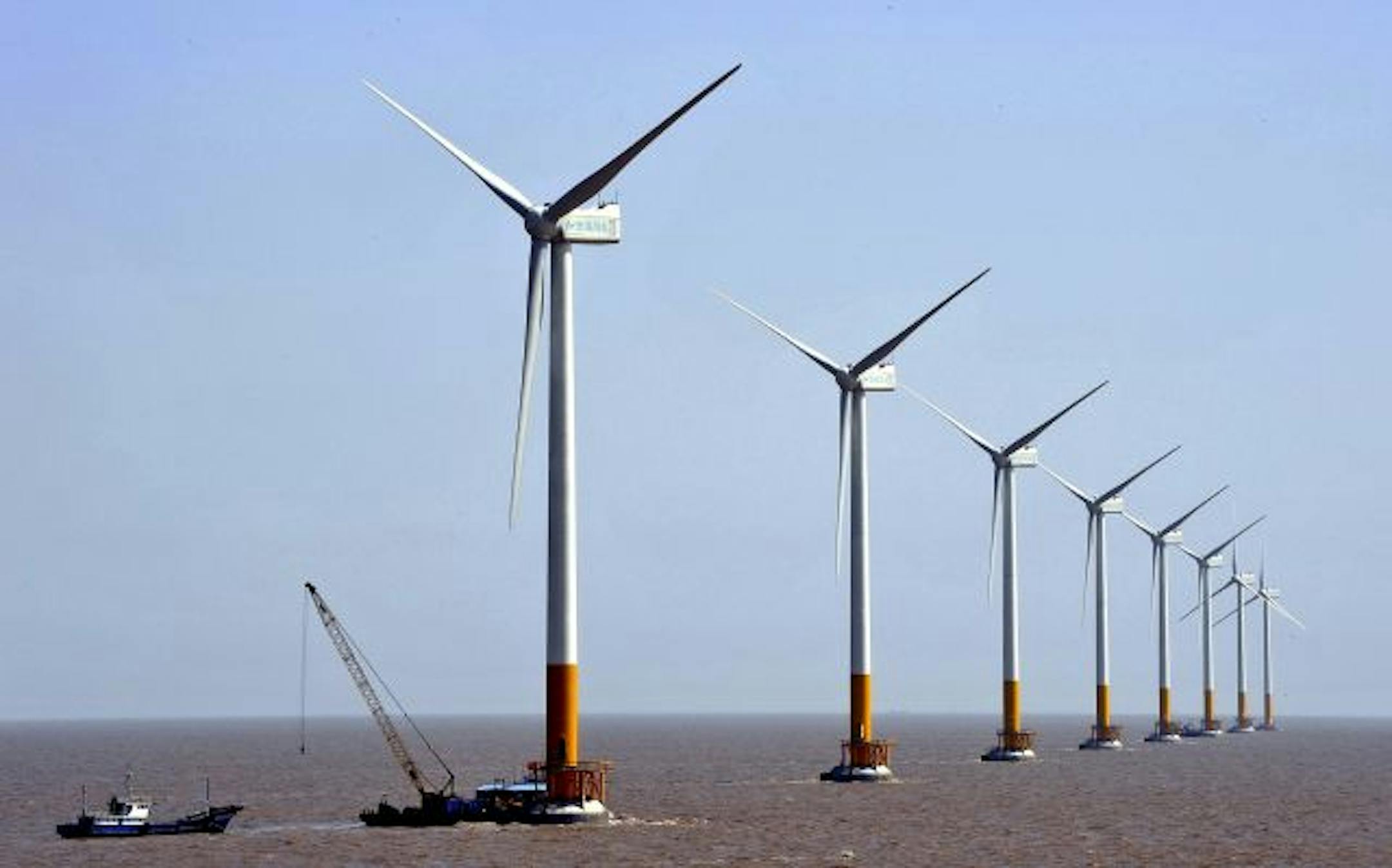
China WindPower Group., Iberdrola SA and Duke Energy Corp. will lead development of an estimated $65 billion of wind-power plants this year that let utilities reduce their reliance on fossil fuels.
The estimate from Bloomberg New Energy Finance assumes a 9 percent increase in global installations of wind turbines this year, adding as much as 41 gigawatts of generation capacity. That's the equivalent of 34 new nuclear power stations.
Utilities that built natural gas-fired generators during the last decade are increasingly erecting turbines and buying wind power from competitors, tapping a renewable-energy source as governments consider ways to penalize carbon-based fuels.
"Wind development is moving fast," James Rogers, chairman of Duke, which owns utilities in the U.S. Southeast and Midwest, said in London last week at the Bloomberg New Energy Finance conference. "In the last 10 years, 90 percent of plants we've built have been gas. I've used gas plants like crack cocaine."
While gas-fired plants are relatively cheap to build and pollute less than coal plants, they still emit carbon dioxide, which will carry higher costs if governments tighten environmental rules.
Last year, $63 billion was invested in turbines, adding 37.5 gigawatts of new capacity and bringing potential output of electricity from wind to 157.9 gigawatts, according to the Global Wind Energy Council, a Brussels-based industry group. A third of those turbines were installed in China, which doubled capacity to 25 gigawatts.
Wind is gaining support as turbine costs fall and government stimulus money helps pay for plants. Prices for turbines have declined by about 15 percent to $1.44 million per megawatt over the past two years, according to William Young, an analyst at Bloomberg New Energy Finance.
"It makes sense and it makes money," said Michael Liebreich, founder of the London-based consultant, which Bloomberg bought in December.



