

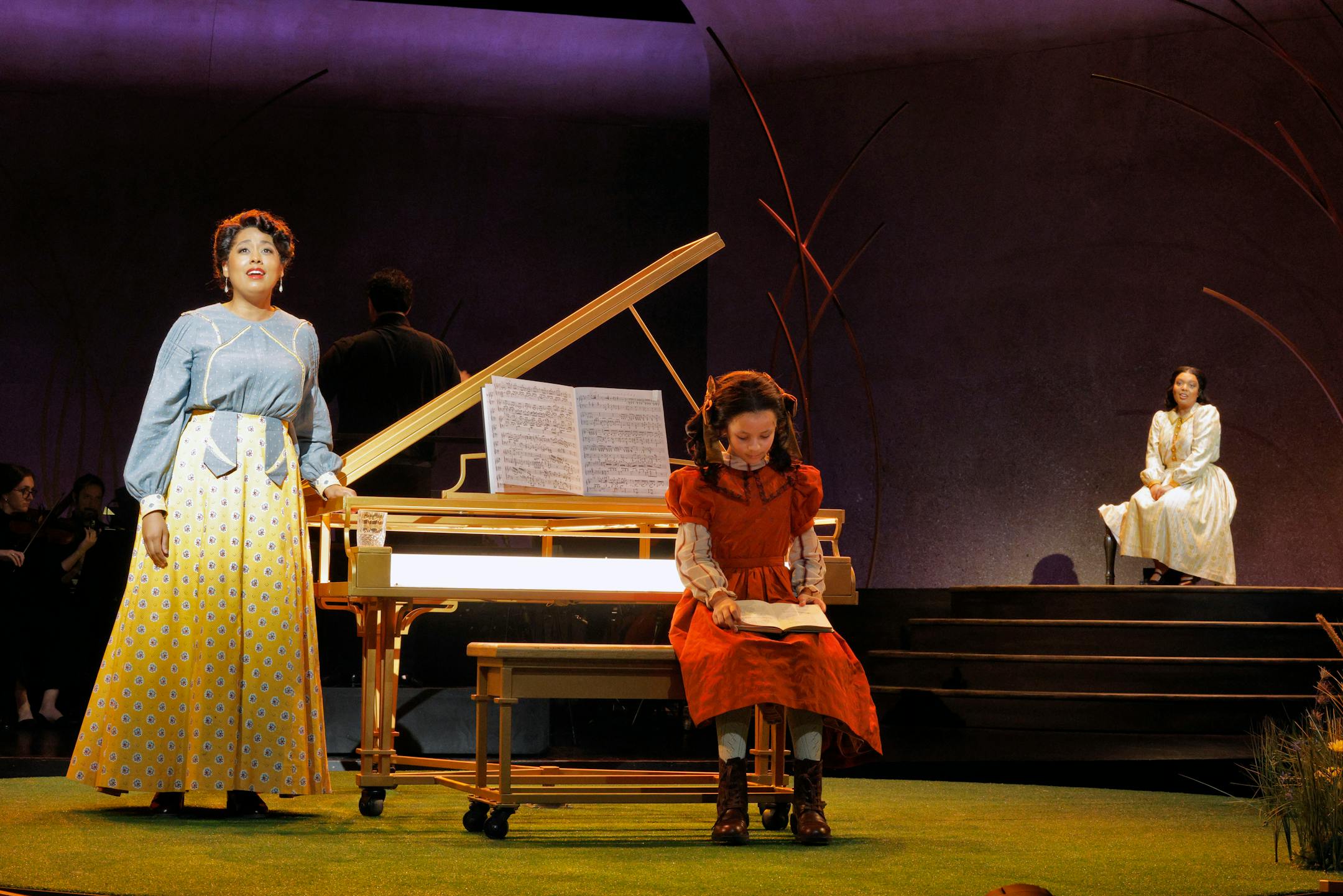
Most cinematic musical biopics don’t give you a strong enough sense of the combination of imagination and hard work that making music requires. But Minnesota Opera is premiering a work that offers some insight.
“My Name is Florence” takes us into the life and creative process of 20th-century African American composer Florence Price. She struggled to get her works heard during her lifetime because of racial discrimination and misogyny in the classical music business, but is lately finding fresh ears thanks to major orchestras and soloists.
Minnesota Opera commissioned composer B.E. Boykin and St. Paul-based librettist Harrison David Rivers to create this chamber opera, and they’ve taken an imaginative approach to telling her story. By exploring how she inherited her sense of musical discipline from her mother and passed it on to her own daughter, it becomes a story told by three generations of women.
The opera is most inspired and inspiring when Boykin’s gift for sadly beautiful melodies and layers of conflicted emotion emerge. And soprano Flora Hawk brings them forth in a bravura performance as the composer, her arias and acting displaying remarkable depth and subtlety. She’s the best reason to experience this admirable undertaking, which boasts a lovely design scheme, a clearly committed cast and smooth stage direction from Eboni Adams.
Only 80 intermission-less minutes in length, it goes light on the historical context and drops us into Price’s life for a series of relatively brief vignettes that don’t really add up to a satisfying story arc. Yet Hawk delivers a couple of showstopping arias that take us deep into Price’s heart, and conductor Mario Antonio Marra and the Minnesota Opera Orchestra expertly underline her inner tumult through some arresting instrumental interludes.
We follow Price’s path from an economically and spiritually thriving African American community in Little Rock, Ark., circa 1900, to her student years at Boston’s New England Conservatory of Music to Chicago of the 1930s, where she had a symphony premiered by one of America’s great orchestras, the Chicago Symphony, and her work started to find a wider audience.
But not that wide, and the reasons why could use more fleshing out than the opera offers. For example, your average audience member attending this production might not understand what “the disenfranchisement” was, and that stripping African Americans of their rights and economic opportunities was a conscious series of decisions by white people in positions of power in the early 20th century.
Rivers’ libretto also leans upon repetition instead of introducing fresh text that could have deepened our understanding of the opera’s characters. While Deborah Nansteel impressively inhabits the composer’s elegantly authoritative mother, the character becomes enigmatic. Meanwhile, John Mburu portrays the far more affectionate parent, displaying a welcome playfulness in a production that can be a little too stiff and noble.


