

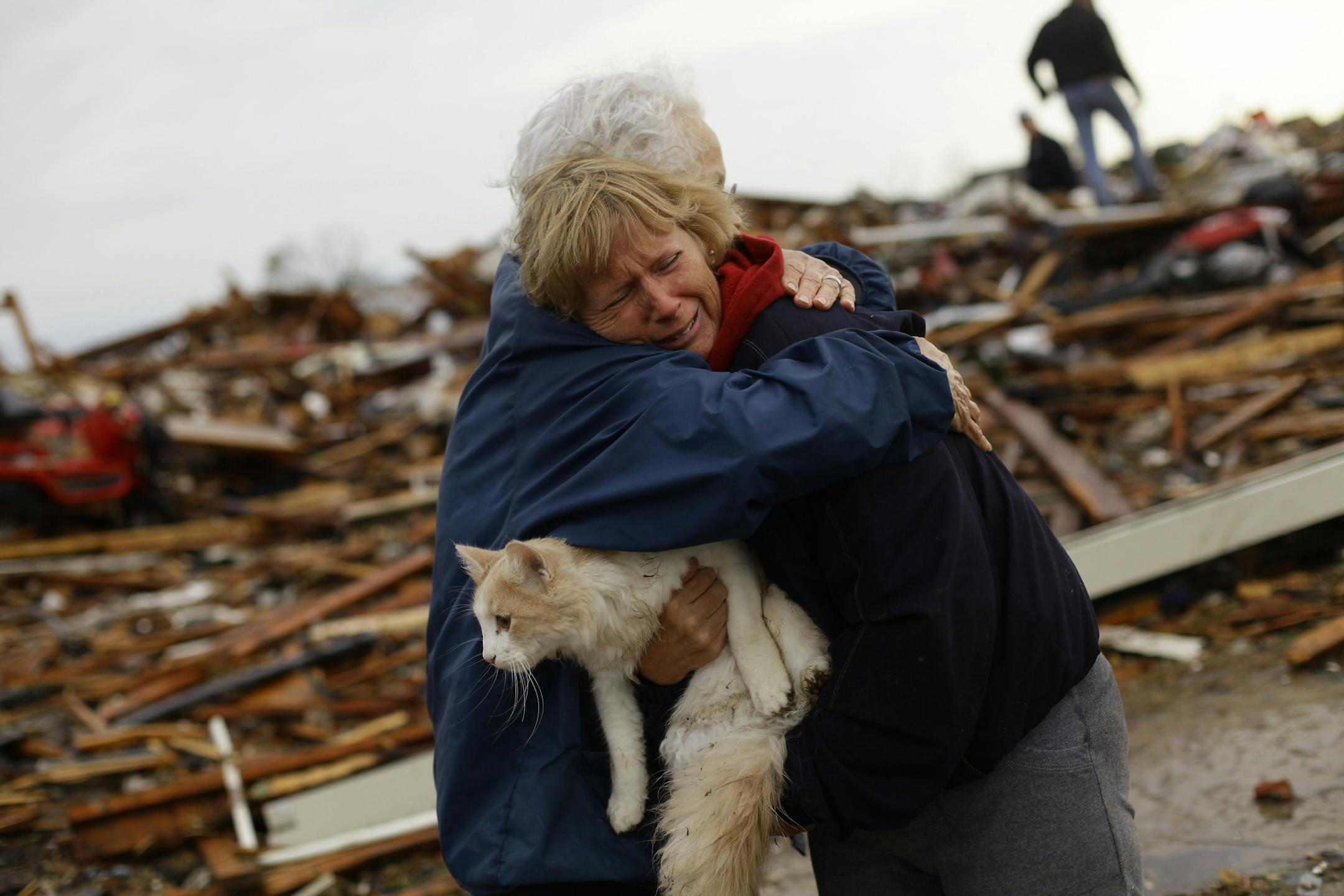
As good news goes, this would have to do: First thing Tuesday, the medical examiner in Moore, Okla., announced that the death toll had gone down overnight.
At day's end Monday, the number killed by a massive tornado was reported to be at least 51, with more expected as rescue workers dug through the wreckage. That was more than twice the number later confirmed dead. A spokeswoman for the examiner's office blamed it on "chaos."
Chaos indeed. The twister, more than a mile wide, swept east across town from west to east, hugging the ground for 40 minutes. The National Weather Service on Tuesday upgraded the tornado to an EF5 rating, meaning it had winds greater than 200 miles per hour for at least part of that time.
At Briarwood Elementary, 70 youngsters huddled in the girls bathroom as the walls crumbled around them. All survived. At Plaza Towers Elementary, children sought shelter in the basement, where seven of them drowned.
Heartbreak and devastation are all too familiar to Moore. The town is situated near the center of "Tornado Alley," which stretches roughly from Texas to South Dakota, between the Rocky Mountains and the Appalachians.
The region is vulnerable to tornadoes because of frequent collisions of warm, dry air from the Southwest; cool, dry air from the Rockies, and warm, moist air from the Gulf of Mexico.
But twisters seem almost magnetically drawn to Moore. In 1999, an EF5 tornado barreled through at 302 mph, the highest winds ever recorded near the Earth's surface, according to the National Weather Service. That one killed 36 people.
In between, the town was rocked by smaller twisters in 2003 and 2010.


