
Readers Write: Teachers' strike, state surplus

Bigger than the budget.

March 8, 2022 at 11:45PM
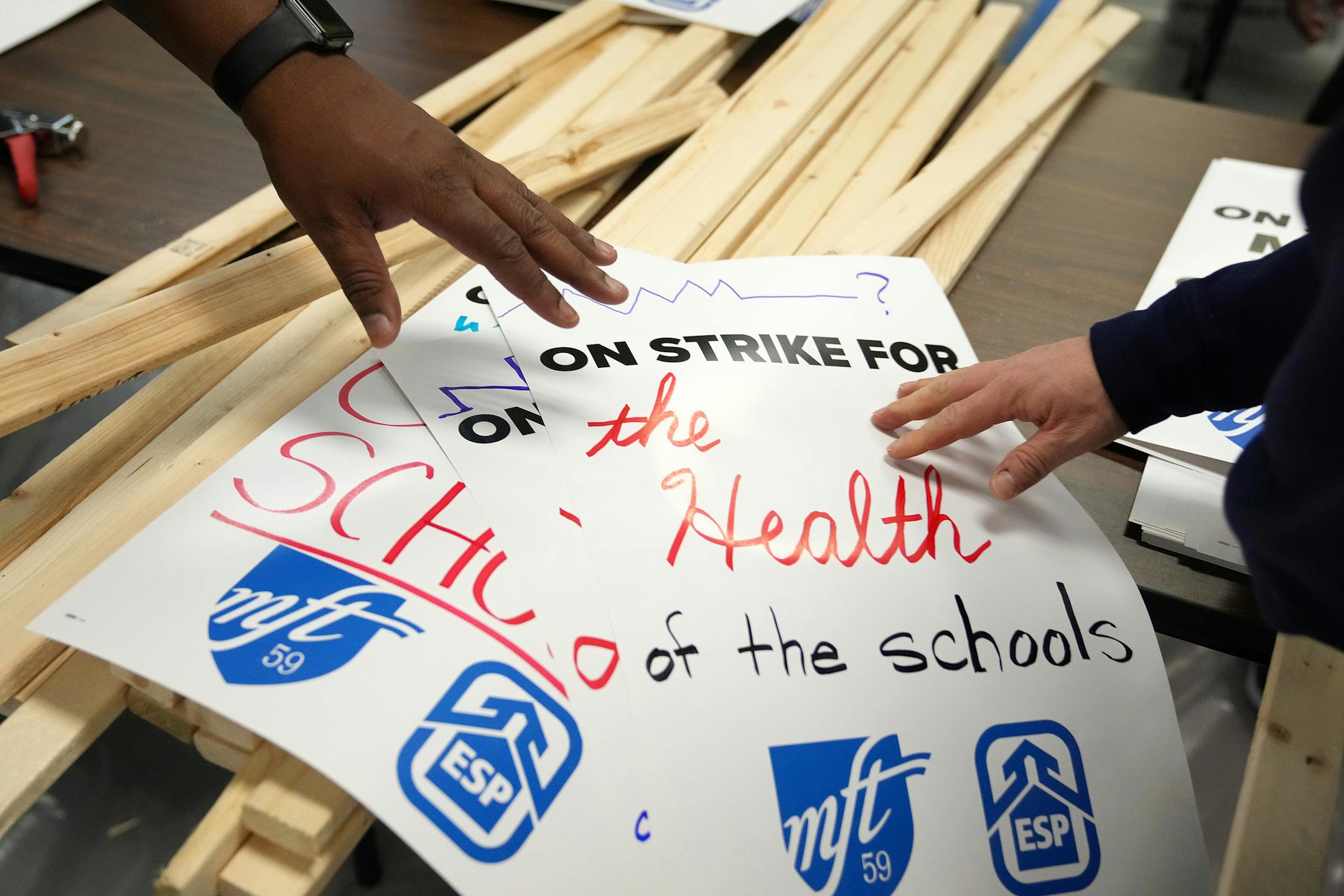
Union members and supporters created picket signs on Saturday at the Minneapolis Federation of Teachers and Education Support Professionals offices in northeast Minneapolis. The strike began on Tuesday. (Anthony Souffle, Star Tribune/The Minnesota Star Tribune)

Here are a few thoughts from an educator: Regardless of how we feel about how Minneapolis or St. Paul schools have managed their budgets, we have a larger systemic crisis that was going on long before the pandemic ("MPS strikes; SPPS averts walkout," front page, March 8). Public schools are woefully understaffed for what society expects us to do. This is not news. It's been going on forever in American society. Teachers are being asked to take on duties that they neither have the resources to tackle or the appropriate training to execute with competence, mental-health needs topping the lengthy list.

More than ever in my teaching career I hear my colleagues saying things like this to students' families: "I'm sorry you are going through this. I don't have the answers, and I'm not sure where to direct you other than our support staff, but that might take a while because they have so many students in their care."

Start at the top. Go to your legislators and others who drive funding and policy. This nonsense going through our Legislature right now in Minnesota is simply a distraction from what our students and educators need to be successful. Demand that our lawmakers actually go into schools and shadow teachers — not just do a photo-op. Demand more understanding of what students are experiencing as a result of increased mental-health needs. Demand more knowledge of the challenges faced by educators and then ask yourself, "Should teachers be responsible for these needs?"

Demand that lawmakers actually ask teachers, "What do you need to be successful?" I started my teaching career 27 years ago, and I can count on one hand how many times I've been asked by the higher-ups, "What do you need? What are your ideas? Do you have any solutions based on what you see from your direct experience?"

We cannot honestly say that we put kids first in our country. This should be our day of reckoning.

Sarah Brookner, Minneapolis

•••

Thirty years ago I took a job as a support professional working 10 hours a week supervising kids for $10 an hour in the lunch room at what is now Justice Page Middle School in south Minneapolis. While we were opening stubborn milk cartons for the kindergarten small-fry and doing our best to channel middle school enthusiasm for all things chaos, I commented to one of the veteran teachers that I was "just" an educational assistant. "'Just'!" she said. "We couldn't make it without you guys! We need you, me, the bus drivers, engineers, food service folks — everybody! It's all hands on deck!"

Within a couple of weeks I was moved to a full-day position and within the year a new contract the union had been working on for years increased my pay to $14 an hour. Suddenly a part-time job I'd taken as our children entered school became a viable career.

Over time that career-level pay has been reduced to part-time-job level, and again teachers are reminding us of the value of educational assistants, bus drivers and lunch servers by insisting on a $35,000 starting pay for the support professionals they rely on daily to care for, educate and, yes, love the beautiful, enthusiastic children of Minneapolis. Thank you, teachers, for seeing us. Thank you, bus drivers, for delivering students safely to our doors. Thank you, parents, for entrusting your precious kids to us. And many thanks, in advance, for the generosity of taxpayers, insightful enough to understand that a $9 billion state surplus means we can afford to keep career professionals in charge of our students' educations at every level.

David Leussler, Minneapolis

•••

The Minneapolis teachers' strike is another example of a government unable to establish meaningful priorities. Back in late 2013, then-outgoing Mayor R.T. Rybak insisted that the City Council rush through a massive subsidy package for development in downtown Minneapolis. Tragically, the council agreed and public scrutiny was limited.

Well, that package contained millions in aid for billionaire Zygi Wilf to help build the Vikings stadium in Minneapolis. To this day, the city is paying off that indebtedness while declaring its school district cannot afford decent salaries for teachers and their staff.

Arne H. Carlson, Lake City

The writer was governor of Minnesota from 1991-1999.

•••

Three years of COVID disruptions, 30 years of state disinvestment in public education and the use of outdated funding formulas have combined to produce some of the starkest disparities in the U.S. between the outcomes of white students and their peers who are Black, Indigenous and of color. General education funding has increased an average of 1-2% per year for the past three decades, at a time when inflation and costs have risen at many times that rate. The general education funding formula hasn't been updated since 1989 and significantly devalues students eligible for special-education and English-learner services. The statewide cross-subsidies for these services this year total about $900 million. Caps and restrictions on compensatory education revenue for students eligible for free or reduced lunch further limit the ability of districts to support them.

The same state-level forces have also created the conditions compelling educators in one of the state's largest districts to strike. Educators are reasonably demanding increased pay and reduced class sizes and caseloads, but Minneapolis Public Schools doesn't have the money to meet its demands — in fact, both Minneapolis and St. Paul schools have current and projected operating deficits.

The state has an unprecedented budget surplus and an "open tab" with public schools. I urge state legislators to prioritize K-12 schools in surplus decisions, close the special-education and English-learner cross-subsidies and fix the general education funding formula creating them. These actions would benefit every single public school in the state.

Sara Spafford Freeman, Minneapolis

STATE SURPLUS

Repay the unemployment fund

When COVID-19 first hit Minnesota and businesses were forced to shut their doors, the state's unemployment system was flooded with workers needing assistance. By April 2020, Minnesota had lost 416,000 jobs, and the following month the unemployment insurance system processed nearly 800,000 applications. This provided a much-needed safety net for workers while simultaneously draining the Unemployment Insurance (UI) Trust Fund.

Also at the same time, federal relief funds started pouring into the state to help alleviate issues caused by the pandemic. Between March 2020 and March 2021, Minnesota received $5.4 billion in pandemic relief funds. None of these relief funds were spent to replenish the unemployment fund, even though 31 other states fixed their UI fund deficits.

Today in Minnesota, our UI Trust Fund has a $2.7 billion deficit and is accruing interest every day, even though there are still federal relief funds available and a $9.3 billion surplus. A March 15 deadline is bearing down on employers who will face double-digit payroll tax increases to replenish the fund. Not only is this a major cause of concern for businesses, but if passed after March 15, the state's own Department of Employment and Economic Development will have to spend months of time and additional taxpayer dollars to figure out how to process the changes appropriately. There's absolutely no need for that to happen. Remember, this is a fund that benefits employees. It must be repaid so that if layoffs occur in the future, the funds are there to help support workers and their families.

The governor supports repaying this fund and included it in his budget. The state Senate agreed and in bipartisan fashion passed legislation making this fix. We urge the House to move quickly and fix this unnecessary problem before it's made even worse.

Jessica Beyer, Mankato, Minn.

Lori Higgins, Blaine

The writers are president of Greater Mankato Growth and president of MetroNorth Chamber of Commerce, respectively.

We want to hear from you. Send us your thoughts here.

about the writer

about the writer