
Readers Write: Shoveling snow, the printed Star Tribune, housing, vets, white male authors

Up the enforcement on snow, please.

The Minnesota Star Tribune
December 30, 2025 at 12:00AM
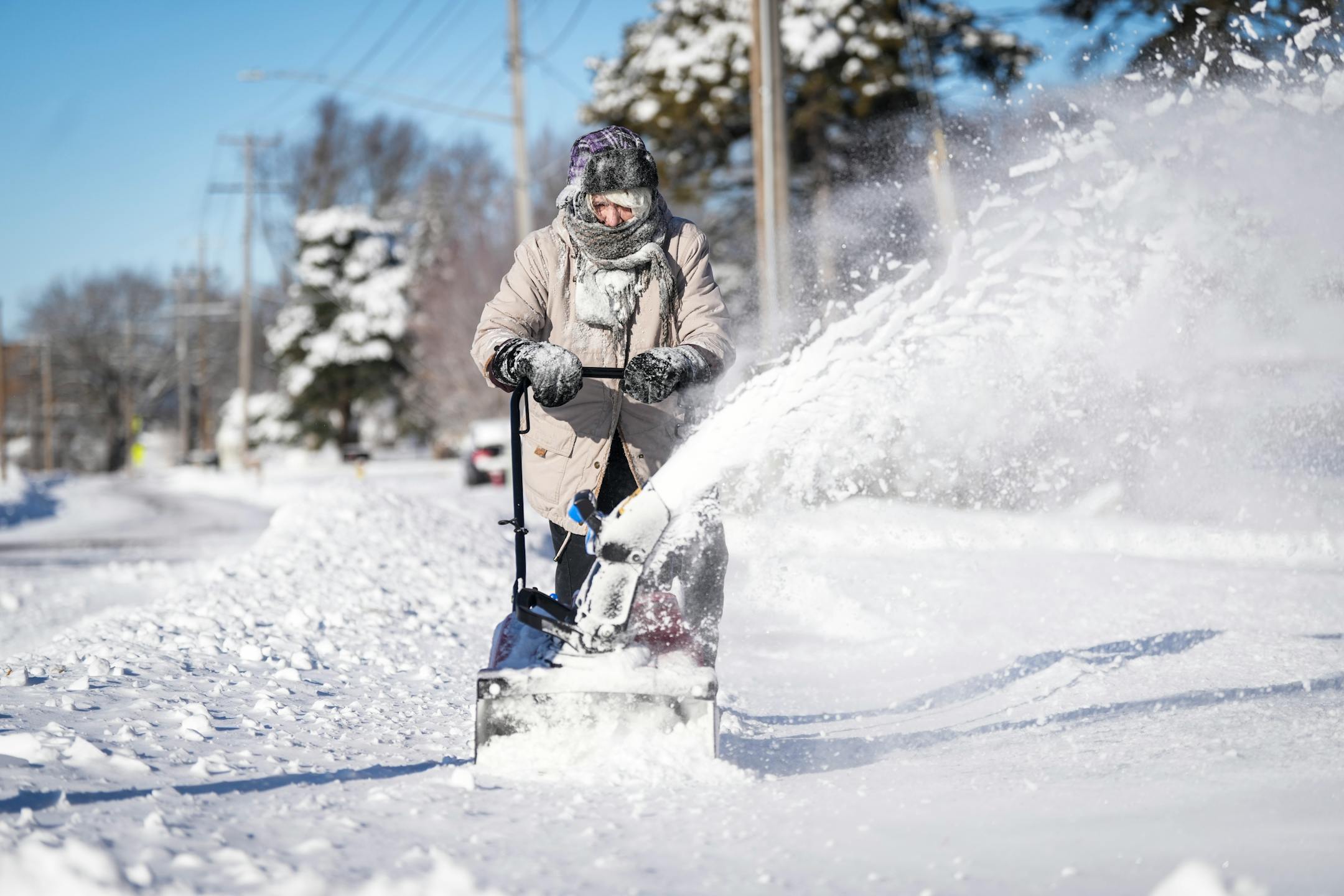
Amy Bounds, 75, clears her sidewalk on Dec. 29 after more than 6 inches of snow fell in Prior Lake. (Renée Jones Schneider/The Minnesota Star Tribune)

Opinion editor’s note: Strib Voices publishes letters from readers online and in print each day. To contribute, click here.

•••

Regarding William Hendricks’ Dec. 24 commentary, “Shoveling sidewalks should be a priority for Minneapolis”: Right on, brother!

As a retired senior who regularly tries to use sidewalks in south Minneapolis during the winter months (November to April ...) it is more than maddening to see that 90% of folks shovel their walks while 10% let the snow and ice accumulate to the point of impassability.

I have neighbors who use canes and motorized scooters who regularly join me walking in the street because of the rudeness and/or cluelessness of a minority of homeowners and landlords. (Don’t get me started on the major fail of the city to clear sidewalk intersections in a timely manner.)

The Minneapolis Public Works Department needs to have its own “ice patrol” to regularly check if sidewalks are passable and fine known repeat shoveling scofflaws.

Make the fine more painful than the cost of hiring a plowing or shoveling service; an extra grand added to the property tax bill might be just the, er, ticket ...

Daniel Swalm, Minneapolis

STAR TRIBUNE PRINTED EDITION

It snows here? Gosh, who knew

I’m starting the week with tea and karma this morning. The day after reading about the demise of the Star Tribune’s Minneapolis printing facility, I’m notified that my Des Moines-printed paper cannot be delivered until tomorrow. Did management forget that occasionally it snows in these parts? And why is a newspaper that is being promoted for all of Minnesota being printed in Iowa? Karma, baby, karma.

Laurel Watt, St. Paul

•••

The second I read about the closing of the Star Tribune printing plant and the outsourcing to an Iowa printer, I immediately thought about how often Interstate 35 from Des Moines is closed due to snow. The first day of Iowa-printed paper turns into the first day of no home delivery. The allure of that valuable real estate was too great to resist.

Gregory Leaf, Hudson, Wis.

•••

Yes, it is sad and poignant that the Strib’s Heritage printing plant has rolled out its last editions. But that doesn’t mean readers and employees must forgo sampling the sights, sounds and scents of newspaper publishing. Every summer, volunteers at the Minnesota Newspaper Museum at the State Fair use a vintage Linotype machine (complete with hot-lead ingots) and flatbed presses to publish the Maynard News and take-home posters of the First Amendment. The museum, adjoining the 4-H Building, is a labor of love for those volunteers and for visitors who love newspapers. Worth a visit!

Dan Wascoe, Plymouth

The writer is a retired Star Tribune reporter and columnist.

HOMELESSNESS

Turn from housing first is ill-conceived

President Donald Trump’s shifting of resources away from housing first programs is an overcorrection in federal policy and will worsen the homelessness crisis (“Trump questions ‘housing first’ plan,” Dec. 26).

The overwhelming majority of studies comparing housing first and Trump’s favored method, treatment first, show that housing first is more effective at getting people off the streets. Additionally, there are over 170,000 people in shelters sponsored by housing first programs that are vulnerable to budget cuts, according to the National Alliance to End Homelessness. When Trump reallocates more than a billion dollars away from housing first programs, he is spending the money less effectively and threatening the shelter of those housed by the programs.

One of the primary pieces of research cited by this article in opposition to housing first policies was a “small Boston study.” The study’s official title is “Housing Boston’s Chronically Homeless Unsheltered Population.” In this study, researchers tracked only 73 people, and 45% of them passed away during the survey period. Those who died were included in those not housed at the end of the study, leading to a misleadingly small percentage of people identified as stably housed at the end of the 10-year period.

Housing first provides a stable base from which substance and mental health issues can be addressed, and by pulling back to a primarily treatment first method, many of the benefits of housing first are lost.

Odin Foote, St. Peter, Minn.

VETERINARIANS

Another force is at play: investors

The commentary regarding veterinarians and their stressful lives was of particular interest to me (“I complained about a vet bill that saved my dog’s life — until my daughter yanked my leash,“ Strib Voices, Dec. 27). Like most people, we adore our own vet and can vouch for how much she cares about her canine patients. Nonetheless, as owners of a healthy but geriatric dog we are also familiar with author Mike Tighe’s lament about the cost of vet services as well as pet medicines, both of which are approaching that of human health care. In our discussions with our vet about a sudden and rapid increase in costs for everything, it came to our attention that her clinic had recently been purchased from the previous veterinarian–owner by a large private equity firm. A little research showed that, indeed, privately held vet clinics have become yet another prime target for private equity firms. It makes sense: Humans love their pets and are, to a certain extent, willing to pay whatever it takes for our beloved furry family members. And do.

I have no idea where this may or may not fit into the “state of emotional exhaustion” for many vets, but I know where it fits into mine. I love our vet but really dislike being taken advantage by faceless “investors” who wouldn’t know a Cavalier from a St. Bernard. And care even less.

D. Roger Pederson, Minneapolis

PUBLISHING

Maybe it’s what the market wants

I found the recent commentary by Annie Holmquist on the dearth of white male writers to be off base (“You can’t be diverse if you exclude white men,” Strib Voices, Dec. 26). As a white male reader, I don’t find it particularly hard to find books written by authors from my demographic group. The novelist Jess Walters and John U. Bacon, who wrote “The Gales of November” about the sinking of the Edmund Fitzgerald, come to mind when I think of popular books written by white male authors that I read in 2025.

If there truly is an issue around white male authors struggling to break into the industry, it might be because of an attempt on behalf of the publishing industry to better reflect their readers. Multiple studies in recent years have shown that women read more books and spend more time reading for pleasure than their male counterparts. You can’t blame publishers for trying to appease the largest segment of their audience.

Sam Benson, Minneapolis

•••

I read with interest and surprise the commentary asserting that white males are being excluded from the world of publishing. In fact, three of the six finalists for the 2025 Booker Prize are white males. So are the authors of four of the 10 books on the New York Times’ list of best books of the year. Ian McEwan’s “What We Can Know,” Thomas Schlesser’s “Mona’s Eyes” and Patrick Ryan’s “Buckeye” are on many “best” lists this year. William Kent Krueger and Richard Osman are among the white men who have published bestselling mysteries this year (and in many previous years).

And these are just a few examples that demonstrate how well white males are faring in the publishing world, along, of course, with many women and people of color, whose success I doubt they begrudge. I’m not sure what Holmquist’s agenda is, but I’d suggest she better inform herself before making her assertions.

Cyndy Crist, St. Paul

about the writer

about the writer