
Readers Write: Mental health, rural health, Israel-Hamas deal, trans athletes

This state Supreme Court ruling highlights known cracks in our mental health system.

The Minnesota Star Tribune
October 12, 2025 at 8:26PM
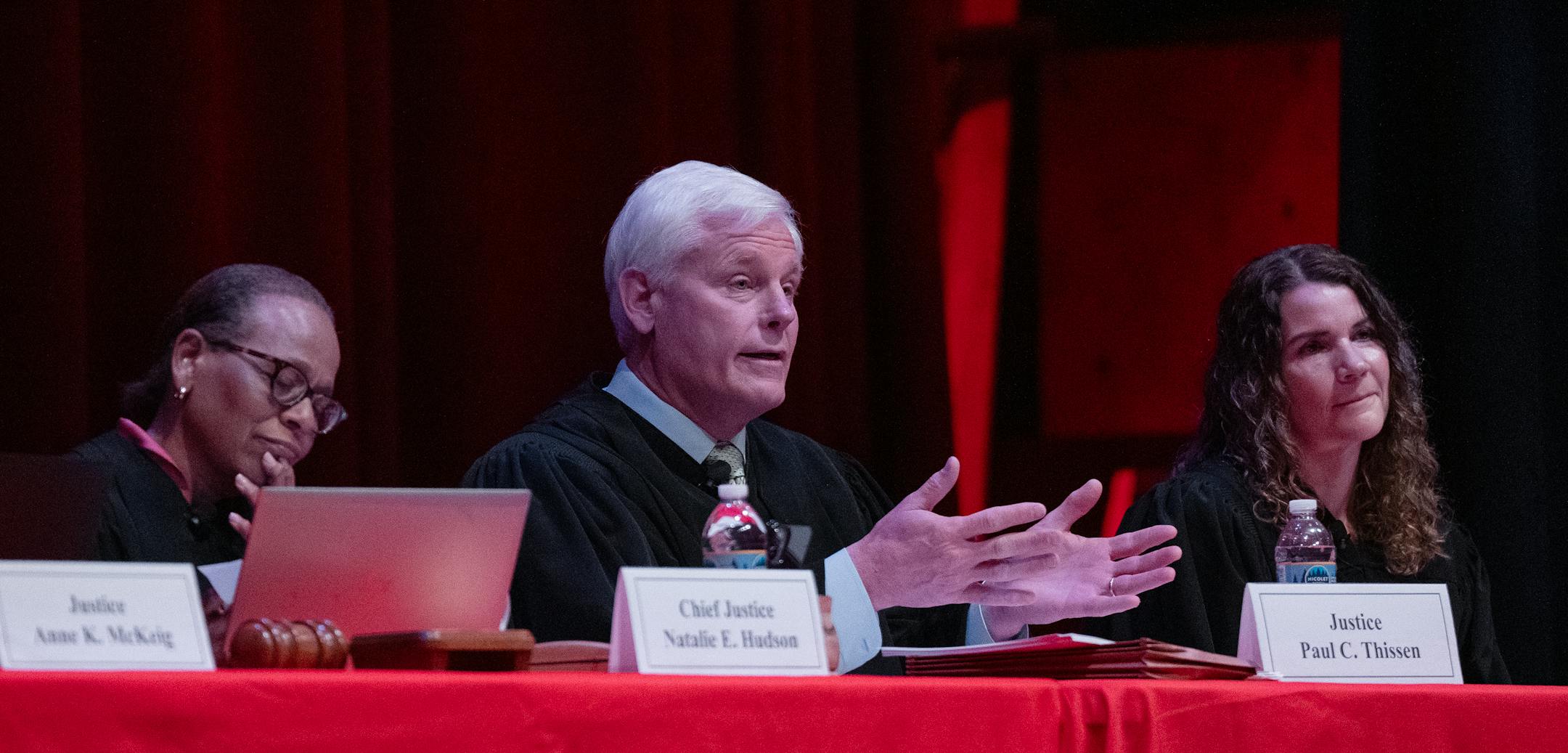
Chief Justice Natalie E. Hudson, left, Associate Justice Paul C. Thissen and Associate Justice Theodora Gaïtas hears arguments in a civil commitment case in May in St. Paul. (Jerry Holt/The Minnesota Star Tribune)

Opinion editor’s note: Strib Voices publishes letters from readers online and in print each day. To contribute, click here.

•••

The article “Ruling focuses on bed space need for mentally ill” (Oct. 9) focused on the court’s decision regarding who pays for legal fees, but included in it is the problem Minnesota and many other states are facing: increasing numbers of people with mental illnesses deemed incompetent to stand trial.

In 2013 when the original law requiring people in jail deemed incompetent and committed to be moved within 48 hours, there were only 46 people waiting for a state hospital bed. That number jumped to 424 in 2024. That law was suspended because the deadline could never be met.

It’s important to note that actions are being taken, from a legislatively directed task force in 2019 to review competency restoration issues, to the forming of the priority admissions task force in 2023. Both groups developed recommendations on how to address this issue, several of which have been implemented.

While adding 50 new beds at Anoka Regional Treatment Center was a key recommendation, we knew we could not build our way out of this problem. Those beds are a “backdoor issue” and we need to look at the “front door” of the jails. How do we intervene early before someone has a mental health crisis and comes into contact with police? (Note that the person at the center of the lawsuit in the article was in a hospital when arrested.)

The new voluntary engagement pilots will hopefully prove to be effective in intervening and engaging people in treatment voluntarily before a crisis. Mobile mental health crisis teams covering all 87 counties are effective but are woefully underfunded. First Episode of Psychosis programs help young people change the trajectory of their lives, but we have too few programs to meet the needs. We have more services than ever before, but it’s difficult to expand them because Medicaid rates, the largest payer of mental health services, are very low compared to the cost of providing treatment.

We know what to do — and have known for many years. We need to fund it.

Sue Abderholden, St. Paul

The writer is executive director of NAMI Minnesota.

RURAL HEALTH CARE

Our model is working

In Minnesota’s rural communities, health care is more than a service; it’s a lifeline. It connects generations, strengthens local economies and anchors the future of the towns we call home.

At Cuyuna Regional Medical Center, that lifeline is fiercely protected. We are an independent, nonprofit health system with deep roots and a forward-looking vision. Our independence is our operating model, our strategic edge and a testament to what’s possible in rural health care when local voices lead local care.

When the Miner’s Hospital in Crosby nearly closed in the 1950s, our community refused to accept “no” from those who thought we didn’t need a hospital. They rallied — bake sales, self-imposed taxes and persistent advocacy — until a new hospital opened in 1964. Today, we carry forward that same spirit of resilience, problem-solving and pride in place.

Rural health care is at a tipping point. Rising costs, workforce shortages and ongoing uncertainty threaten small systems like ours. Yet we’re meeting the needs of our growing communities with bold action: expanding specialty services in neurology, oncology and surgical care; investing in new and upgraded facilities to improve access and safety; and creating partnerships (like our new collaboration with Vivie) to keep care close to home.

Some decisions have been tough. But each move we make, alongside our physician partners, is guided by a singular commitment: to ensure that patients in Lakes Country can receive expert care and connection right here, not hours away.

To state and federal leaders: Come see how we’re doing it. Come see what’s possible when care is built around community.

And to our neighbors, patients and partners: Thank you for trusting us. We’ll keep showing up and adapting with you, and for you.

Rural health care can’t afford to stand still. And neither will we.

Amy Hart, Crosby, Minn.

The writer is CEO of Cuyuna Regional Medical Center.

ISRAEL-HAMAS DEAL

You’ve got to hand it to Trump

President Donald Trump deserves the Nobel Peace Prize (“Joy and fear as Gaza deal nears,” Oct. 10). With the hopeful Israel and Hamas deal, I can’t think of anyone who deserves it more than Trump, who believes in peace through strength. Bravo!

David Tulanian, Henderson, Nev.

Thanks to the efforts of Trump, the war in Gaza is at an end. Hamas has agreed to release the remaining hostages, and in return Israel has agreed to release 2,000 Arab prisoners from its jails, some of whom are serving multiple life sentences for murdering Israeli civilians. Will these prisoners change their ideology? Will Palestinians continue to call the state of Israel the “occupation” and deny its right to exist? Will Iran expand its funding of other Islamic radicals bent on destroying the state of Israel? Will this signal the beginnings of a new era of peace in the Middle East? I am pessimistic.

Stephen Elston, Golden Valley

In lieu of bragging about stopping numerous wars around the globe (I’ve lost count recently), perhaps the president should do something about the internal war in his own country, instead of his continued efforts to sow division by throwing gasoline on the fire every day. President of all the people? His actions and words express exactly the opposite.

Ron Bender, Richfield

TRANS ATHLETES

Letter signers don’t get it

I was disgusted and disappointed to read the letter that 150 or so members of Minnesota school boards (which represent fewer than 7% of the total number of school board members in the state) sent to our state’s Department of Education, the Minnesota State High School League and the attorney general, urging them to comply with President Donald Trump’s demands that Minnesota public schools violate state law by discriminating against transgender children in order to stop Minnesota schools from losing Title IX funding (“Funding fears drive push to reverse Minnesota transgender athlete policy,” StarTribune.com, Oct. 8).

Students in freshmen-level biology classes know better than to think gender is as simple as XX or XY. I won’t entertain the fallacy that Trump is concerned with fairness or safety for girls and young women. One has only to look at court records to see this president’s prior conduct on those issues.

Trump is the bully that keeps coming for your lunch money. School board members: If you think that complying with this latest demand will mean that Minnesota schools and institutions will get to keep their funding, think again. Trump has a very short memory when it comes to loyalty. Succumb to his demands on an issue that’s not important to you today, and be prepared for another demand next week, and more to come. If you choose to side with bigotry and hate over liberty and justice, be prepared for what our history books will teach to future generations one day about your compliance to a dictator.

Lisle Thielbar, Long Lake

Karen Tolkkinen’s column “Transgender athletes should not compete with girls, but everyone deserves a place to play” (StarTribune.com, Oct. 9) builds its case on emotion, not evidence. She acknowledges that “nobody knows how common” transgender athletes are in Minnesota, yet argues for restrictive policies anyway. That’s not fairness; that’s fear.

There’s also no evidence that transgender participation has taken opportunities from anyone. The Minnesota State High School League already reviews eligibility case by case to ensure both inclusion and competitive balance. The system is working as intended — quietly and responsibly.

The idea that girls are being forced to sacrifice is a political talking point, not a measurable fact. What’s really being asked of us is whether we believe every student deserves a place to belong, even those whose identity or experience we may not fully understand.

High school sports were never just about winning. They teach teamwork, discipline and self-respect, lessons that lose meaning if we start excluding students who simply want to play. Protecting opportunity for all young people is how we strengthen fairness, not weaken it.

Max Maher, Plymouth

about the writer

about the writer