
Readers Write: Masked immigration agents, federal troops in cities, the element of surprise

Unmask yourselves and act like cops.

The Minnesota Star Tribune
October 14, 2025 at 12:00AM
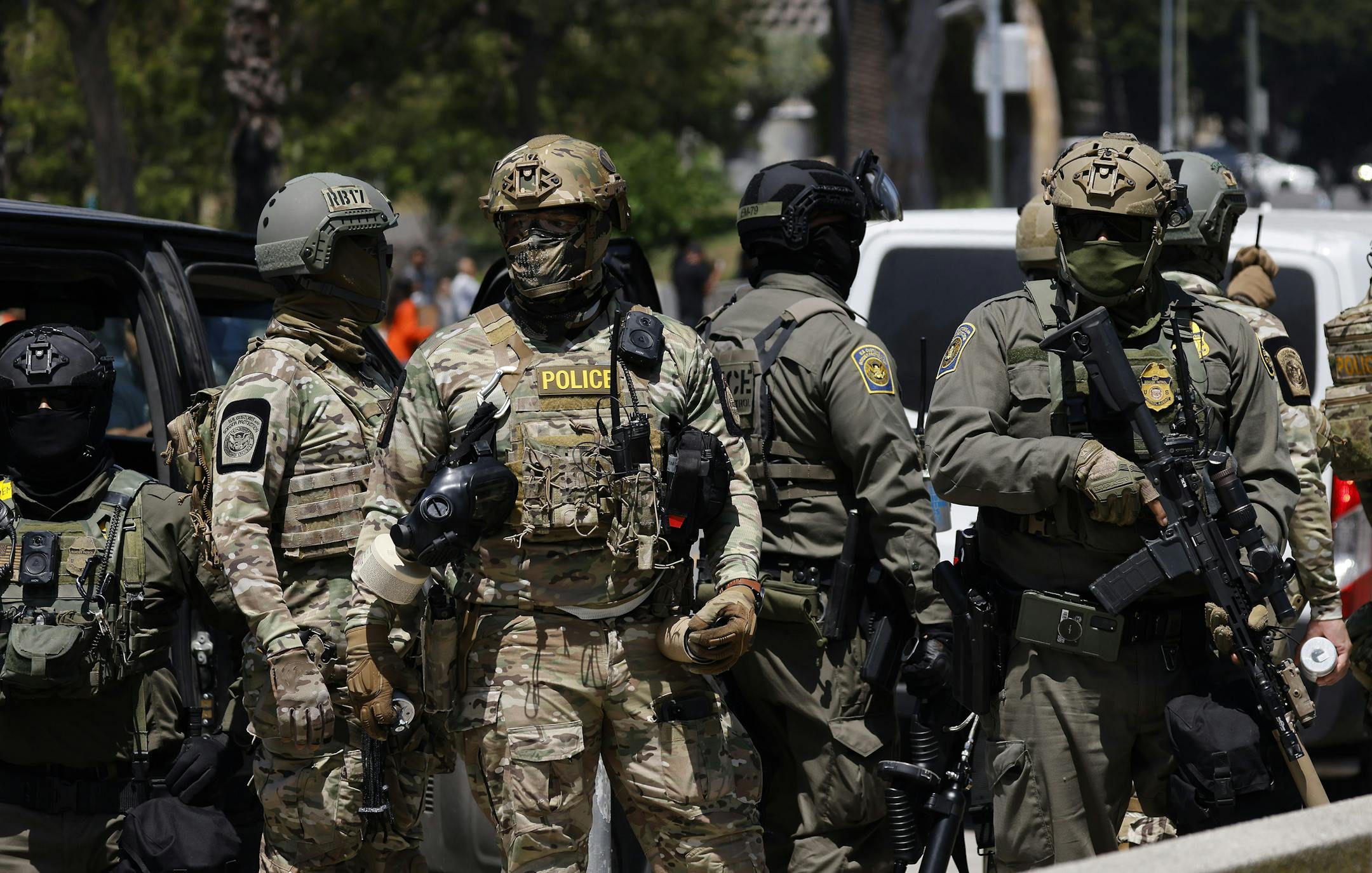
Federal immigration agents wait near MacArthur Park on July 7 in Los Angeles. (Carlin Stiehl/Tribune News Service)

Opinion editor’s note: Strib Voices publishes letters from readers online and in print each day. To contribute, click here.

•••

Homeland Security Secretary Kristi Noem explains it is necessary for federal agents to be masked and refuse to identify themselves because they or their families might be threatened.

Huh. I had a 40-year police career in Minneapolis. The first 11 years were as a uniformed patrol officer rotating shifts. My partners and I, sometimes our families too, were threatened. We were threatened making arrests, handling domestic disputes, responding to mental health crises, even writing traffic tickets — and yes, at protests, too. It goes with the territory. We weren’t permitted to wear masks or refuse to identify ourselves despite the fact that the risks to us were greater than anything these federal agents face. Why is that?

If someone was serious about carrying out a threat against a police officer, they knew where to find us. We would be back in the same neighborhood, in the same uniform, in the same car, the next day. Federal agents rarely find themselves in the same neighborhood more than once. In fact, they may not even be in the same city twice.

In addition, for six years I was on a joint Minneapolis Police Department/FBI SWAT team. Annually I was redeputized as a special deputy United States Marshal. We arrested genuinely violent offenders. We didn’t wear masks or conceal our identities. If there were threats made to us, they were never acted upon.

The threat justification for today’s federal agents concealing their identities is the very definition of a red herring. If you want to be a cop, be a cop.

Gregory Hestness, Minneapolis

The writer is a retired police chief of the University of Minnesota Police Department and retired deputy chief of the Minneapolis Police Department.

FEDERAL TROOPS IN CITIES

An enticing, simple and wrong answer

Many interesting viewpoints were expressed in Readers Write on Oct. 11 concerning President Donald Trump’s marshaling National Guard forces to quell insurrections and fight crime (“Walz, Ellison stand against tyranny”).

I hear that Trump voters approve of his methods — by any means necessary — to “get things done” and “get control of the country.” Our founding fathers, 250 years ago, set up a constitutional government that respects the majority consent of the governed. However, following an election, a rule-of-law-based system is supposed to be followed, in which it’s not “winner take all” or “the winner can do anything they want.” The destination of “getting things done” has never been as important as respecting the steps needed on the journey to get there. This is where Trump’s vision or program falls short of the mark. The powers he’s taken on to are mostly not his to use. It’s surprising to a lot of us, since all previous presidents have mostly attempted to follow the Constitution, that an individual like Trump can actually just do whatever suits him with virtually no consequences.

Trump’s vision is not nuanced but quite simple, and I believe that’s why so many people stick with him, no matter what he does. Simple solutions are more easily grasped and much more conclusive and satisfying. Democracy is not simple, easy, black-and-white or right-vs.-wrong. A lot of people, it seems, are willing to give up on the democratic concept of compromise or collaboration because it’s interpreted as “weakness” or idealistically impure.

Strength in leadership has been simplistically and narrowly redefined as bravado, intimidation, retribution and retaliation. The number of people with so many different ways of seeing and interpreting the world has been narrowed down to the views of the powerful few. America, which has always benefited from the ability to harness the vastness of many solutions and viewpoints to address thorny issues, is being steadily reduced to the simplest and lowest common denominator. As a nation, we will ultimately suffer for this.

Connie Clabots, Brooklyn Center

•••

Every city that Trump has sent troops into (and those he’s threatening to) have had pre-existing drops in violent crime and, more importantly, understaffed police forces. Rather than wastefully sending in troops, the administration could fully fund the Justice Department’s Office of Community Oriented Policing Services (COPS), which gives grants to police departments across the country for staff, which would help alleviate their shorthanded rosters. The program has been proven effective at reducing violent crime, but the Trump administration proposed cutting 17% of its budget, according to a recent Atlantic article, even though, when fully funded, it’s a fraction of the price of the National Guard deployments.

The article says, “Based on the known spending so far, the deployments could end up costing Americans roughly two-thirds of a billion dollars.” Employing troops in cities that have experienced drops in violent crime and murders makes little sense when places like Little Rock, Ark., for instance, have a homicide rate that has grown 39% in the first half of 2025. Could there be a more wasteful, ineffective way of fighting crime than shifting funds away from local law enforcement and toward troops who stand in low-crime areas and don’t make arrests? I think the answer to that is self-evident.

Gordon Abel, Minneapolis

•••

Most of us understand that police patrols affect crime. A saturated patrol of high-crime areas lowers crime rates in those areas. But where to find the cops?

While Democrats object wholeheartedly to Trump’s vindictive insertion of federal troops in their cities, Democrats have to take credit for their crime-ridden cities. Yes, I know, they can cite statistics that document lower crime rates. This is nonsense. Go downtown. Go to Uptown. Take a ride on the light rail. These areas are no longer safe, and there are no political equivocations that will solve that conundrum.

It all circles back to the killing of George Floyd and the knee-jerk reaction by Democratic lawmakers to advocate for defunding police. The Minneapolis City Council voted to defund and as a result police officers left the department in droves — and who can blame them — leaving the city more vulnerable to violent crime than ever before. And let’s face facts: Civilian violence disrupters are not cops. They may have a minuscule effect on crime but even that is doubtful.

Minneapolis needs cops. Lots of cops. Hundreds of cops. Where are these young men and women going to come from?

Sorry, they are not coming anytime soon. With democratic socialists vying for more City Council seats and an agenda that includes getting rid of police and jails, one would have to be delusional to apply to the city of Minneapolis to be a police officer. (Apologies to the recent recruits. Thank you for your service!) Suburban police departments pay just as well, and citizens and local politicians actually support their police forces.

Democratic cities like Chicago, Portland and Minneapolis should say, “Yes, please!” when Trump threatens to send federal troops. Can you imagine a safe downtown, Uptown, public transportation system? This is a Democrat-driven crisis. If you don’t want troops, figure it out!

Richard Greelis, Bloomington

The writer is a retired Bloomington police officer.

THE MINNESOTA STAR TRIBUNE

Cheers to the unexpected

It’s getting harder to be surprised by what I find in my paper delivered every morning, and not just because a lot can happen between the print deadline (5:15 p.m. starting next year!) and when my dedicated delivery driver tosses it on my driveway.

I’ve found myself at the age of 34 thinking I’ve got everyone and everything pretty much figured out. Take columnist Andy Brehm for example. He writes something I disagree with, and I promise to write a scathing rebuttal that never actually makes it out of my email drafts.

His latest column (“An ode to group running,” Strib Voices, Oct. 10) finally finds me motivated to hit send.

Similar to Brehm, I’ve found the running community in Minnesota to provide, as he stated, “a serene sanctuary in this weary world of ours.” Similar to Brehm, I have also found that putting the bottle down a couple of years ago has greatly enhanced my life.

I don’t know for sure if I’ll find many similarities in his next column, but I do know I’ll be a little more willing to be surprised and open-minded. Benefits like this are well worth the yearly subscription price (still will need some convincing to send in any donations, though — sorry to CEO Steve Grove).

Joe Kennealy, Eden Prairie

about the writer

about the writer