

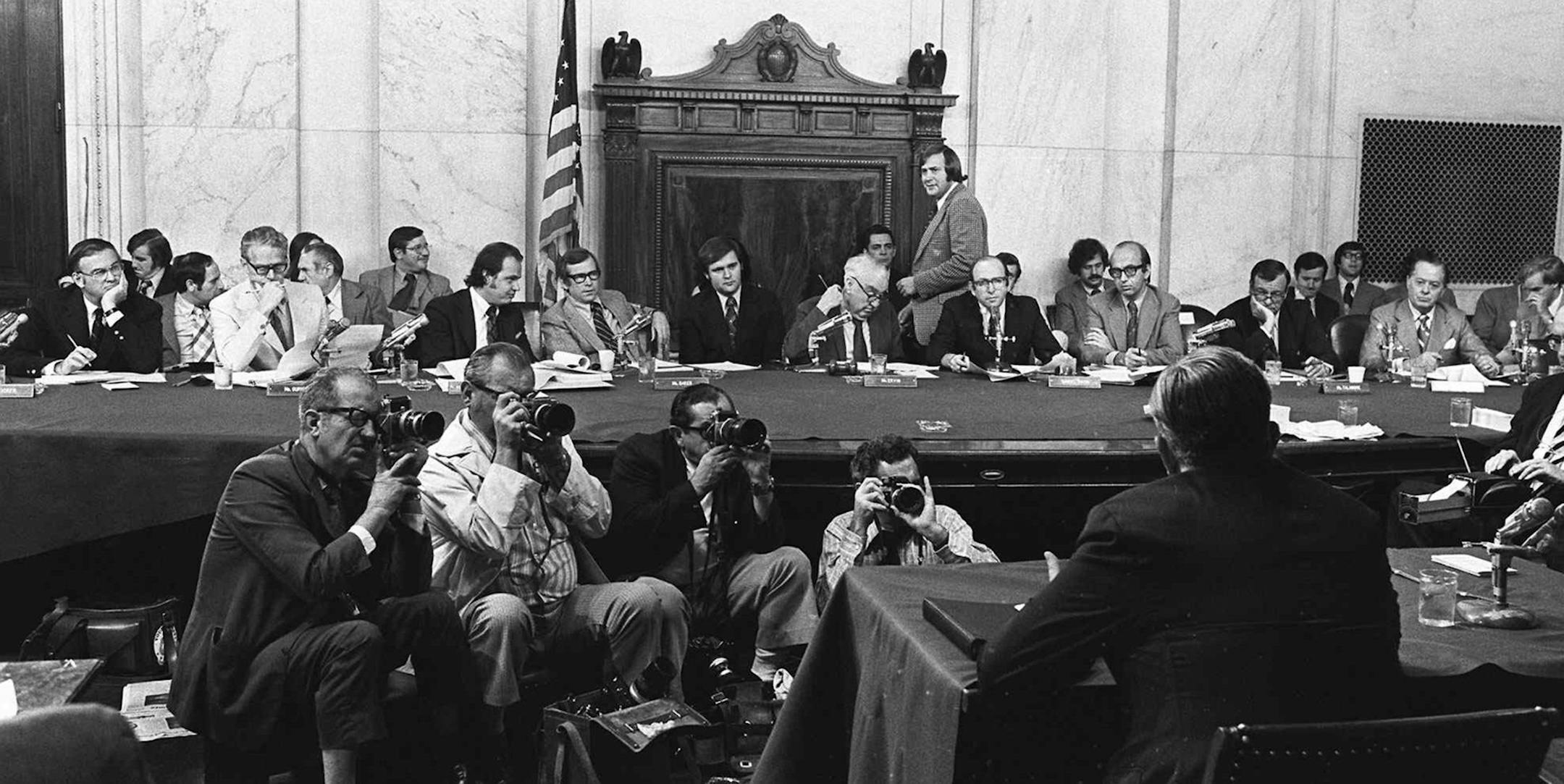
I was a 20-year-old news junkie when the Watergate hearings were initiated. I worked my viewing of live coverage around my class and work-study obligations, even as my black-and-white CRT TV set contracted some sort of tube-related virus that created a horizontal bar in the middle of the 15-inch screen. My memories of the hearings all have an annoying horizontal bar in the middle of them.
The big heroes in that era were the investigative journalists. Majors in journalism spiked for several years after that; you can look it up.
The heroes of today's hearings are State Department and national security infrastructure professionals. There could be no better legacy of this era than if people started majoring like crazy in world languages, comparative literature, political science, economics and all the other ways they might get on track for a career in the diplomatic and security services. And then all they have to do is to take their oaths seriously. And tell the truth. Even as self-proclaimed patriots mount vendettas against them.
Richard Robbins, Mankato
OUR SOCIETY
Wait … that doesn't make sense
Some mornings when I pick up the newspaper, I wonder if I've entered an alternative universe where morality in the U.S. has become completely scrambled. How can it be that the two major political parties are dithering over whether to disavow the use of disinformation (fake videos and false social media tales) in their 2020 campaigns ("Dems weigh tactics pledge," front page, Nov. 26)? How can it be that our elected officials in Congress and the White House approve laudable legislation to protect cats, dogs and horses from abuse ("Trump signs federal ban on animal cruelty," Nov. 26), when the government is detaining migrant children in inhumane conditions?
Barbara Crosby, Minneapolis
WARREN'S PROPOSED TAX
The richest households will be fine
Megan McArdle's commentary on Nov. 23 ("Warren-Booker exchange sums up Democrats' choice") wrongly assumes that Sen. Elizabeth Warren's proposed wealth tax would erode the capital base, productivity and workers' income. But it would actually increase workers' incomes. Warren's 2% wealth tax on households with more than $50 million would affect approximately 75,000 households. This tax, coupled with a billionaire surcharge, and increased corporate taxation would generate enough revenue to help fund her climate agenda, eliminate most student loan debt and invest in universal child care. These concrete programs, funded by her tax plan, would bolster workers' incomes and eliminate many of the financial hand grenades that have decimated the shrinking middle class.
McArdle remarkably claims that Warren caters to white professionals with "healthy household balance sheets." Baloney. Aside from the working-class programs listed above, Warren spearheaded the creation of the Consumer Financial Protection Bureau that established safeguards and banking regulations to stop fraudulent practices in the areas of credit cards, mortgages and student loans.
Ms. McArdle, I'm not worried about the 75,000 households affected by Warren's tax plan; I'm not worried about corporations whose tax rates were slashed from 35% to 21% under Trump's 2017 tax bill or if they'd be hurt by Warren's increased corporate taxes. They will undoubtedly continue to prosper. I'm worried about the rest of America. Warren laid out a detailed tax plan with how the revenue would be spent. No presidential nominee has ever produced such a detailed road map of what a voter can expect if she is elected. From my vantage point, she once again has our backs.
Lane Kirchner, St. Paul
RENAMING BUILDINGS
Snark doesn't solve anything
I take exception to Garrison Keillor's letter to the editor about Macalester College in the Nov. 20 Star Tribune. His premise is that, as the college takes the Edward Duffield Neill name from a building, it must similarly sever all associations that are in any way tainted with prejudice. Keillor fails to take seriously this complex issue that academic institutions face. His wit and humor is designed to kick up as much dust for the institution as possible rather than to admit the difficult challenge of addressing the most egregious expression of bias.


