
Readers Write: ICE shooting, character in public life

The rule of law is teetering.

The Minnesota Star Tribune
January 11, 2026 at 7:28PM
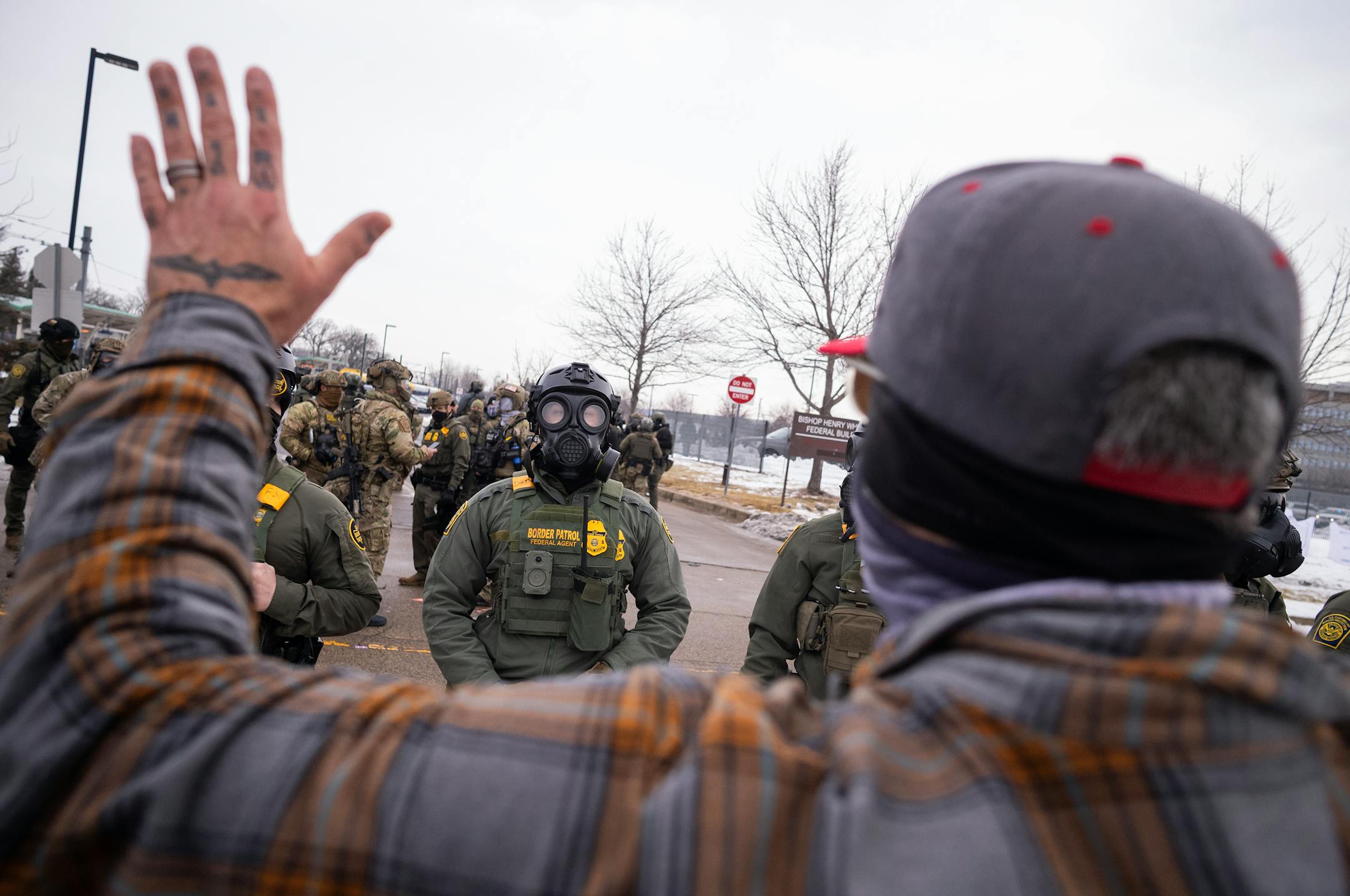
People protest against immigration agents near the the Whipple Federal Building in St. Paul on Jan. 8. (Richard Tsong-Taatarii/The Minnesota Star Tribune)

Opinion editor’s note: Strib Voices publishes letters from readers online and in print each day. To contribute, click here.

•••

“We can’t even agree on what we saw in a video. That’s a symptom of a flawed democracy.” This is according to Eric Zillmer, a neuropsychology professor at Drexel University. No! Democracy is not flawed when we disagree with an interpretation of what is shown or revealed on a video. Sports fans do this all the time. We expect and depend on empowered officials to make a judgment. Only then can we disagree with them.

A functioning democracy depends on the rule of law and resilient checks and balances limiting government power. That is what’s being threatened here in Minnesota.

Lee Beecher, Maple Grove

•••

Regarding John F. Cox III’s commentary (“What I learned as an FBI special agent about restraint in using deadly force,” Strib Voices, Jan. 9) and certain letters to the editor on Jan. 9, I would like to add another perspective to the shooting of civilians.

I spent 28 years in the military with time in several hostile environments. In every case our aggressive actions were guided by rules of engagement (ROEs). ROEs are intended to minimize, to the greatest extent possible, harm to innocent people. The result, if not the intent, was for the burden of risk to be borne by us, the trained professionals. Many a military career was ended by violating those rules and, sadly, many a military life was also lost by following them.

It is probably too much to expect law enforcement officers to be willing to follow rules as stringent as the military’s, but it is not outlandish to expect that they are trained to give extraordinary care before they use deadly force. They are, after all, contemplating the possible execution of an individual for whatever act they appear to be doing.

My point here is simply that it seems to me that the definition of a threat to a law officer that allows the use of deadly force needs to be much more clearly defined, trained and enforced. That said, I would be interested in how much of that type of training these so-called immigration officers receive.

In any event, from all video evidence I doubt very much that Renee Good’s action’s, real or alleged, deserved a death sentence.

D. Roger Pederson, Minneapolis

•••

Like so many others, I am heartsick after seeing the videos of the shooting of Good. The grief was accompanied by a surge of other emotions: shock, despair, anger and frustration. I kept asking myself, how could this have happened?

Unfortunately, almost immediately, an information war was triggered — fanning the flames of righteous anger and turning this tragedy into yet another red-blue accusatory debate. Politicians on all sides rushed to assign blame long before all the facts were known.

While the videos looked deeply troubling to me, ambiguous evidence requires time, investigation and restraint — not instant, partisan conclusions driven by outrage or political advantage. That is why I believe justice will ultimately prevail. Still, to me, patient restraint until we know more feels logical and fair, even if emotionally difficult or nearly impossible.

It is also tempting to immediately fold this tragedy into the broader and highly partisan debate over immigration, a debate that carries real complexity and legitimate disagreement on both sides. But this case, at its core, is simpler: It is either murder, or it is justified. Nothing else.

How the courts — and perhaps more important, the court of public persuasion — come to understand this case will shape the broader conversation far more constructively than reflexive outrage ever could.

Perhaps right now it is more important to grieve and lament for Good — for the loss of a mother and for the family left behind to carry this tragedy. It is also worth praying for the ICE agent, who whether in a moment of malice or fear has irrevocably altered his life as well.

Despite the shock and sadness, the hardest and most necessary response is restraint. Prudence calls us to wait until all investigations are complete rather than rush to judgment. In moments so charged with emotion and politics, restraint is not indifference or weakness; it is a moral discipline — and the foundation of justice and public trust, honoring truth and the dignity of every life touched by this tragedy.

Ward Brehm, Minneapolis

•••

I am grateful I had the opportunity to attend the early-morning protest at the Bishop Henry Whipple Federal Building on Jan. 8 to exercise my rights to protest and assemble. While it is very common for news to focus on the bombastic images of tear gas, anger and yelling, I wanted to highlight what attending this protest meant to me. Grief and love from community members grieving the loss of a neighbor. A woman providing cups of hot tea from a thermos she’d carried in. Young people offering older folks an arm so they could safely cross the treacherous, icy streets. When multiple people fell, or nearly fell, everyone nearby rushing to help them. Introductions between people of all ages and backgrounds. Some people offered to stand in front of others when tear gas and pepper spray were threatened.

What we want is for our community to be safe, and I felt safe around my fellow protesters.

Ashley Lange, Blaine

•••

President Donald Trump warned the Iranian government that the U.S. was “locked and loaded and ready to go” if it “[shoots] and violently kills peaceful protesters.” Maybe we should stop killing our own before we threaten other countries.

Peter Sandberg, Minneapolis

•••

A number of people have pointed to the fact that it is illegal to obstruct law enforcement, which is true. While video of Good’s car shows it blocking a lane, it also shows cars simply passing it in the other lane. Then the ICE truck appears and instead of just driving around, as others did, agents get out and aggressively try to drag her out of her car. They could have gone around; they could have had her move her car. What was the obstruction? Were they afraid to go around her car? Were they in a hurry to get somewhere? Death is a high price to inflict for obstruction.

Kevin Burge, Ham Lake

•••

The day after the George Floyd riots, I saw thousands of people crowding the sidewalks, many with brooms and shovels and Home Depot buckets, clearly intent on helping clean up our city.

I’m an immigrant, raised in Hurley, Wis., moved here in 1986. But that day I was proud to be part of Minneapolis. We have problems, but when you can fix your problems if you’ve got people motivated by community spirit.

I write this following our latest tragedy. There are some who would have us pack up Minnesota Nice and replace it with something less charitable to our neighbors. I hope that doesn’t happen.

Steve Nichols, Minneapolis

POLITICIANS

Good character is not outdated

I am surprised at the lack of reader response to the commentary by Jack Leslie and Ward Brehm published on Jan. 1, which should be considered consequential (“When character no longer matters, power becomes the only credential,” Strib Voices).

When was the last time you heard someone say, “She is a woman of integrity,” or, “He is a man of strong character”? Both sound jarringly anachronistic, at odds with current cultural norms and more likely to draw attention to the motives of the person speaking than to the subject of the statement itself.

Yet we lament the degradation we see in societal norms for acceptable behavior and yearn for a culture that places greater emphasis on respectful treatment of others, embodies a healthy balance of individual gain with concern for the common good and ushers a return of character to its rightful place as a central consideration in our society. Moral fiber, code of ethics, personal principles — all of these matter, and not in some abstract or indirect way. They shape our personal conduct.

Matters of character also shape our public officials’ words and actions, which directly tie to the headlines in the daily news. The irony is that despite their role, considerations of character are pushed to the bottom of the page, if they make the paper at all. We cannot expect a change in the conduct of public officials until we begin to consider matters of character to be determinants of a candidate’s basic fitness for office and give them primacy over experience, party, policies, power, influence, connections and electability.

This letter is itself an anachronism, something that could easily have been slipped without notice into the Jan. 1 letters from winters past. The authors’ commentary was no less important for all of that. If we ignore it, it’s a shame, and to the detriment of our collective welfare.

John Ibele, Minneapolis

about the writer

about the writer