
Opinion | What I learned as an FBI special agent about restraint in using deadly force

Instructors taught us that the facts on the left side of the equation — the person with a gun, the escaping felon in a car, the person running into a home or away from the agents — did not always equate to an authorized use.

January 8, 2026 at 7:36PM
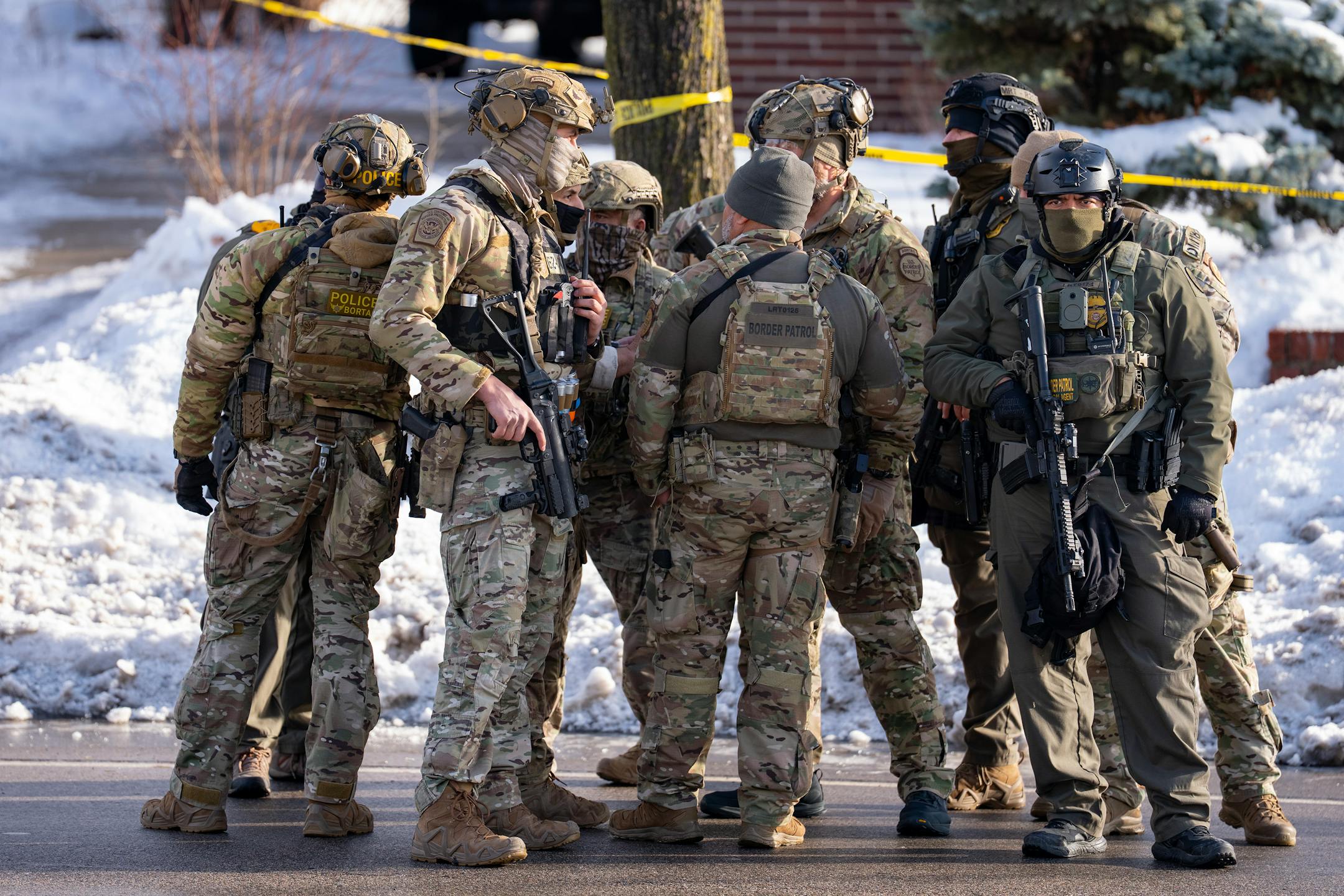
Federal agents including ICE and U.S. Border Patrol huddle near the scene where federal agents shot and killed a woman earlier in Minneapolis on Jan. 7. (Alex Kormann/The Minnesota Star Tribune)

Opinion editor’s note: Strib Voices publishes a mix of guest commentaries online and in print each day. To contribute, click here.

•••

It was my first day as an FBI special agent and some senior squad members had learned that I had previously served as a federal law clerk and an assistant U.S. Attorney. Though I had not seen the movie, I heard and understood a Sylvester Stallone character reference — judge, jury and executioner — but didn’t give it more thought. And the nickname didn’t stick.

I knew from my education and professional training that our country is one of laws. And a divided government. Legislatures enact laws, the executive departments enforce the laws, juries of our peers make determinations of guilt and innocence and judges mete out punishment and, most importantly, ensure that the process is fair.

But the second and most important reason was that the instructors at the FBI had ingrained in me and my class the integrity and paramount value of human life.

The Jan. 7 shooting of Renee Nicole Good by an Immigration and Customs Enforcement agent in Minneapolis hit home. Hard. Initially because my second daughter works in Minneapolis, and my first fear as her dad was that it was her. But second, and with genuine sympathy for all involved, the shooting took me back to a time when I was wearing that badge, carrying that gun and making those decisions.

The FBI’s emphasis on human life was the department’s and Director Louis Freeh’s edict embodied in the attorney general’s Oct. 17, 1995, Memorandum on Resolution 14 — the then new Department of Justice’s Use of Deadly Force policy — which came to life after an Aug. 22, 1992, firefight where Deputy U.S. Marshal William Degan died, along with Randy Weaver’s 14-year-old son, on Ruby Ridge. The rules of engagement during the standoff that followed were improvised — agents were instructed that they “can and should shoot any armed male.” Sadly, an FBI sniper’s second shot, fired from a distance during that standoff, caused the unintended death of Randy Weaver’s wife. She had been unobservable to the sniper behind a door when he fired at an armed male. The irony is not lost on me that that shot, 30 years ago, called to action and drove the Department of Justice to issue a uniform policy recognizing and elevating the value of human life over immediate apprehension or even, to some, agent safety.

But back then I didn’t know any different than that an FBI special agent was authorized to use deadly force when the agent had a reasonable belief that there was an imminent danger of death or serious bodily injury to agents or others and there was no safe alternative to its use. That second factor, the absence of a safe alternative, was key. Through the use of hypothetical scenarios, the instructors taught us that the facts on the left side of the equation — the person with a gun, the escaping felon in a car, the person running into a home or away from the agents — did not always equate to an authorized use of deadly force. It was Freeh’s prescience to impose a limitation — the absence of a safe alternative, a requirement above the applicable constitutional standard — that gave human life its paramount value.

And here, the department’s October 1995 guidance could not have been clearer. It expressed its “full commitment to take all reasonable steps to prevent the need to use deadly force” as reflected in its training and procedures. And where deadly force might be used, “in keeping with the value of protecting all human life, the touchstone of the Department’s policy regarding the use of deadly force is necessity” (emphasis in original). According to the department, “[t]he necessity to use deadly force arises when all other available means of preventing imminent and grave danger to officers or other persons have failed or would be likely to fail.”

This higher standard meant that while an agent might use deadly force after a person refused an agent’s lawful order to drop his or her gun, deadly force would not be appropriate if the agent was a safe distance away with a position of cover when he or she refused to do so. It meant that when agents attempted to arrest a person for bank fraud and he or she ran into their home, agents were not authorized to shoot under the policy even though the risks to them were now arguably greater, as the person could now have access to a weapon that might be inside and could have gained the use of cover and concealment to shoot.

As the FBI Law Enforcement Bulletin recognized in its April 1996 issue, the department’s policy did not require agents to consider alternatives to the use of deadly force that increased risk to themselves. But “if a safe alternative to the use of deadly force is likely to achieve the purpose of averting an imminent danger, deadly force is not necessary.” And, therefore, not authorized. Factors weighing to safely seizing a person without employing deadly force included using verbal warnings, the availability of cover and law enforcement reality of action beating reaction. Also important was the uncomfortable reality that the application of deadly force does not often result in immediate incapacitation and an end to an imminent threat.

The policy had an additional important factor. The application of deadly force could not pose a danger to third parties that outweighed the benefits of its use. Under the policy it would be unreasonable to shoot at a fleeing armed subject who had committed a violent crime as that subject ran into a crowd, or perhaps was present in an apartment occupied by third parties, because that shot or shots would create danger to others which would outweigh the likely benefits of its use.

The department’s policy set the standard. The scenarios taught us judgment. Judgment of when the use of deadly force was appropriate under the policy, and when it was not. Two things became crystal-clear. First, the presence of imminent danger did not always justify the use of deadly force. A determination had to be made: Was this use necessary under the circumstances or, in other words, was there a safe alternative? Perhaps step out of the way of a vehicle, or don’t stand in front of it in the first place? And second, that in performing this calculus the agent was invariably increasing the risk to his or herself, because the calculus took time. Despite the guidance that the policy was not intended to increase risk to the agent it inevitably did.

But the trade-off made sense. At least to me. Like Freeh, I too believed in the paramount value of human life. And while I had accepted the authority to use deadly force in becoming a special agent, and carefully assessed those factors constantly during my ensuing service on various FBI violent crime squads and task forces, I did not want to be called Judge Dredd.

John F. Cox III served as a federal law clerk in the Eastern District of Virginia, an assistant U.S. Attorney in Washington, D.C., and as an FBI supervisory special agent. He served on various FBI violent crime squads before joining the FBI/Metropolitan Police Department Cold Case Squad in Washington, D.C. The views expressed here are his own.

about the writer

about the writer

John F. Cox III

More from Commentaries

See More
card image
Alex Kormann/The Minnesota Star Tribune

The staff member who was taken by immigration enforcement greeted my kids by name, wiped tears, tied shoes and helped create the stable environment every child deserves.

card image
card image