
Readers Write: Guns, the future of energy, political whiplash

Requiring trigger locks on guns in public wouldn’t help.

The Minnesota Star Tribune
November 28, 2025 at 12:00AM
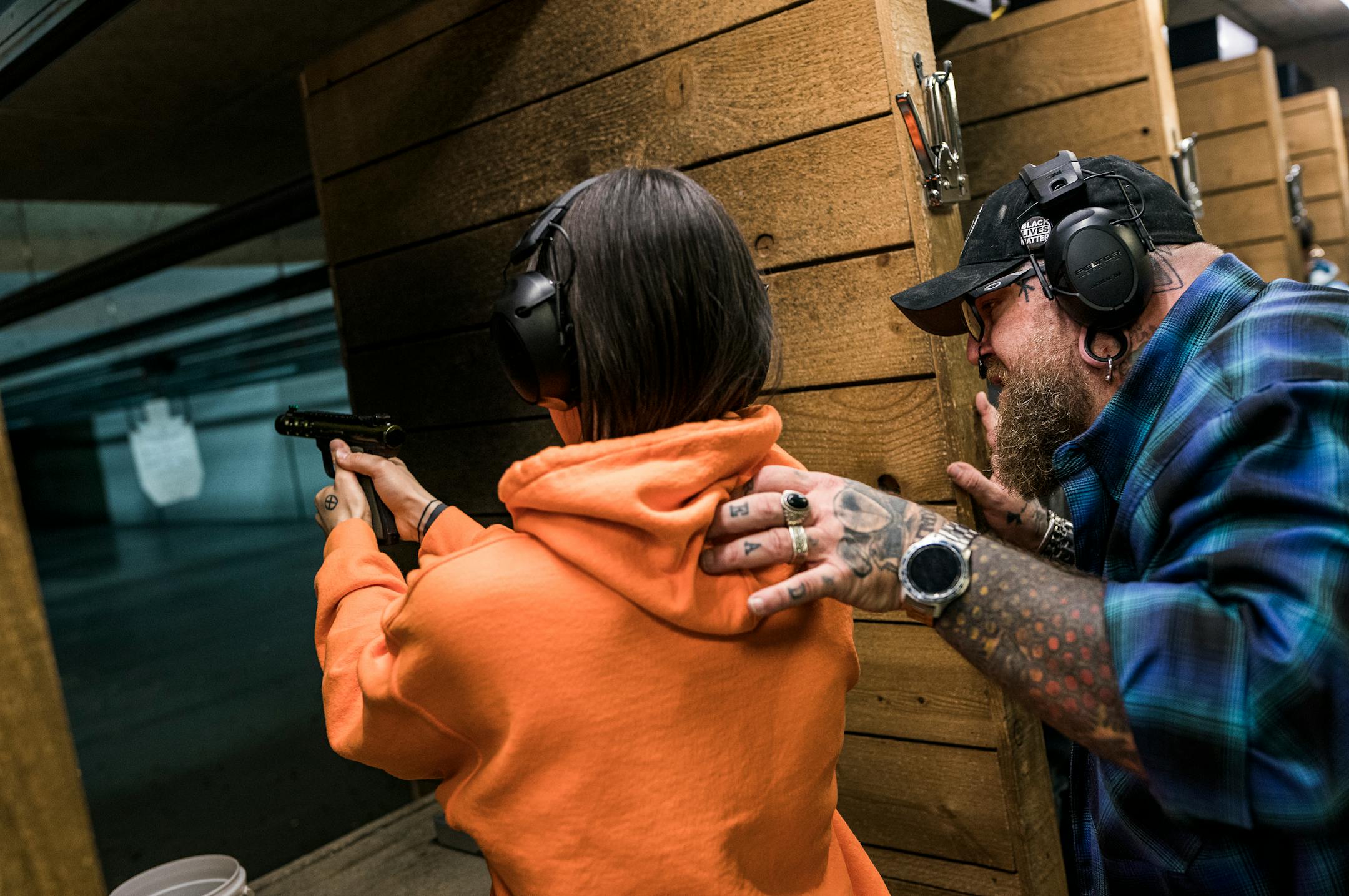
Firearms instructor Mick Sharpe tutors his carry permit student Alex Mars at Stock & Barrel Gun Club in 2022. (Richard Tsong-Taatarii/The Minnesota Star Tribune)

Opinion editor’s note: Strib Voices publishes letters from readers online and in print each day. To contribute, click here.

•••

Writer John Zwier would have been better served if he had read John Davey’s piece “Why learn about firearms?” (Strib Voices, Nov. 18) before submitting his inane commentary, “All firearms out in public should have visible trigger locks” (Strib Voices, Nov. 18). First, firearms don’t have rights; we the people have rights, specifically that right under the U.S. Constitution — a fact an assistant Minnesota attorney general should be aware of. Second, what firearms in public do you ever see with the trigger visible? Pistols are typically holstered when carried, and even open carry in a holster covers the trigger. Are hunters with a rifle on state land rapidly unlocking the trigger guard when a deer appears? Finally, his argument that this rule would buy time for law enforcement is asinine: Someone looking to perpetrate violence is not going to worry about legally locking their firearm before approaching the scene of the crime. Zwier, please reach out to any responsible gun owner and talk to them just once — you’ll be better educated for your career and for life.

Gary Myers, Carver

•••

Reports of gun violence and mass shootings have flooded Minnesota news in recent months. The tragedies at Annunciation Church, Cristo Rey Jesuit High School and one of Minneapolis’ homeless encampments have led to a renewed wave of support for gun regulation, leading to St. Paul’s ban on assault weapons on Nov. 12. Although the ordinance is currently unenforceable, I hope for future change at the state level.

As a prospective social worker and current master’s of social work student, I would like to draw attention to the role of social work in the prevention of mass acts of violence and in the healing process following these tragedies. Social workers are among the first responders to emergencies such as these, providing immediate support to witnesses and survivors. Following traumatic events, social work practitioners continue to provide counseling to victims, families and communities impacted by acts of mass violence.

Specifically in Minnesota, the Next Step program assisted in the aftermath of the Annunciation mass shooting. Since 2016, Next Step has worked to prevent community violence, support healing for survivors and families, and to educate communities on violence prevention. Only a month prior to the Annunciation shooting, the Trump administration cut Minnesota’s funding for preventative programs like Next Step, further proving the need for social work involvement in community safety and well-being. I believe that acknowledging the importance of this work is especially necessary amid serious cuts to funding for social services that are very much needed in our communities.

Molly Redmond, Plymouth

•••

Regarding guns, may we migrate from the barren landscape of vacuous slogans and enter the lush forest of real conversation. May we truly listen to the fears of our brothers and sisters, instead of mentally reloading while they opine. And may we courageously engage in a little less conversation and a lot more action!

Justin Vorbach, Marshall, Minn.

THE FUTURE OF ENERGY

Not particularly reassured

A recent article from the Associated Press republished by the Star Tribune (“Demand for electricity to outpace energy growth,” Nov. 13) details the challenges facing the world in global energy production, and the International Energy Agency’s (IEA) forecasts regarding the future. While the IEA does recognize global challenges, its prediction for a 2030 peak of oil and gas demands is far too optimistic given the current political environment, and assumptions that they make about available technologies. Acknowledged in their report is the increasing expansion of energy needs to less developed countries, some without electricity. While expanding access is a good thing, lack of investment means oil and gas remain cheap, and thus attractive options for developing nations. In addition, political pressure from developed countries is forcing a timeline change. According to the New York Times, pressure from the Trump administration has forced the IEA to release a “current policies” scenario. This shows that, far from capping demand around 2030, the current trajectory would see ever-increasing demand, a less-than-optimistic thought.

Even if the IEA’s plans were to succeed, this business-as-usual approach would not be enough. According to analysis by Oil Change International, the peak at 2030 would lead to 2.5 degrees Celsius of warming, much higher than the assumed 1.5 degrees, unless we are actively reversing our carbon emissions. With these flaws in mind, it is hard to be reassured by the IEA’s projection, or the current actions of our leaders.

Benjamin Ryan, St. Peter

•••

Culturally I see passivity as we wait for governments and utilities to provide more sustainable options for energy. As community-minded individuals, I encourage us to actively reduce energy consumption — not just change the source, say from fossil fuels to electric. Whether it’s to promote responsibility with the world’s precious metals or sustainability in our grid capacity, or reduce radioactive waste, or decrease pollution of all kinds, I urge us to work as a community to attend to the “reduce” element in the mantra of “reduce, reuse, recycle.” Anything that you can do with your body, instead of using external power, is better for our immediate personal health and the long-term environmental health. If inconvenience tempts us to delay changing, consider how inconvenient it will be for our children and grandchildren to not be able to safely breathe the air or drink the water.

Many ways to reduce energy consumption can be found by critically examining habits. Turn off the car if you aren’t driving. Dress for the weather. Don’t give that able-bodied child an e-bike. Instead of blowing those leaves, skip your gym workout and rake. Walk or bike for local errands or trips. Hang out your laundry to dry. The list goes on. What works for one may not work for all, but please, let’s each try to find ways to reduce.

Marynia Wronski, Minneapolis

POLITICS

Grow up and compromise

The current state of political affairs inspires me to point out the obvious: There’s no such thing as a “mandate” when a fluctuating majority/minority isn’t seeing the immediately overpromised benefits. Our current model of a back-and-forth, every-few-years power-grab contest presents the dysfunctional facade of governing the American people and yet somehow, most people seem to think it’s because the “other” side is clueless. Democracy has never been a winner-take-all proposition when it’s working well. We need to put together enough adults in the room that can see a future longer ahead than a four- or even eight-year election cycle. How can it be more obvious that even though you get a majority of votes in this election, if you ignore the concerns and opinions of the current revolving-door minority, all your policies will be dust when you lose the next election?

Ideology can only drag us so far until it meets cold, hard reality. Compromise and seeing things from another perspective is not weakness; it’s operating as a functional adult. It’s not about right and wrong or about being “nice” but instead about what works and what doesn’t. Clearly, our current winner-take-all approach is not working!

Connie Clabots, Brooklyn Center

about the writer

about the writer