

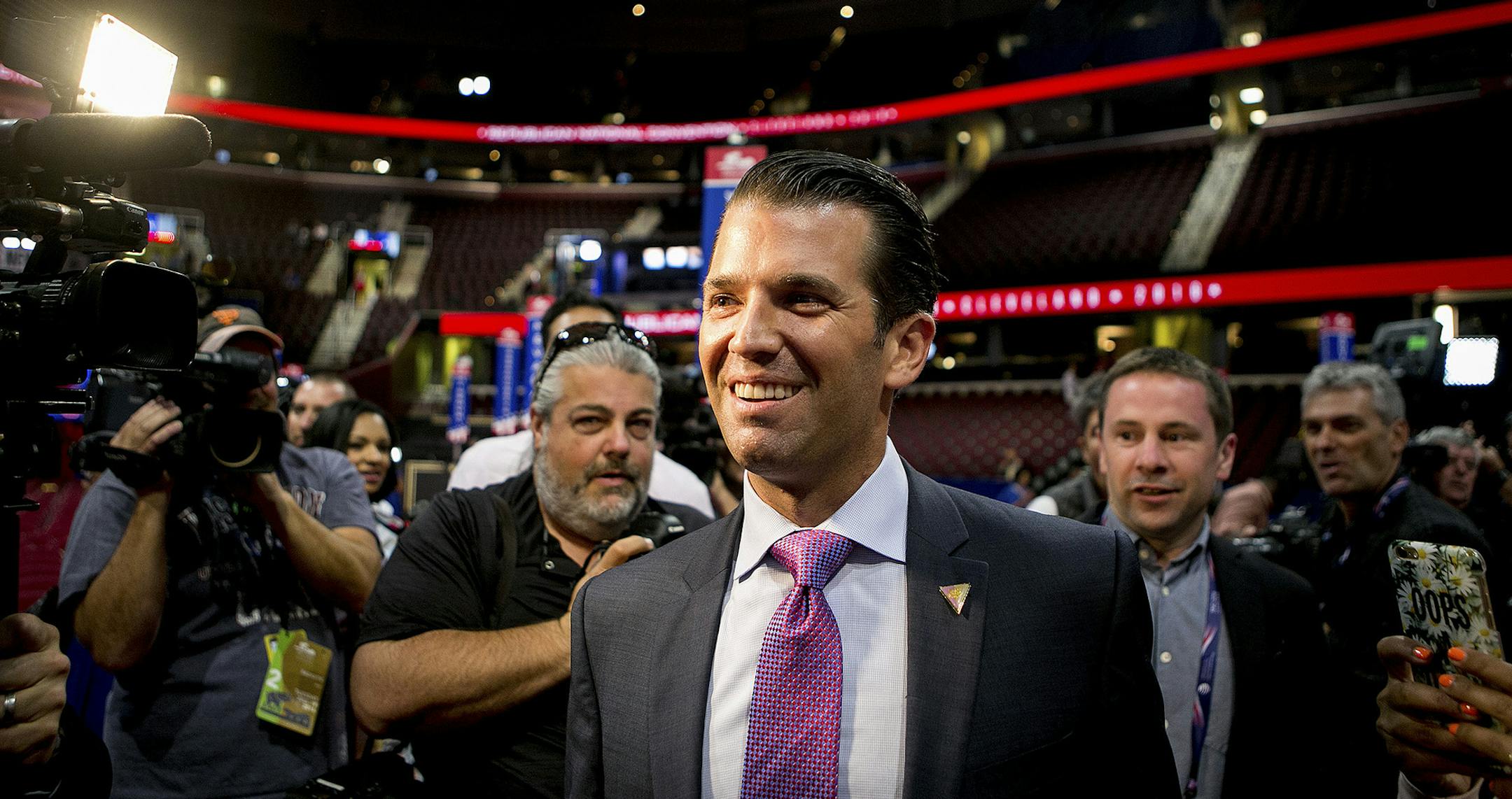
If a U.S. citizen working for a presidential campaign is contacted by a foreign government that is willing to give damaging information about a competitor's campaign and that person agrees to the meeting, is that not a foreign government interfering with our democratic process with the consent of a campaign member? I call that collusion. That foreign government then knows that this party (Donald Trump's) will accept its help in defeating the candidate it wishes not to win (Hillary Clinton). Yes, Donald Trump Jr. colluded with Russia on behalf of his father, and who would ever believe that his father did not know about it or encourage it?
Sandra Hanf, Deephaven
PARTY ENDORSEMENTS
That's right — they're obsolete; voters prefer open contests
Older folks (like me) sometimes miss the reassuring comfort of "Uncle" Walter Cronkite telling us "that's the way it is" as the world seemed to spin out of control. Yet we also know today's world is way too complicated to sum up with one simple worldview. That's why political party endorsements are going the same way as the old three broadcast network monopoly ("Twin Cities DFLers consider: Are endorsements obsolete?" July 3). Voters want choices and to think for themselves. They also demand enough information to weigh all of their choices before going to the polls.
Uncle Walter no longer can tell us how to frame daily events, and increasingly out-of-date political processes cannot dictate how to vote. Rather than adapt to changing times, some political stalwarts are blaming ranked-choice voting (RCV) for "destroying" the political nomination process.
To quote Ann Landers (another reassuring voice from the past): "Wake up and smell the coffee!"
The truth is, with or without RCV, party endorsements — especially in big-stake, nonpartisan races — don't count with rank-and-file voters like they used to.
Fortunately, the full complement of candidates in this year's mayoral races in Minneapolis and St. Paul will compete for the hearts of voters in November, rather than be winnowed by a small group of party faithful who vote in the primary. And voters will be able to rank their preferences, knowing that if their first choice doesn't make it through the first round, their second choice can count. Candidates elected under an RCV system must strive for the support of a majority (50 percent plus one), so they have a natural incentive to put away their black-and-white hats and think realistically about what may be the best solutions for the majority of people they seek to serve.
Ellen Brown, St. Paul
ELECTRIC CAR CHARGING NETWORK
State agencies are plotting to support a niche market
In reading "Will Minnesotans plug into the electric car surge?" (July 10), I failed to see an important aspect spelled out. With over 5.25 million registered vehicles in Minnesota, 1,600 electric cars constitute a niche market. As a minuscule bump in electric cars is expected, leave it up to public policy to cater to the novelty. The feds already provide for a substantial tax refund. Nowhere in the piece did the author mention what the cost would be for a "charge." I assume, therefore, that the energy is free.
The notion that government must provide for charging stations on the taxpayer dime is an outrage! How can it be justified that this should be provided at a convenient roadside location? Are these owners more virtuous because they perceive to be fighting climate change? Electricity doesn't magically come out of a plug-in. There is a cost to the equipment, infrastructure, maintenance and the power generation. Leave it to government to prove that, once again, you can't make this stuff up!


