
Readers Write: Birthright citizenship, St. Paul’s finances, local income taxes, George Floyd Square

Trump is right on birthright citizenship.

The Minnesota Star Tribune
December 10, 2025 at 12:00AM
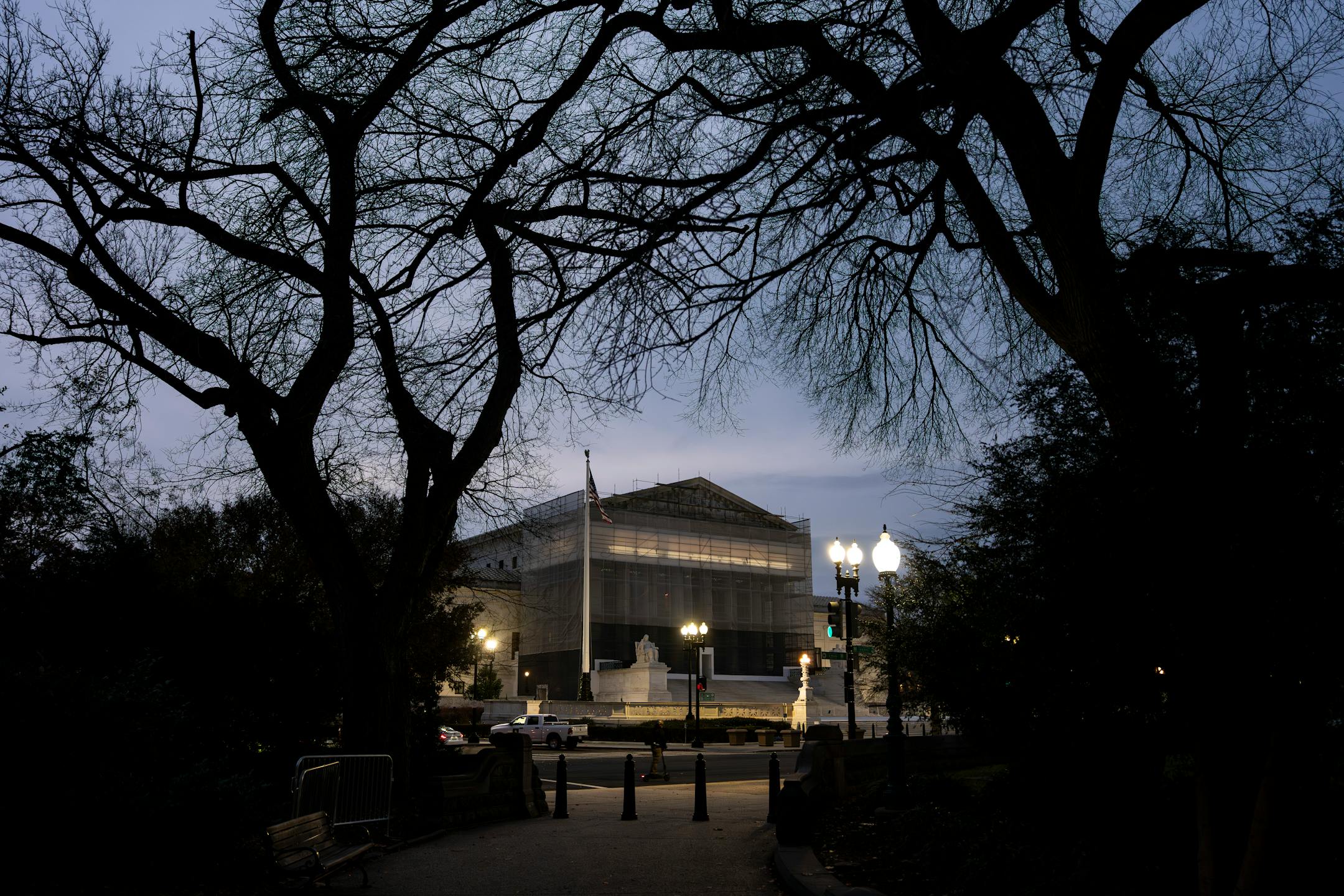
The Supreme Court in Washington, D.C., on Dec. 8. (AL DRAGO/The New York Times)

Opinion editor’s note: Strib Voices publishes letters from readers online and in print each day. To contribute, click here.

•••

The Supreme Court has agreed to hear President Donald Trump’s executive order ending birthright citizenship for the children of illegal immigrants. The case primarily turns on five words in the 14th Amendment: “and subject to the jurisdiction thereof.”

That conjunction does real work. The clause establishes two conditions for citizenship: birth on U.S. soil and subjection to U.S. jurisdiction. The second requirement cannot mean mere physical presence — the Supreme Court in Wong Kim Ark affirmed traditional exceptions for children of foreign diplomats, those born on foreign ships and enemy occupiers. These exceptions prove the jurisdiction clause limits automatic citizenship.

Originalist scholarship reinforces this reading. Professor Ilan Wurman of the University of Minnesota demonstrates the amendment requires complete municipal jurisdiction, not territorial presence alone. At minimum, this analysis proves birthright citizenship’s scope remains genuinely disputed. At best, it restores the clause’s original meaning, one that never extended to children of people here illegally in the first place.

The current “any birth equals citizenship” rule inflicts real damage. Citizenship embodies a covenant: The community claims the citizen, and the citizen pledges allegiance. When membership becomes a geographic accident, we destroy civic belonging.

The rule invites exploitation. Birth tourism thrives because we reward circumventing legal channels. A Constitution that does so becomes an engine of its own subversion. Serious nations guard their membership. Great powers don’t survive by making foundational laws easy marks. America shouldn’t either.

Ultimately, the executive order deserves enforcement. So, does the court have the courage to say so?

Jimmy Murphy, Golden Valley

•••

We should be getting a 9-0 ruling from the Supreme Court striking down Trump’s executive order declaring that children born in the U.S. to undocumented immigrants (both father and mother?) would no longer be entitled to U.S. citizenship. If Trump can do this by executive order, can the next president undo it by executive order? How frequently could the law change to accommodate presidential whims? Can a president undo years of understanding under the Constitution by a simple-minded and biased executive order? What other constitutional standards could be abolished by presidential decree? This should be an easy case for unanimous decision.

Thomas Wexler, Edina

The writer is a retired Hennepin County district judge.

ST. PAUL

Perform basic functions, please

Once again the city of St. Paul has ventured outside the ordinary responsibilities of a city and the result has been failure and financial loss at taxpayer expense (“St. Paul tells nonprofit to return funds,” Dec. 8).

St. Paul paid nearly $1 million to Maryland-based BlackFem to provide “financial literacy lessons” for elementary schoolchildren, and nothing has been delivered. One wonders what the city had in mind. If you go to BlackFem’s website, the first page reads, “We are a wealth justice organization. We are not a financial literacy organization.” The organization states that it exists to “reimagine wealth-building opportunities for Black women” by “healing financial trauma.”

It’s bad enough that the city is sticking its nose in the education sphere and has not received any deliverables. More astounding is the fact that the city kept advancing money to BlackFem even after delays and blown deadlines. Now the matter has festered into a federal lawsuit that will cost the city even more money.

Though the Star Tribune describes (without attribution) St. Paul’s CollegeBound program as “one of Mayor Melvin Carter’s most notable achievements,” it has been a wasteful foray into an area outside the city’s core function. It is another example of why the city of St. Paul needs financial literacy lessons more than kindergartners do.

Carolyn V. Wolski, St. Paul

MINNEAPOLIS

Run far away from a local income tax

As a Minnesotan now living in Michigan, I read with interest Minneapolis Board of Estimate and Taxation President Steve Brandt’s opinion piece, “Minneapolis needs an alternative to rising property taxes” (Strib Voices, Dec. 5). Before Minnesotans get excited about a local income tax, I’d encourage them to investigate Detroit’s finances leading up to its 2013 bankruptcy. In 2012, Detroit had the highest local income tax and property tax rates in Michigan. Meanwhile, almost none of its suburbs levied a local income tax. Detroit started the local income tax at 1%, which soon grew to 2% and then 3%. Every time Detroit raised tax rates, revenues would spike upward and then quickly resume their downward trend as rising taxes incentivized people and corporations to leave. My main issue with a Minneapolis local income tax is that it would send a very strong message to leave the city. It is basically bribing people to move to the suburbs.

Compared to property taxes, a local income tax is much more transparent. Every savvy Michigan taxpayer knows which communities levy a local income tax and can quickly calculate how much a 2% income tax will cost. On the other hand, a property tax bill has amounts for city and county government, watershed districts, parks, mosquito control, transit, schools and more, so it is harder to directly compare bills between cities. Another downside is that a local income tax is a pain to calculate for nonresidents who work at employers with facilities inside and outside the city.

Minnesotans won’t like a local income tax.

Mark Bjelland, Grand Rapids, Mich.

GEORGE FLOYD SQUARE

Stop stalling, for goodness’ sake

Bravo for the submission by Matt Stoltman on the sadly stalled renewal of George Floyd Square in south Minneapolis (“Minneapolis City Council can still do the right thing for George Floyd Square,” Strib Voices, Dec. 8). He provides an excellent recent historical context for the stalling and the City Council decisions to date. There is no sound reason for the City Council decision to impose a “pedestrian plaza” as the new format for the square. Council Member Jason Chavez, as the leader of this idea, and other members have completely ignored the repeated neighborhood surveys on the best solution for the square and the key intersection. The Public Works plan of a year ago is the best solution — it was well-thought-out and incorporated the neighborhood survey results. This plan both gives due honor to Floyd and also provides a practical solution for the health of local businesses and for thoughtful public transportation needs.

The City Council in its next vote needs to honor the hard and considered work of the Public Works team.

Robert Lyman, Minneapolis

SELF-DRIVING CARS

From doubt to admiration

We spent Thanksgiving on the West Coast, including a few days in San Francisco. Everywhere we looked we saw white Waymo Jaguars. While unsure when I first heard of driverless vehicles, I knew this was our chance to try them out. Boy, were we impressed! We felt safe, comfortable (I mean, riding in a Jag) and opted in for at least seven trips during our visit. A screen allowed us to see our destination time, control the temperature and choose the music. It was like riding in a private limo with an experienced, confident driver! And when the vehicle pulls up, your initials are on the roof sensor to help you locate your car amid the many Waymos passing by.

We saved money on the high parking rates and a big bonus: no bickering over routes, getting lost, etc.!

We’re sold. Welcome to Minneapolis, Waymo!

Elaine Love, Shorewood

about the writer

about the writer