
Readers Write: Assisted living, aging, military service

Amid valid concerns about senior living, we found great care.

The Minnesota Star Tribune
September 28, 2025 at 8:58PM
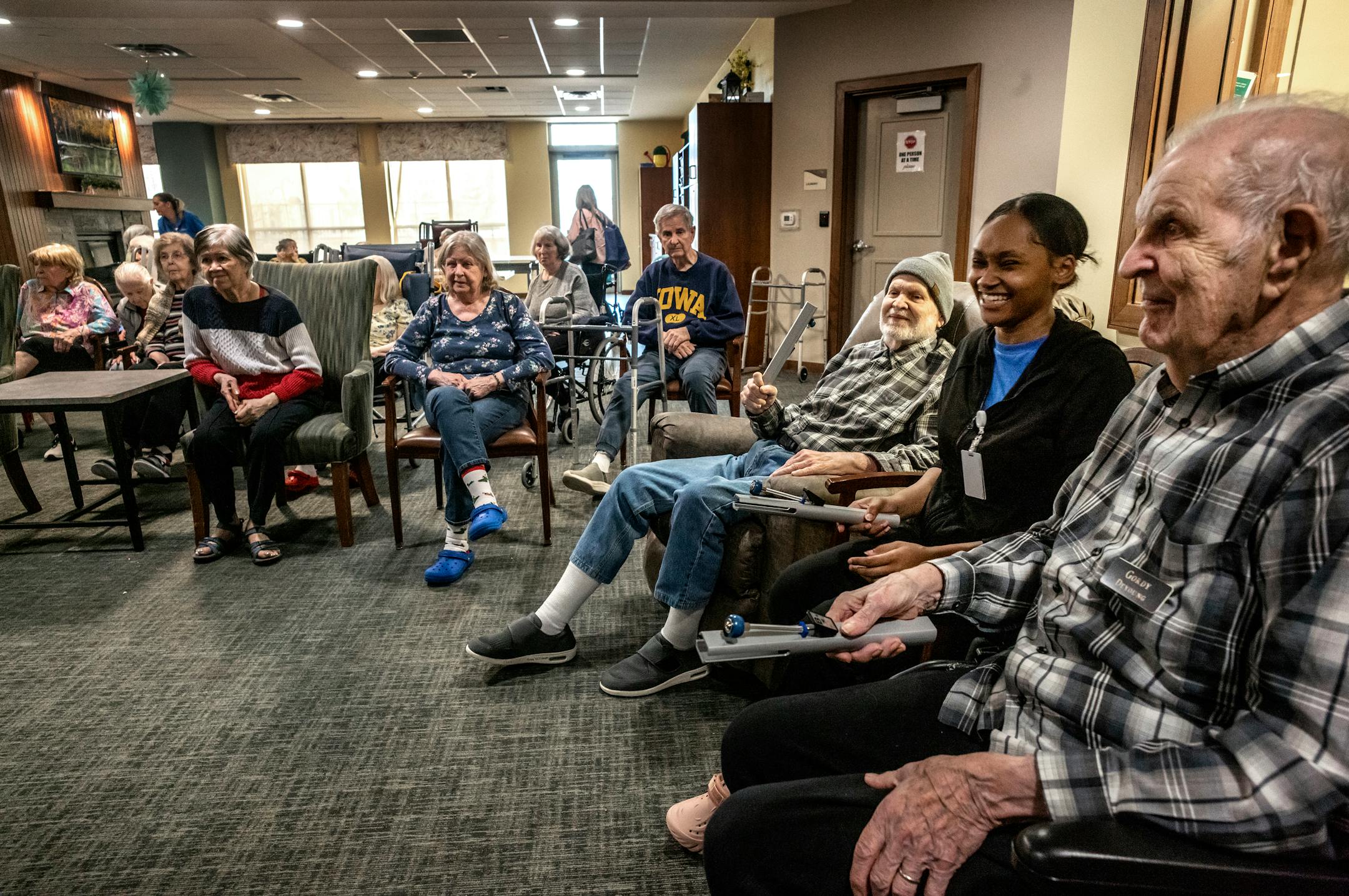
Memory care residents attend a bell choir class at the Aurora on France senior living facility in Edina in 2024. (Jerry Holt/The Minnesota Star Tribune)

Opinion editor’s note: Strib Voices publishes letters from readers online and in print each day. To contribute, click here.

•••

I read with concern the recent article “More seniors are moving into assisted living, not nursing homes. That could be problematic” (StarTribune.com, Sept. 26). While your piece raises important points about quality and safety concerns, I would like to share a very different experience — one rooted in gratitude and respect for the assisted-living community that cared for my mother.

My mother moved into an assisted-living community one-and-a-half years ago. For eight years prior to that, she had been living in her own independent-living apartment in the same building — St. Therese of Woodbury. She spent several weeks in transitional care after a fall and then moved to assisted living as she needed an additional level of care. I cannot speak highly enough about the care she received, from transitional care to assisted living. Having the full continuum of care on the same campus was one of the most important reasons we selected the senior living community we did.

The staff knew her by name, encouraged her and celebrated her victories, and partnered with her physician and nursing staff to monitor her health. If she ever had a concern — no matter how small — staff listened. I saw them respond quickly, adjusting care plans and arranging physical therapy. My mother’s social life continued to blossom, as well. She enjoyed participating in church services, shared meals and good conversations daily with neighbors, friends and staff.

Yes, assisted living facilities are not without challenges. But my mother’s experience counters a one-size-fits-all view. In her community, she was safe, socially engaged, had her medical needs met and was in a community where she belonged and was respected. We visited often and never hesitated to voice questions; we always received respectful, fact-based answers.

I urge readers and policymakers: Don’t paint all assisted living communities with a broad brush of concern. There are thousands of Minnesotans who call assisted-living communities home, and the majority of those facilities provide exceptional care and support to their residents every day.

Ann Tinucci, Woodbury

AGING

Don’t just accept unusual symptoms

By the age of 80, my dad had run over 50 marathons, climbed Mount Rainier and, all through his 70s, still lifted weights five days a week. After a severe injury and surgery last December, he experienced dizziness and brain fog that lingered for months. When he asked his doctor if these symptoms could be related to his medications, the answer was blunt: “You’re just 80. These things happen as you age.” That answer was not acceptable — and it shouldn’t be for any older adult.

As his daughter — and a neuropsychologist with 18 years of experience — I knew enough to be concerned. Reviewing his medications, I noticed gabapentin, prescribed for the week before surgery, was still being taken even though he no longer had pain. One of gabapentin’s most common side effects is dizziness and brain fog.

We brought this to his physician’s attention. My dad requested to discontinue the medication. The doctor agreed, set a taper schedule, and he has since stopped it. Almost immediately, the lingering fog began to lift.

This experience taught me two critical lessons: one for physicians and one for older adults.

For physicians treating older adults: Don’t assume new symptoms are “just due to aging.” Consider each patient’s baseline, health trajectory and recent events. Listen carefully to their concerns, and take questions seriously. Regularly review medication lists. Many drugs commonly prescribed to older adults — including sedatives, pain medications and certain blood pressure medications — are linked to increased risks of falls, hospitalization and even death. Sometimes, the simplest intervention — a careful medication review — can restore months of lost function and vitality.

For older adults: Trust your instincts. Ask questions. Don’t assume the first answer is the only answer. Don’t accept medication side effects as inevitable. Aging is not a life sentence to dizziness, brain fog or inactivity. At 80, my dad’s life is far from over; he is beginning a new chapter of active, healthy living.

After stopping gabapentin, I hope he will enjoy another 15 to 20 years of hiking, lifting, running and embracing life fully. Our story reminds me that age should never be the default explanation for new symptoms. Medications matter, voices matter and listening can profoundly change quality of life.

For older adults and their physicians alike, it’s worth pausing, reviewing and asking: Could this symptom be caused by something other than age? Often, the answer can be life-changing.

Liz Adams, St. Paul

The writer is a neuropsychologist.

MILITARY SERVICE

What veterans really fought for

Thank you to John Rash for his column on the return of Korean War veteran Sgt. Rosslyn Edward Gresens and the moving tribute paid to him by the Hill City community (“After 75 years, Korean War sergeant finally at rest, at home,” Strib Voices, Sept. 24).

My father served in Korea during the Vietnam War and recently returned to the country through the Revisit Korea program, organized by the Korea Defense Veterans Association. Although he rarely speaks about his service, he shared how deeply moved he was by the respect and reverence shown by the Korean people. He never expected to return — especially under circumstances that allowed him to reflect on his experience and connect with those genuinely grateful for his sacrifice. Contrast that with the recent Immigration and Customs Enforcement raid in Georgia, where legal Korean workers had their rights violated and were treated like criminals. Generations of goodwill are being jeopardized by racist ignorance and fearmongering from this administration.

I believe international cooperation and human connection are the only paths forward. Let us all take a moment to honor the brave men and women who fought for a world where truth, liberty and solidarity prevail — not fear and prejudice.

Nick Hansen, Lakeville

•••

My dad spent 25 years in the Navy, coming from a small farm in Nebraska, enlisting at 18, becoming a machinist and spending most of the next 25 years of his life on submarines. He was at Pearl Harbor on Dec. 7, 1941, when the Japanese bombed the island. My brother and sister and I grew up with a solid understanding of respect and honor for our country.

After my dad retired in the early 1960, we were watching the evening news and videos of American flags being burned by American protesters over the U.S.’ actions in the Vietnam War. He sat very quietly and studied the videos. I watched his every move, wondering what his reaction would be to this horrible action. Then he said: “I guess that is what I fought for.” That’s all he said.

I cannot understand how President Donald Trump, a billionaire who never spent a second in the military, can criticize any individual who express their peaceful disagreement with our government and its actions. How is it that my father, after spending all those years in our country’s service, got it? He didn’t like it, but he got it. “I guess that is what I fought for.” Our freedom to express without fear. Too bad Trump doesn’t get it.

Ron Ray, Laporte, Minn.

about the writer

about the writer