
Readers Write: Affordable health care, Lisa Demuth’s gubernatorial campaign

It’s the same conversation, again.

The Minnesota Star Tribune
November 15, 2025 at 9:30PM
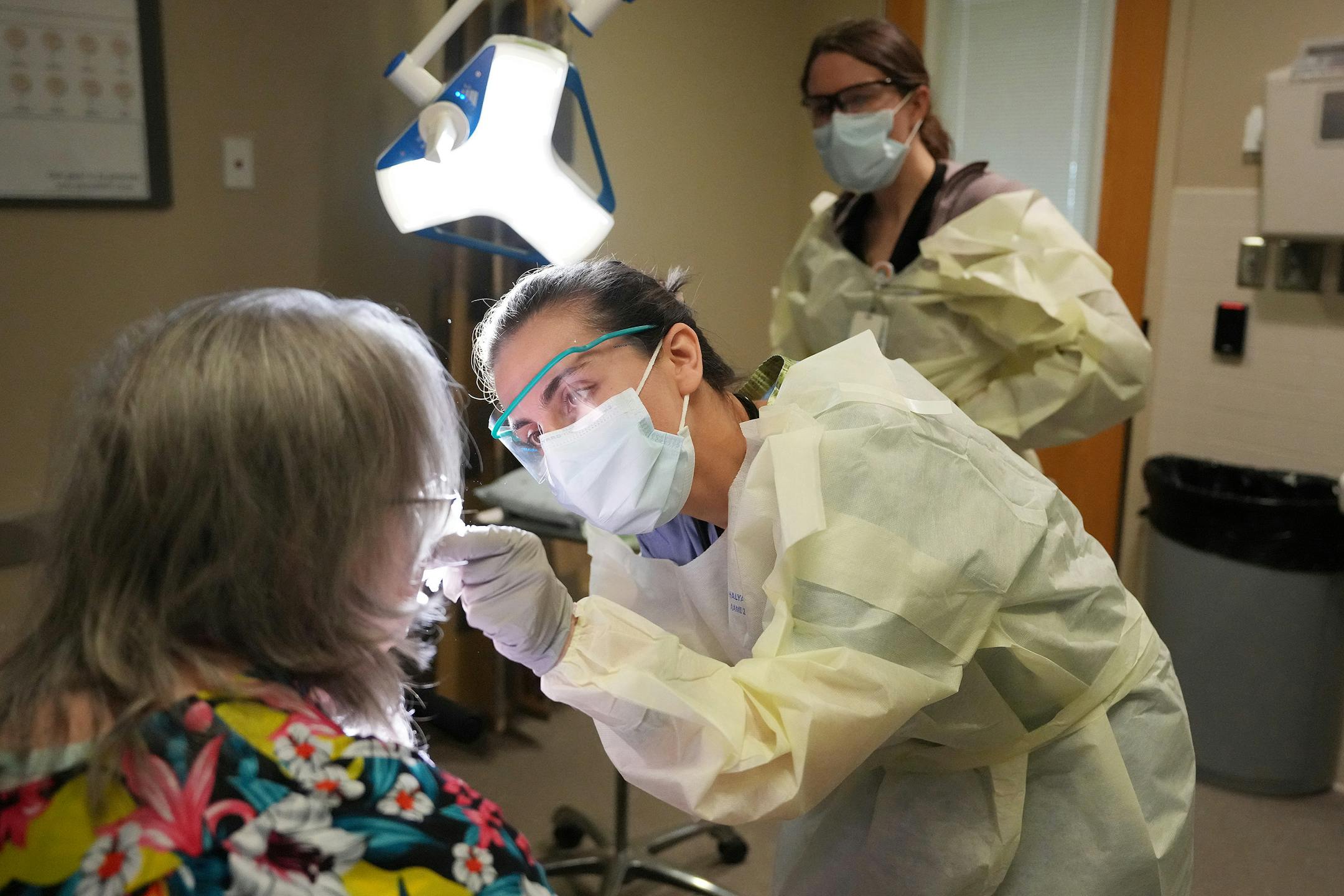
A doctor at Sanford Bemidji Medical Center treats a patient's bloody nose in February in Bemidji, Minn. (Anthony Soufflé/The Minnesota Star Tribune)

Opinion editor’s note: Strib Voices publishes letters from readers online and in print each day. To contribute, click here.

•••

We all want the same thing: affordable health care. Yet year after year, we end up in the same circular argument about how to get there. It’s like the harsh seasonal reality every Minnesotan knows too well: Potholes (“A single-payer insurance plan administered by Minnesota would help a lot,” Strib Voices, Nov. 8).

Democrats, for all their flaws, have accepted the cold, hard truth that taking on insurance companies head-on is a political impossibility. So they’ve chosen the lesser of two evils: government subsidies that make coverage affordable for more people, even if it means taxpayers end up indirectly footing the bill for insurance companies’ inflated prices. It’s not bold reform, but it’s something. At least they can say they’re trying to fill potholes.

Republicans, meanwhile, call this approach wasteful and misguided (and maybe they’re right). But they’ve yet to present a meaningful alternative, and their rabbling-rousing rings hollow. They’re all talk, no pothole-filling.

In the end, we’re left with one party trying to patch a broken system and another insisting the patch is too expensive. Meanwhile, Minnesotans spend another year trying to dodge potholes.

There’s a recurring pattern with problems like these: The real issue is the cost itself, not who’s paying the bill. Lowering the cost of health care will take both parties. Full stop. Until our leaders acknowledge that, we’ll keep grumbling down the same broken road.

Alex Frecon, Minneapolis

•••

I was delighted to see Vanessa Dayton’s commentary on the single-payer Minnesota Health Plan (“A single-payer insurance plan administered by Minnesota would help a lot“), because as a health economics student currently studying in Sweden, that sort of health system is what I study. In exchange for paying your income taxes, which are typically not much higher than in Minnesota, everyone gets an ID card with a social security number that serves as your insurance. Even I get one despite only being here on a student visa. Health care is high-quality and fees are minimal because there’s so much less administrative waste. For example, I had to go to urgent care last summer and there’s a flat fee of about $40 essentially no matter what care you need. And the waits in Swedish health care have been the same or shorter than I’ve experienced in the U.S. If you think you need help, they don’t want you worrying about the cost. They just want you to come in so your issue doesn’t get worse and more expensive to solve. I also work part time at the government agency here that decides which medications are worthy of public insurance coverage. Prices are far lower here because we negotiate with manufacturers on behalf of all Swedish patients. For example, EpiPens cost about $60, compared to about $340 in the U.S. You can look up the Swedish price of your own medications at tlv.se/in-english/prices-in-our-database.html. (Note that if you look up the Swedish price of other medications in our super cool TLV database you may need to first google the name it goes by in Sweden, because it may not be the same as in the U.S. Usually in Sweden it’s the active ingredient’s name or the generic name.)

The sooner our Legislature passes Sen. John Marty’s brilliant bill, the sooner we stop suffering needlessly.

Thomas Lane, Excelsior

The writer is a health economics master’s student at the Karolinska Institute in Stockholm and an analyst at the Swedish Dental and Pharmaceutical Benefits Agency.

•••

I am writing to support the plea for an effective, equitable and affordable health care system as advocated by Dayton in a recent commentary. Let’s keep it simple. The U.S. is paying far more per person for health care than any other country but our life expectancy is around 49th in the world. How much more are we paying? Around $4,000 per person per year more than the second-most-expensive country.

If U.S. cars cost vastly more than cars in the rest of the world but got worse gas mileage and broke down more often, what would we do? We would look at how the cars from other countries were engineered. The U.S. does not have to invent a fix to massively improve U.S. health care, we simply have to open our eyes and ears to see what really works in the rest of the world.

Allow me to give a little more detail. The U.S. does not have a health care system. We have a dysfunctional situation that is built around a number of businesses whose goal is to extract maximum profit from health care. This is not serving us well. We need an actual system that needs to be managed to benefit all Minnesotans. We have an excellent weather service; we have an excellent Social Security system. We need an excellent health care system, and it is entirely feasible to build such a system. A sensible health care system would insure all Minnesotans, eliminate the massive unproductive expense of the current multi-insurance-company situation where huge amounts of money go to unnecessary advertising, excessive executive salaries and a mind-bogglingly inefficient billing and payment situation. (Ask your local hospital administrator how much of his budget is spent on coding and billing insurance companies.) A true health care system would look at problems like the loss of obstetrical care in rural Minnesota, the unaffordable costs of some prescription drugs and the scarcity of primary care physicians and be able to take steps to improve those situations.

Careful analysis has shown we already spend more than is necessary for all Minnesotans to have excellent health care. Let me repeat this critical point: We can save ourselves significant dollars by a thoughtfully structured health care system.

This is not theoretical physics. This is a problem that is not being solved because the businesses that are the root of the dysfunction are manipulating the narrative to make many Minnesotans fear the change our community needs. The legislation Dayton referred to, the Minnesota Health Plan, is a great framework for developing the improved health care system we all deserve. Call your elected representatives in the Minnesota Legislature and tell them to support the Minnesota Health Plan. It is the right answer for your budget, the Minnesota budget and your health care.

Mark Brakke, Coon Rapids

The writer is a family physician.

•••

Dayton is absolutely right: A single-payer health system could cover everyone and expand access to all providers while costing us far less. What she omits is that the cost is eye-popping. Health care costs so much money that, for a state to provide comprehensive coverage to its residents, it would cost more than the state’s total, current state budget. Vermont, New York and California are among the states that have proposed a single-payer system in the last two decades. All three backtracked when considering the cost involved.

The extraordinarily high cost of health care isn’t a reason not to do single-payer health care. But it makes it much harder, especially at the state level where federal laws make it difficult to raise the required sums. To succeed, we all need to understand how horribly expensive health care is and the sums of money that would be required to do a proper single-payer system. We also, unfortunately, would need a cooperative federal government willing, where possible, to waive compliance with some federal laws.

Laura Hermer, St. Paul

DEMUTH’S GUBERNATORIAL CAMPAIGN

How about a better second impression?

As an independent, not aligned with either major party, I was happy to see the Nov. 4 column by Rochelle Olson that House Speaker Lisa Demuth announced she was running for governor (“Demuth brings Trump into the race, courting MAGA outrage,” Strib Voices). I recalled Demuth’s heartfelt comments on the late Rep. Melissa Hortman and the important values Hortman exhibited (“Leading with respect still matters,” Strib Voices, July 8). Demuth said her friend Hortman led with conviction, kindness and dignity — values that are critical to having effective conversations with people who have different opinions.

These are important values I will look for when voting for governor. Rep. Demuth, would you please consider walking back the impression you’ve made in your initial political ads, and consider leading with kindness?

Matt Hansen, Eden Prairie

about the writer

about the writer