

The global financial crisis of 2008 dealt a blow to thousands of Indian laborers. They were set to join hundreds of thousands of compatriots providing the workforce for a construction boom in Dubai. Then the world economy spasmed, the price of oil tanked and international finance dried up. Hundreds of construction projects across the United Arab Emirates stalled. And the workers were left stranded at home, work permits in hand.
Three years later, survey teams deployed across India to interview thousands of these workers, many who managed to get to jobs in the UAE just before the crisis hit and others who drew the short straw: Hired by the same construction company just a few months later, they never left India and had to settle for a local job.
Their lives took very different paths: Those who shipped out to the Gulf, researchers found, earned four times as much as those who stayed, a gain on par with the wage gap between a university-educated worker and an illiterate laborer in India.
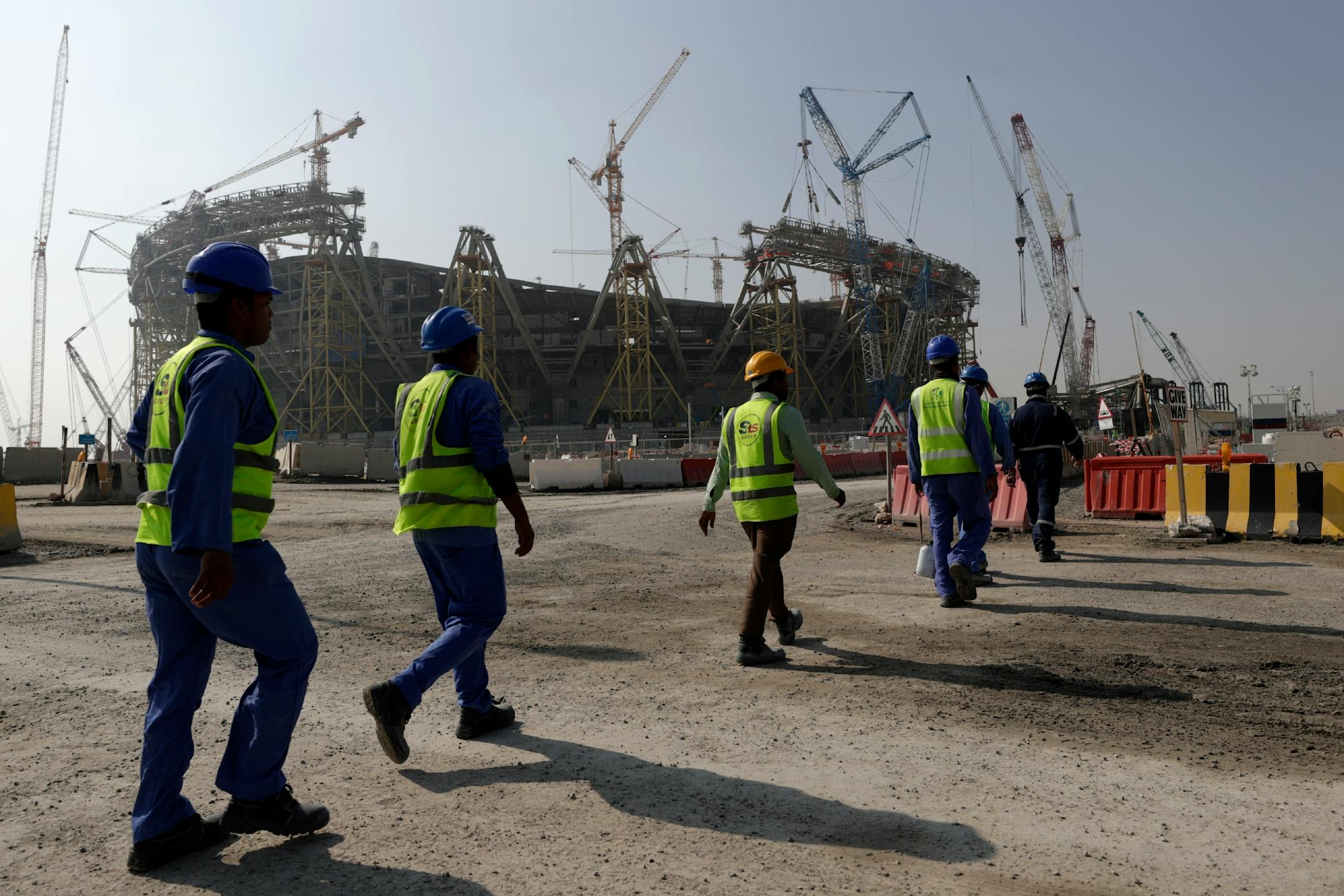
The World Cup in Qatar has drawn the spotlight onto the plight of its migrant workers — 2.2 million of them in 2020, according to statistics from the United Nations. That is 50% more than a decade earlier, when Qatar won the rights to host the tournament. Nearly 80% of them come from Bangladesh, India, Nepal, Pakistan, the Philippines and Sri Lanka.
Human rights organizations have come down hard on FIFA for not doing more to guarantee the rights of these desperately poor laborers who built the gleaming stadia where the matches are being played. They protest exploitative work, rampant wage theft and high death rates, as well as the lack of unions and the use of coercive contracts that tie migrants to a single employer.
And yet, Qatar's minimum wage ranges from four to eight times that in India. Much like the Indian workers who made it to Dubai before the global financial crisis slammed the door shut, the laborers who got jobs building Doha's stadia are the lucky ones.
"It is a life-transforming amount of money," said Michael Clemens of the Center for Global Development, who led the research on Indians in the UAE. "It can mean the difference between life and death for a family member who gets sick, between opening a business and not opening a business, between getting off the farm or staying on the farm permanently."
Migrant work in places like Doha, Dubai and beyond is, in fact, the most powerful tool the world knows to reduce poverty. As Glenn Weyl, a research economist at Microsoft who teaches at Yale, noted in a paper for the "Normative Ethics and Welfare Economics" conference at the University of Chicago several years back, migrant work in the Persian Gulf does more to reduce global inequality than the combined welfare states of the rich world.


