

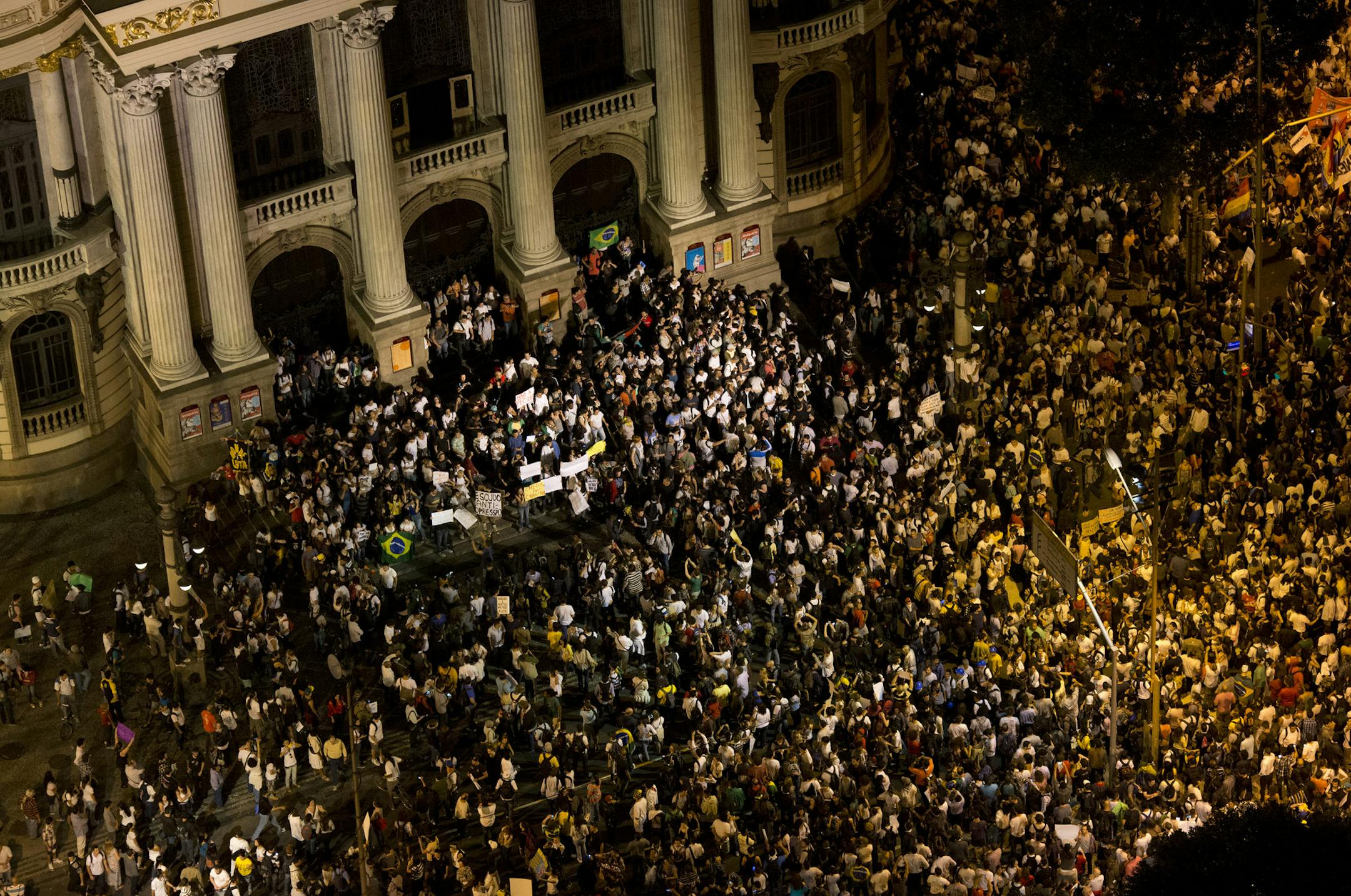
With stunning speed, protests that started on June 6 in São Paulo over a 9-cent rise in bus fares have escalated into the biggest nationwide street demonstrations Brazil has seen since 1992. Then, citizens took to the streets to demand the impeachment of a president on corruption charges. What they want this time is less clear.
The first protests were dismissed by residents unsympathetic to the organizers' demand for universal free bus travel (a policy that would cost the city $2.7 billion a year, the mayor, Fernando Haddad, pointed out). Commuters were unimpressed when the protests made their hellish journeys even worse, and outraged by the vandalism committed by a hard core. Conservative newspapers called for a crackdown.
All that changed on June 13 when ill-trained, brutal police turned a mostly peaceful march into a terrifying rout. Officers with their name tags removed fired stun grenades and rubber bullets at fleeing protesters and bystanders, and hunted stragglers through the streets. Motorists trapped in the mayhem were hit with tear gas. Demonstrators caught carrying vinegar (which lessens the effect of the gas) were arrested.
By June 17 what has been dubbed the "V for Vinegar" movement or "Salad Revolution" had spread to a dozen state capitals as well as the federal capital, Brasília. An estimated 250,000 took to the streets across the country the following nights. There were many more women, families and middle-aged folk than at the initial protests.
The demands also had grown more varied: banners condemned corruption, rising prices, poor schools and hospitals, and the cost of next year's soccer World Cup, for which Brazil will spend $3.1 billion on stadiums alone — three times the cost of South Africa's 2010 World Cup. "First-world stadiums, third-world schools and hospitals," read one placard.
São Paulo's state security chief, Fernando Grella Vieira, ordered police not to use rubber bullets and to stand by unless the protest turned violent. That reduced the mayhem, though on June 18 a splinter group tried to break into City Hall. In Rio de Janeiro the state-government building was damaged and banks and shops looted. In Brasília demonstrators scaled the roof of Congress. Last Wednesday protesters clashed with police before a soccer match in Fortaleza. But most of the marches passed without serious violence.
Small protests have recently escalated into mass movements in other countries, including Britain, France, Sweden and Turkey. Those countries variously suffered from high youth unemployment, ethnic conflict, falling living standards, authoritarian government and worries about immigration.
Brazil is a different story. Youth unemployment is at a record low. Brazilian racism is an internalized reality, not a daily street battle. The past decade has seen the biggest leap in living standards in the country's history. As for immigrants, though Brazil was built by them it now has hardly any. Only 0.3 percent of the Brazilian population was born abroad.



