

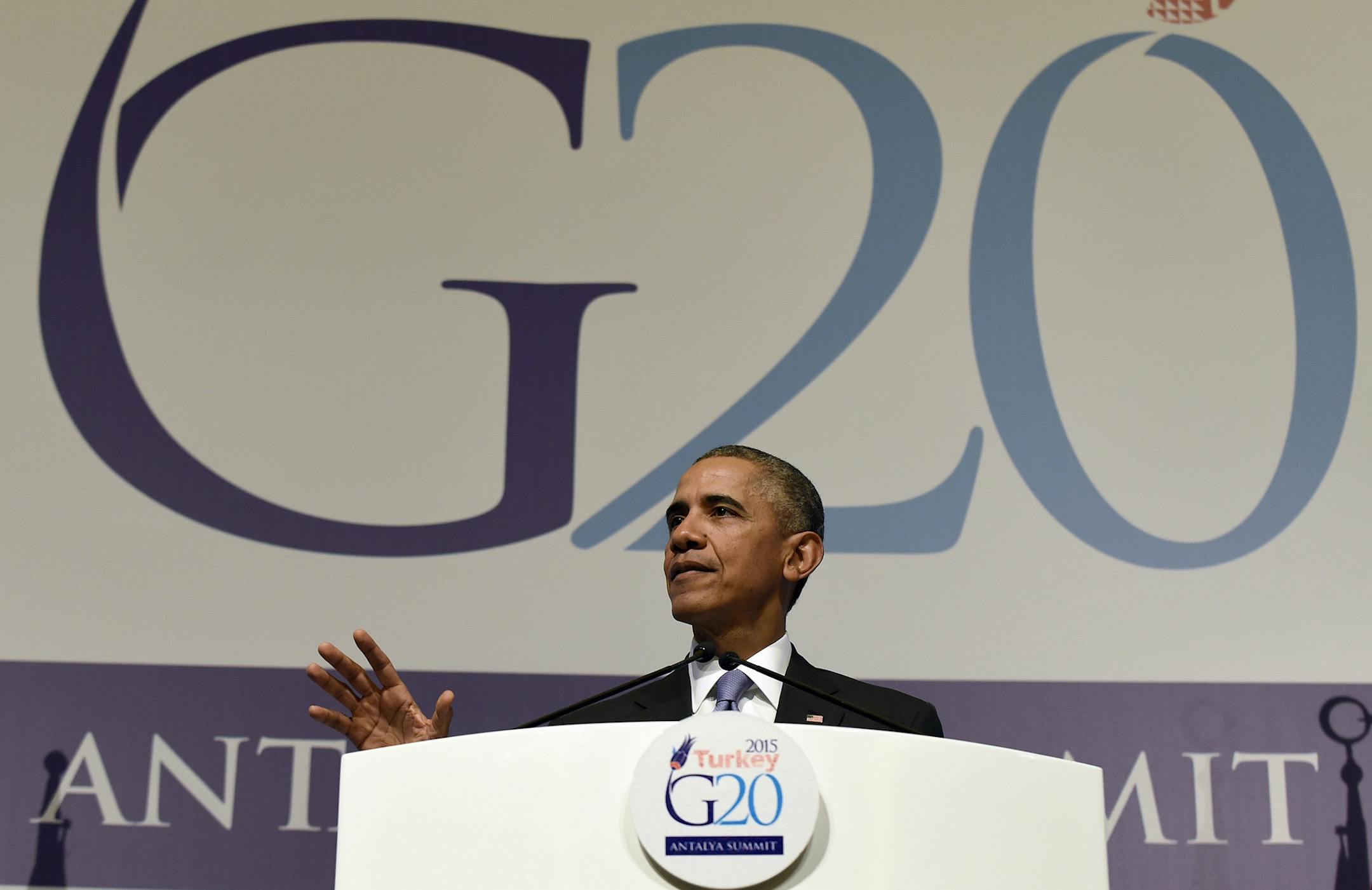
In keeping with his policy, President Obama pivoted to Asia this week.
Well, at least physically. But it was not a full pivot diplomatically.
Sure, after the G-20 summit in Turkey he attended the Asia-Pacific Economic Cooperation (APEC) summit in the Philippines and then the Association of Southeast Asian Nations (ASEAN) summit in Malaysia. But geopolitically, Obama never really left the Mideast, and by extension Europe, as he reacted to the growing global threat from ISIL, as well as other crises roiling the region (and beyond, as evidenced by Friday's hotel hostage drama in Mali).
From Manila, Obama and other APEC leaders issued a stalwart statement on terrorism, and ASEAN leaders likely will follow suit. Yet it's not institutions but individuals, and in particular the president, whose words matter most on global turmoil.
Obama is "incredibly sober in times of crisis," said Bill Burton, the president's former deputy press secretary, in an interview before the University of Minnesota grad spoke on Thursday at the U School of Journalism and Mass Communications' Fall Forum.
Some supporters, especially those who voted for Obama because of his pledge to end U.S. wars in the Mideast, may concur with Burton. Other observers of Obama's Monday news conference, and his previous proclamations on Syria, may not.
Most of the reaction this week was withering. The Washington Post called Obama "petulant-sounding," and that was one of the more restrained descriptions. Not surprisingly, Republican congressional and candidate reaction was strong, and even Hillary Clinton seemed to distance herself from her former boss as she spoke about ISIL at the Council on Foreign Relations on Thursday.
And as with any foreign policy issue, international observers were keenly listening, too, just as they took close note of Obama's previous call that Syria using chemical weapons would cross a red line and that Syrian President Bashar Assad must go.


