
Portrait of an Iron Lady

Margaret Thatcher is rediscovered on screen and on the campaign trail.

January 14, 2012 at 2:28AM
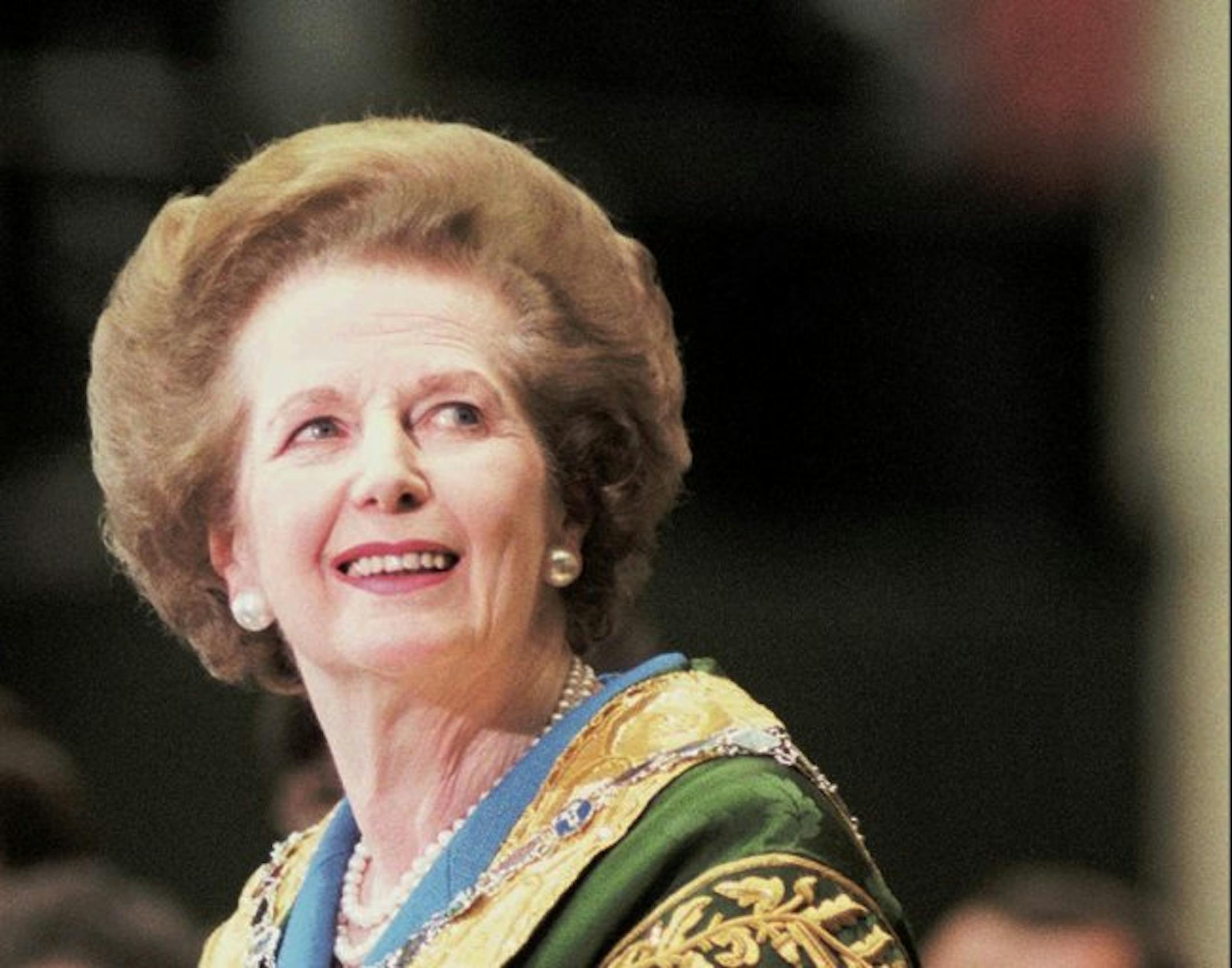
Former British Prime Minister Margaret Thatcher smiles as the audience gives her a standing ovation before her commencement address at William and Mary Hall in Williamsburg, Va., Sunday, May 11, 1997. In a speech Monday, the Iron Lady said the Labor Party won two weeks ago partly by adopting policies of the Conservative Party she led to power in 1979, including privatization and lower taxes.
Former British Prime Minister Margaret Thatcher smiles as the audience gives her a standing ovation before her commencement address at William and Mary Hall in Williamsburg, Va., Sunday, May 11, 1997. In a speech Monday, the Iron Lady said the Labor Party won two weeks ago partly by adopting policies of the Conservative Party she led to power in 1979, including privatization and lower taxes. (Elliott Polk (Clickability Client Services) — Associated Press/The Minnesota Star Tribune)

Viral videos, social-media messages and countless campaign ads still have nothing on the best political messaging ever: A 34-year-old British poster.

"LABOUR ISN'T WORKING," the tagline read over an image of a long line of Brits in front of an unemployment office.

Context is crucial: The poster appeared in 1978, at the Labour Party's low point.

Many were indeed "living off the dole," and those with jobs often took part in strikes that staggered basic public services. Inflation soared. Spirits sank.

So in 1979 voters chose the Conservative Party, making Margaret Thatcher prime minister.

The poster's power, and Thatcher's philosophies, are once again in vogue with voters.

Only this time, it's across the pond.

Mitt Romney updated the ad to "OBAMA ISN'T WORKING." Newt Gingrich lauds Thatcher as often as he credits Ronald Reagan. And before her electoral exit, Michele Bachmann's malleable messaging switched from "titanium spine" to "America's Iron Lady."

It's no wonder that Thatcherism is ascendant. While not nearly as dire, 2012 America looks a bit like 1978 England, with unsustainable spending, uncomfortably high unemployment, and angry protests from Madison, Wis., to Wall Street.

And, as the recently released "The Iron Lady" reminds us, Thatcher's rhetoric sounds as if it could come from the 2012 campaign trail.

"Yes, the medicine is harsh. But the patient requires it," Meryl Streep's Thatcher says about government austerity measures.

The movie's portrayal of the Iron Lady's steely leadership stands in stark contrast with modern-day European leaders, whose serial summits over the European monetary crisis evoke a different film: "Groundhog Day."

This is another reason that Thatcher has been rediscovered: One of the big things she got right was resisting the euro.

But Thatcher engaged in multilateral institutions on other matters. Along with leaders of other NATO nations, she was stalwart in countering communism, but could seize an opportunity.

"I like Mr. Gorbachev. We can do business together," she famously said.

Her iron was unbending, however, when facing the Irish Republican Army, which set a template on how today's leaders deal with Al-Qaida.

The two battles best defining the Thatcher era, however, remain controversial for many.

"The Iron Lady" depicts that even the Reagan administration tried to convince Thatcher to negotiate with Argentina over the Falkland Islands. Others, however, see her British-Empire-strikes-back moment as her finest hour.

And while Thatcher mostly won Britain's brawl over the public sector's role, her policies led to jolting job losses that some never recovered from. To others, her actions saved Britain from a socialist abyss.

Many Thatcherites may be disappointed by her depiction in "The Iron Lady." Golden Globe nominee Streep flawlessly captures Thatcher's accent.

But the action in the film, which didn't deserve or receive a nomination, mostly focuses on a senile Thatcher in twilight, portraying her as more pathetic than powerful.

Filmmakers aren't the only ones who can be accused of revisionism. Some GOP candidates may be doing the same thing.

Indeed, it's important to remember not only what Thatcher stood for, but what she didn't, said John Watkins, a University of Minnesota professor who teaches British history and literature.

Watkins, who lived in England during the Thatcher era, recalls that Thatcher initially raised taxes to lower the deficit, and unlike the debate over Obamacare, she didn't eliminate a real example of "socialized medicine," the National Health Service.

"Compared to our Tea Party wing of the party today, Thatcher would have been seen as a dangerous liberal," Watkins said.

And Thatcher, who voted to decriminalize homosexuality and was prochoice, subjugated social issues for foreign and economic affairs.

"The American Republican Party still comes with a baggage of social issues that were never really part of mainstream politics in Britain," Watkins said. "It would not have been something that Margaret Thatcher would have found compelling."

Like all historical figures, Thatcher is subject to interpretation. That the film came so soon is a testament to her incredible impact.

"It used to be about trying to do something. Now it's about trying to be someone," Streep's Thatcher says in "The Iron Lady."

Margaret Thatcher did something. And accordingly, she was someone.

* * *

is a Star Tribune editorial writer and columnist.

about the writer

about the writer

John Rash

Editorial Writer

John Rash is an editorial writer and columnist. His Rash Report column analyzes media and politics, and his focus on foreign policy has taken him on international reporting trips to China, Japan, Rwanda, Kazakhstan, Turkey, Lithuania, Kuwait and Canada.

See Moreicon

More from Commentaries

See More
card image
Richard Tsong-Taatarii/The Minnesota Star Tribune

Calls for de-escalation and toning down the rhetoric in recent days is exactly what was needed, even if it might have felt like capitulation.

card image

Opinion | What happens after our shock fades?

card image