

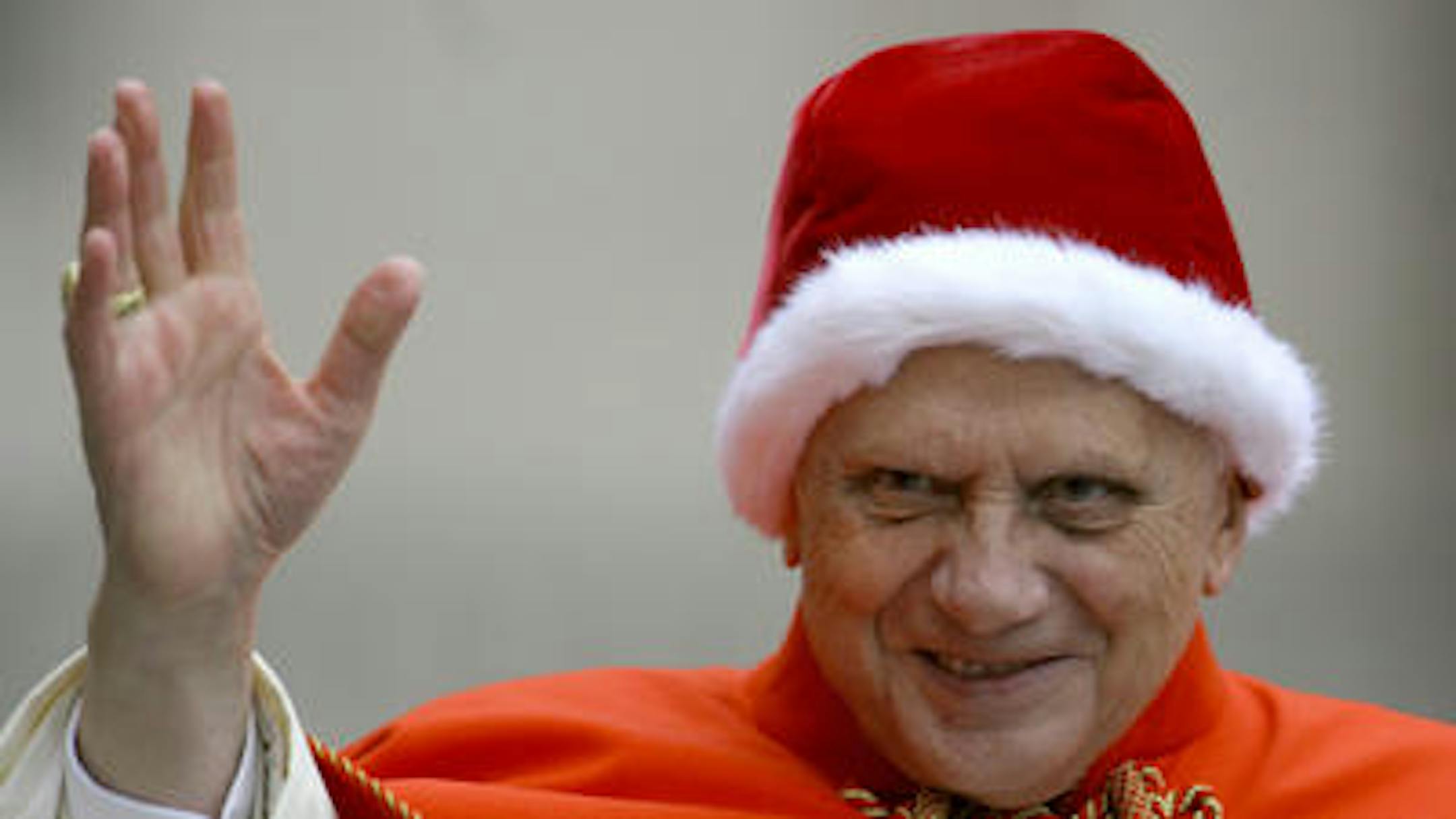
I'm a Catholic, but I'll admit it (or should I say "confess" it?): When Pope Benedict XVI announced his pending resignation, my first thought wasn't religious. It was in fact downright superficial. "There goes the best-dressed pontiff ever!"
During his nearly eight years on the throne of St. Peter, Benedict has always looked absolutely perfect, sartorially speaking, whether garbed in elaborate vestments for an Easter liturgy or clad in the simple but meticulously tailored white caped cassock (it's called a "simar" in church lingo) that he wears on more ordinary occasions. He's been the Duke of Windsor of popes.
My own fashion sense is nearly nonexistent, but that only makes me more appreciative of Benedict's. Some highlights:
- Benedict saying Mass in 2008 at Washington's Nationals Park stadium in a billowing scarlet satin chasuble (a priest's outermost liturgical garment) trimmed with crimson velvet and delicate gold piping.
- Benedict greeting worshipers in Rome, his chasuble this time woven of emerald-green watered silk with a pattern of golden stars.
- Benedict on Oct. 21 canonizing Kateri Tekakwitha, the first Native American saint, while attired in a fanon, a gold-and-white striped shoulder covering, dating to the 8th century, that only popes may wear.
Benedict's immediate predecessor, Pope John Paul II, was a saintly figure and a commanding intellectual presence, but he had little interest in clothes, tending to wear whatever was handed to him and shunning elaborate adornments.
Pope Paul VI, who reigned from 1963 to 1978, started out dressing fancy, but he gradually simplified his attire, abandoning, for example, the papal tiara, the high triple crown that popes had worn since the early Middle Ages.
Benedict didn't bring back the tiara, but he has revived many other traditional papal garments and accessories. For his public appearances he almost always wears the bright red shoes that popes have worn since Roman times (John Paul preferred brown or black footwear).
Benedict also began wearing the mozzetta, a waist-length cape, and the camauro, a red velvet cap with a white fur border that reminded Americans of a Santa Claus hat. Neither of those items had been seen much on popes since the end of the Second Vatican Council in 1965.
Benedict's sartorial revivals have offended many liberal Catholics, who argue that he has been trying to "turn back the clock," as they often put it, on the churchly reforms of Vatican II. The cattiest critic was Hans Kung, the dissident German priest who had once been a colleague of Benedict, or Josef Ratzinger as he was then called, on the faculty of the University of Tubingen.


