
Poorest Americans suffer most from Medicaid fight

October 5, 2013 at 10:02PM
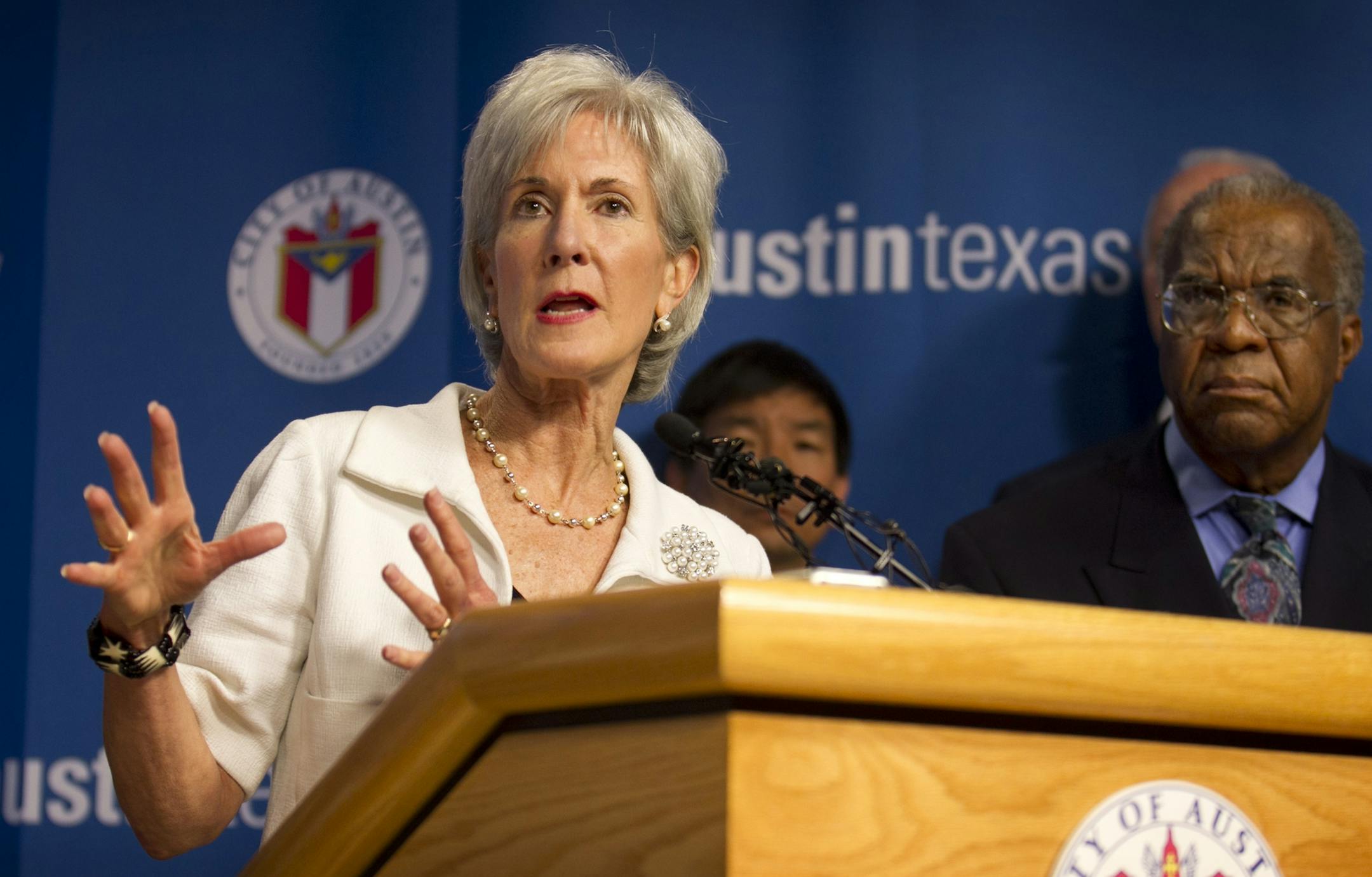
Secretary of Health and Human Services Kathleen Sebelius, left, speaks at a news conference at City Hall in Austin, Texas, on Thursday, Aug. 8, 2013. Sebelius said her office is open to crafting a uniquely Texan plan to make sure everyone has health insurance. She was in Austin and San Antonio to talk about how local communities can take advantage of the Affordable Care Act. Texas has the nationís highest rate of people without health insurance, most of them the working poor and single adul
Secretary of Health and Human Services Kathleen Sebelius, left, speaks at a news conference at City Hall in Austin, Texas, on Thursday, Aug. 8, 2013. Sebelius said her office is open to crafting a uniquely Texan plan to make sure everyone has health insurance. She was in Austin and San Antonio to talk about how local communities can take advantage of the Affordable Care Act. Texas has the nationís highest rate of people without health insurance, most of them the working poor and single adults. Texas has the option of expanding Medicaid to include those who cannot afford health insurance, but Gov. Rick Perry has rejected all portions of act. (AP Photo/Austin American-Statesman, Jay Janner) AUSTIN CHRONICLE OUT, COMMUNITY IMPACT OUT, MAGS OUT; NO SALES; INTERNET AND TV MUST CREDIT PHOTOGRAPHER AND STATESMAN.COM ORG XMIT: MIN2013091315303751 (The Minnesota Star Tribune)

It is outrageous that millions of the poorest people in the country will be denied health insurance because of decisions made mostly by Republican governors and legislators. These people will neither qualify for their state's Medicaid program for the poor nor for subsidized coverage on new insurance exchanges that are being established in every state by the health care reform law.

Their plight is a result of the Supreme Court's decision last year that struck down the reform law's mandatory expansion of Medicaid and made expansion optional. Every state in the Deep South except Arkansas has rejected expansion, as have Republican-led states elsewhere. These 26 states would rather turn down incredibly generous federal funds that would finance 100 percent of the expansion costs for three years and at least 90 percent thereafter than offer a helping hand to their most vulnerable residents.

As reported last week, two-thirds of the country's poor, uninsured blacks and single mothers and more than half of the uninsured low-wage workers live in those states. The reform law originally sought to help poor and middle-income people through two parallel mechanisms. One was a mandatory expansion of Medicaid (which in most states cover primarily children and their parents with incomes well below the poverty level) to cover childless adults and to help people with income levels above the poverty line. That approach fell apart when 26 states decided not to expand Medicaid, at least for now.

FROM AN EDITORIAL IN THE NEW YORK TIMES
about the writer

about the writer

More from Commentaries

See More
card image
Marco Trovati/The Associated Press

A steep slope doesn’t care about narrative arcs, but hard work and perseverance are always inspiring.

card image
card image