

PolitiFact: Sanders overstate's NAFTA's negative impact

Economies are complex, and economists can reach different conclusions.

March 12, 2016 at 12:43AM
Democratic presidential candidates Hillary Clinton, left, and, Sen. Bernie Sanders, I-Vt., argue a point during a Democratic presidential primary debate at the University of Michigan-Flint, Sunday, March 6, 2016, in Flint, Mich. (Jake May/The Flint Journal-MLive.com via AP) LOCAL TELEVISION OUT; LOCAL INTERNET OUT; MANDATORY CREDIT ORG XMIT: MIN2016031112493247
Democratic presidential candidates Hillary Clinton and Bernie Sanders during a debate on March 6 in Flint, Mich. (The Minnesota Star Tribune)

In a series of exchanges between Vermont Sen. Bernie Sanders and former Secretary of State Hillary Clinton, the Democratic candidates have sparred repeatedly over trade issues. At their March 6 debate in Flint, Mich., after Clinton laid out how she would go after companies that aim to shift production overseas, Sanders leveled this charge:

"Secretary Clinton supported virtually every one of the disastrous trade agreements written by corporate America," Sanders said. "NAFTA, supported by the secretary, cost us 800,000 jobs nationwide … ."

NAFTA is the North American Free Trade Agreement, signed by President Bill Clinton in 1993. It significantly reduced trade tariffs among the U.S., Mexico and Canada. Hillary Clinton obviously had no vote on the deal, but in 1996, during her husband's presidency, she did say "I think NAFTA is proving its worth." Since then, she has said it "has not delivered" and should be fixed.

Our focus is whether, in fact, the trade deal caused the loss of 800,000 American jobs.

The Sanders campaign pointed us to work by the Economic Policy Institute, a research group that gets about a quarter of its funding from unions. A 2014 report from the group found that from 1993 to 2013, "the U.S. trade deficit with Mexico and Canada increased from $17 [billion] to $177.2 billion, displacing 851,700 U.S. jobs. All of the net jobs displaced were due to growing trade deficits with Mexico."

But other analyses say the impacts were much less dramatic.

The Congressional Research Service, the nonpartisan policy arm of Congress, summarized a number of studies and said it is difficult to tease out the effects of NAFTA by itself. Factors such as economic growth, inflation and changes in exchange rates cloud the waters. That said, the report struck a measured tone.

"NAFTA did not cause the huge job losses feared by the critics or the large economic gains predicted by supporters," the report said. "The net overall effect of NAFTA on the U.S. economy appears to have been relatively modest."

A similar review published by the international Organization for Economic Cooperation and Development reached the same conclusion, noting that jobs in certain industries, such as cars and electronics, might have suffered, but overall, the job impact was nominal.

Economist Martin Baily at the Brookings Institution said Sanders' number "looks high" and observed that it's possible that NAFTA has not cost the country any jobs.

In 2014, a pair of researchers, Lorenzo Caliendo at Yale University and Fernando Parro at the Federal Reserve, drilled down to examine not just exchanges among the U.S., Mexico and Canada, but how NAFTA affected trade around the world. In their model, NAFTA produced more gains for Mexico than the United States, but both countries were slightly better off.

The China factor

Economies are enormously complex systems, and economists can reach different conclusions. Part of what makes the legacy of NAFTA challenging to assess is that in the last year of his presidency, Bill Clinton signed legislation granting China permanent normal trade relations. From 2000 on, this had an enormous impact on trade between the two nations. That overlaps with about half the period when analysts have tried to gauge the effect of NAFTA.

A 2014 report published by the Federal Reserve Board linked that change to major job losses in the U.S. It "reduced total employment growth by -19.5 percentage points from 1997 to 2007 versus the prior decade," the authors wrote.

Our ruling

Sanders said that NAFTA, which Clinton used to support, cost the U.S. economy 800,000 jobs. There is a report from a left-leaning policy group that reached that conclusion. But many nonpartisan reports found that the trade deal produced neither significant job losses nor job gains. This is a result of competing economic models and the challenges of teasing out the effects of NAFTA from everything else that has taken place in the economy.

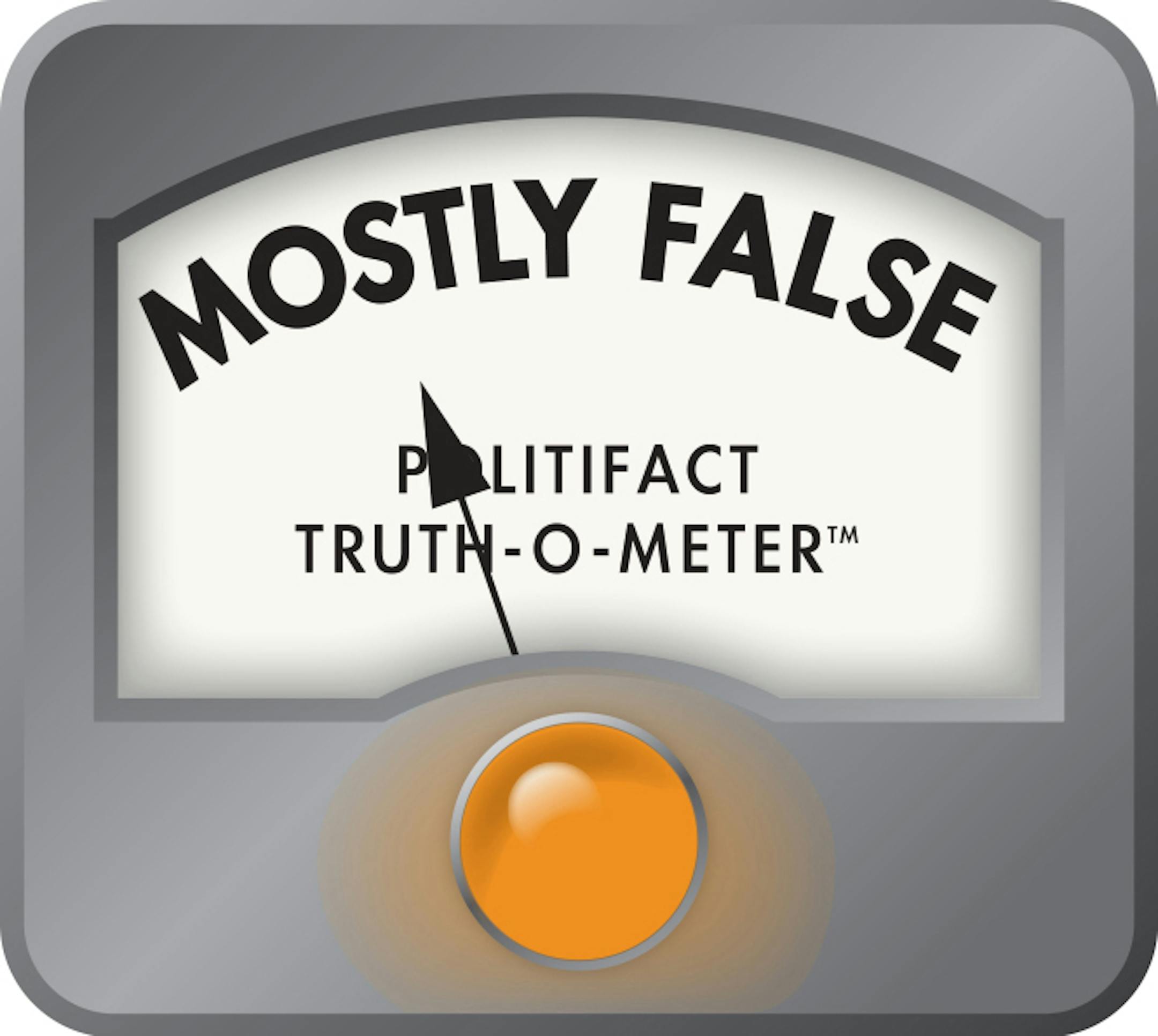
The report Sanders cited is an outlier, and his use of its findings ignores important facts that would give a different impression. We rate his statement Mostly False.

The assertion: “NAFTA, supported by the secretary, cost us 800,000 jobs nationwide …” Our assessment: Most studies found little impact. (The Minnesota Star Tribune)
Hillary Clinton and Bernie Sanders face off in a debate moderated by Univision and the Washington Post at Miami-Dade College Kendall Campus on Wednesday, March 9, 2016, in Miami. (Carolyn Cole/Los Angeles Times/TNS) ORG XMIT: 1181775 ORG XMIT: MIN1603092316075347
Bernie Sanders (The Minnesota Star Tribune)
about the writer

about the writer

Jon Greenberg, PolitiFact

More from Commentaries

See More
card image
Alex Kormann/The Minnesota Star Tribune

The administration’s justifications keep changing. The focus on county jails is just one of the latest.

card image
card image