
Pine Needles: Where art and science come together to create a masterpiece

November 18, 2025
icon2:44
The Science Museum of Minnesota has a cabin near St. Croix on Marine for artists in residence

How the Science Museum of Minnesota’s artist in residency program is bringing science to a wider audience

Provided by Science Museum

At the Pine Needles cabin, artists find inspiration at every turn. It’s in the scientific discoveries being made down the road. It’s in the area’s rich history. And it’s in the tranquil natural environment that surrounds the cabin.

But no matter what’s behind their creations, the artists at Pine Needles are helping the Science Museum of Minnesota make its work accessible to more people.

Haley Prochnow works inside the Science Museum of Minnesota’s Pine Needles cabin
The Science Museum’s Pine Needles cabin
Scenery near the pine needles artist cabin
The Pine Needles cabin is on the scenic St. Croix River, just north of the town of Marine on St. Croix

Exploring the intersection of art and science

Tucked along the St. Croix River just north of the town of Marine on St. Croix, the Pine Needles cabin has hosted artists in residence for more than two decades.

Each artist stays at the cabin for several weeks, working on creative projects ranging from written pieces to paintings and even musical compositions.

But regardless of the medium, program operator Alaina Fedie said Pine Needles looks for artists who want to combine art and science in their finished work.

“The mission statement of the Pine Needles program is to enhance scientific understanding through art,” Fedie explained.

But what exactly does that look like? Many artists look at work being done at the nearby St. Croix Watershed Research Station, where researchers from the Science Museum examine Minnesota waterways and environmental factors influencing them.
The end result might incorporate photographs, graphics, field notes, or other parts of the research process into an artistic output.

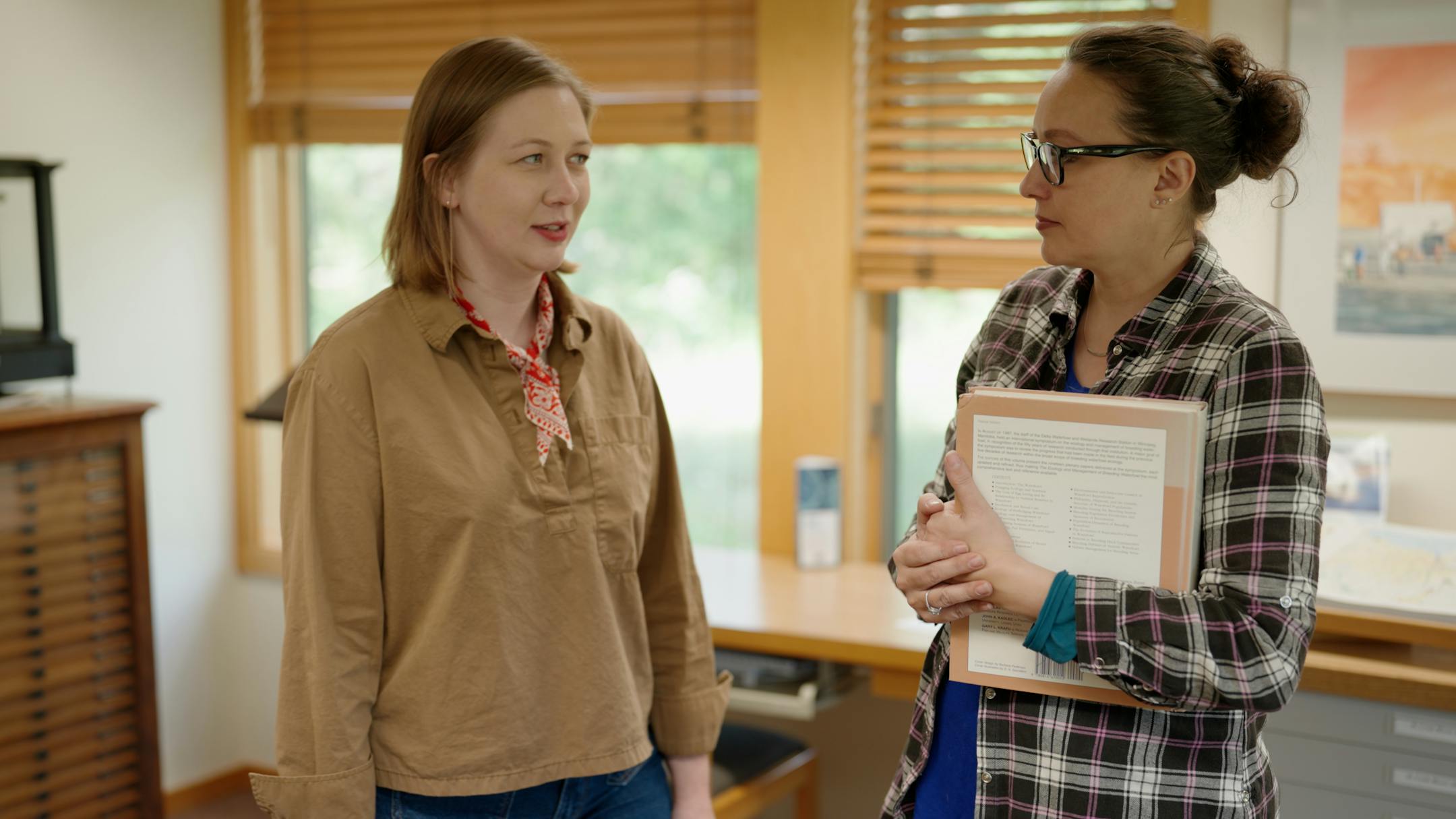
Haley Prochnow (left), artist-in-residence, and Alaina Fedie (right), Pine Needles program director, talk at the Science Museum of Minnesota’s St. Croix Watershed Research Station

Bringing science to new communities

By translating scientific topics into art, the Pine Needles artists are bringing science to a wider audience.

As part of the program, applicants must demonstrate how they plan to share their work with the public.

“We seek artists who explore, interpret, and communicate science within their work, who share the integration of art and science with their communities and audiences,” Fedie said.

The current artist in residence at Pine Needles is Haley Prochnow. Like many artists who have worked with the program, Prochnow is hoping to bring a lesser-known story to light.

Prochnow is studying the life of St. Croix Falls native Florence Baker Riegel, a biologist and conservationist who lived and worked in the area in the early 1900s.

Eventually, she plans to turn what she’s learned into a written piece that explores Riegel’s contribution to river preservation and the relationship between environment, history, and identity.

Using materials in the Research Station’s library, Prochnow hopes to get a sense of what the area was like when Riegel lived there.

Beyond those resources, inspiration lies right outside her door at the cabin.

“It’s really important for me to actually experience the same landscapes and environment that this person I’ve never met experienced decades before me,” Prochnow said. “It brings me closer to the story and just helps me contextualize this person that I’m learning about.

Haley Prochnow works inside the Science Museum of Minnesota’s Pine Needles cabin
Inside the Science Museum of Minnesota’s Pine Needles cabin
The Science Museum’s Pine Needles cabin provides a peaceful retreat for artists to work

A peaceful retreat

For artists like Prochnow, one of the biggest benefits to the Pine Needles program is simply enjoying the time and the space to dive completely into a project.

Free from outside distractions, Prochnow says she’s been able to dedicate the time her project needs to get off the ground.

“Putting myself out of my normal environment into a new one, I noticed pretty much immediately I’m a lot less distracted here,” Prochnow said. “I have a lot more time to focus, to think through a lot of the concepts that I’ve been kicking around for a while.”

When she’s not writing, Prochnow can find inspiration walking on the property’s trails or admiring local wildlife.

“It’s pretty special,” Prochnow said. “Most people don’t get to see that view, so it really feels like a privilege to be here.”