

Super Bowl commercials this year featured robots interacting with humans in ways that far surpass the capabilities of real-world systems today. In one rather meta ad for a telecom provider, robots brainstorm with humans to come up with the premise for another commercial.
At the Allen Institute of Artificial Intelligence in Seattle, computer scientists are working on imbuing software with humanlike abilities to recognize images and understand language that could someday make that sort of collaboration possible.
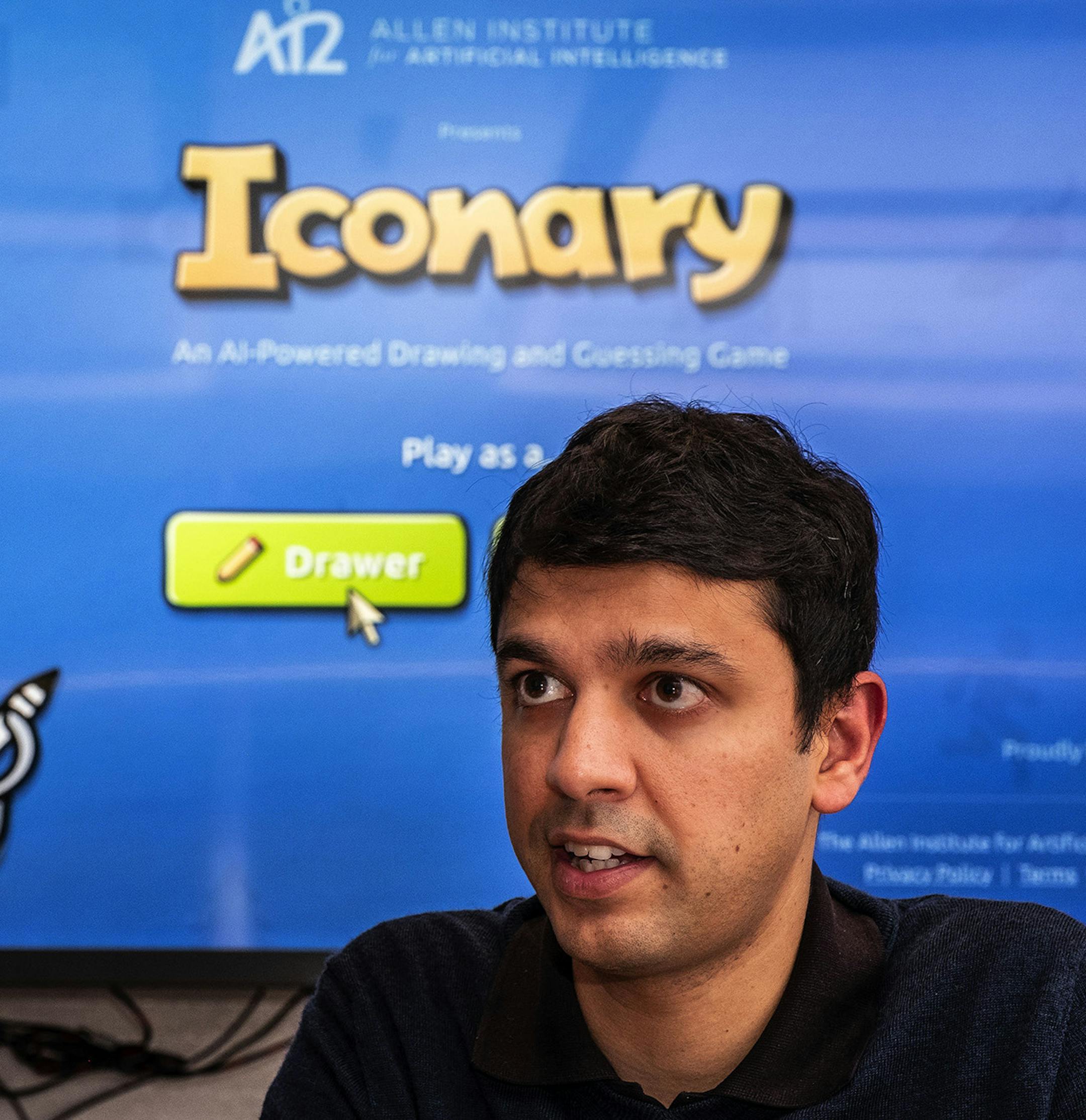
Their latest effort is a game modeled on the guessing-and-drawing diversion Pictionary. Iconary can be played in collaboration with a collection of algorithms nicknamed AllenAI, said Ani Kembhavi, senior research scientist at the institute. "It's collaborative, it's communicative, it's not adversarial," he said.
In recent years, advanced software systems — given the ill-defined label of artificial intelligence (A.I.) — have famously bested humans at chess and Go. These games, however, have rigid and explicit rules and clearly defined winners and losers within their limited contexts.
AlphaGo, DeepBlue and more recent A.I. systems that play large-scale online strategy games such as StarCraft represent remarkable achievements, Kembhavi said, but show the limits of these systems as much as their potential. There is little of the real-world's ambiguity and nuance in a given chess position. "The algorithms that work, they're quite intellectually stimulating, but they cannot be picked up and used on a robot or A.I. agent for a real-world application," he said.
With the Iconary A.I. system, a player works with the system to accomplish a task. AllenAI merges linguistic and visual skills in the context of the game, with a dose of what Kembhavi terms "common sense reasoning." For example, the word "dinner" is a meal associated with evening, which is associated with the moon. So AllenAI might guess "dinner" for a depiction of a meal and a moon.
Kembhavi sees AllenAI as a step on the path toward a more general artificial intelligence — which is one of the goals Paul Allen set for the institute when he launched it in 2013.



