
Souhan: Last Patriots-Seahawks Super Bowl a testament to Bill Belichick’s genius

The coach’s late-game strategy before Malcolm Butler’s interception of Russell Wilson led to New England’s fourth title.

Columnist Icon
The Minnesota Star Tribune
January 26, 2026 at 7:12PM
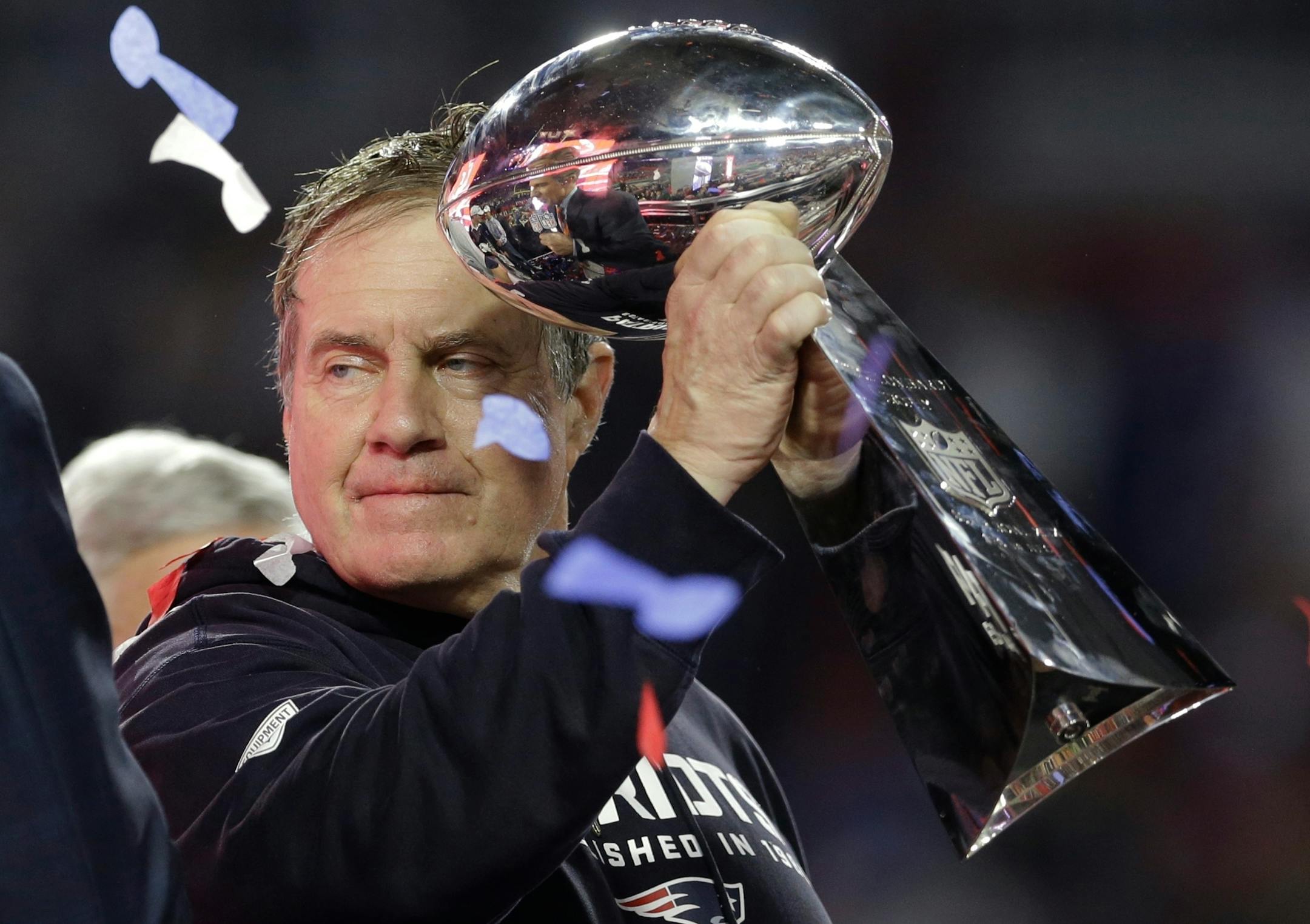
Patriots coach Bill Belichick holds the Vince Lombardi Trophy after New England beat Seattle 28-24 in Super Bowl XLIX in February 2015 in Arizona. The Patriots will face the Seahawks again in Super Bowl LX on Sunday, Feb. 8, in Santa Clara, Calif. (Patrick Semansky/The Associated Press)

We know that Tom Brady was more important to the New England Patriots’ dynasty than Bill Belichick.

Brady won a Super Bowl without Belichick. Belichick didn’t win anything without Brady.

There were certain Super Bowls, though, in which Belichick proved his prowess as a defensive coach and strategic mastermind. One of those was the first Super Bowl between the Patriots and Seahawks in 2015, a matchup that will be repeated in Super Bowl LX on Sunday, Feb. 8, in Santa Clara, Calif.

I was sitting in the press box near the end zone where the deciding plays occurred in Super Bowl XLIX on Feb. 1, 2015, in Glendale, Ariz. The Patriots hadn’t won a Super Bowl in a decade. The Seahawks had destroyed Denver in the previous Super Bowl.

Led by coach Pete Carroll, quarterback Russell Wilson, running back Marshawn Lynch and the “Legion of Boom” defense, Seattle felt like a budding dynasty.

If you’re an NFL fan, you remember Lynch not getting the ball for what could have been a game-winning touchdown in the last seconds of the game. What you might not remember is the sequence that led to Carroll and his offensive coordinator, Darrell Bevell, deciding to pass.

The Seahawks trailed 28-24 late in the fourth quarter. Wilson hit wide receiver Javon Kearse with a 33-yard pass to the Patriots 5-yard line, and Seattle took its second timeout with 1:06 remaining.

On first down, Lynch ran for 4 yards, setting up second-and-goal at the 1. Everyone in the building expected Lynch to get another carry and to score, giving the Seahawks a second straight Super Bowl victory.

ADVERTISEMENT

That’s when Belichick veered from common strategy and displayed his genius.

He didn’t call a timeout.

The Seahawks expected him to do so. Seattle was preserving its last timeout in case a run came up short. So, as the Seahawks waited for Belichick to call a timeout, he noticed that Seattle had three receivers on the field going against New England’s goal-line defense.

Belichick believed his goal-line defense could stop Lynch if Seattle wasn’t going to use its power lineup. So, he waited. The Seahawks’ sideline began to panic, finally calling for a pass play. They figured if the pass was incomplete, they could run the ball on third down and take their timeout if they didn’t score.

Belichick had persuaded his opponent to go away from its strength — Lynch’s power running.

Then, just before Seattle snapped the ball, Belichick sent cornerback Malcolm Butler onto the field, removing a linebacker.

All week, Belichick had tutored Butler on how to jump a certain pass play. Wilson dropped back and threw an accurate pass to receiver Ricardo Lockette in the end zone. Butler jumped the route and intercepted the pass, making history.

By not calling a timeout, Belichick had confused his opponents, prompting them to run a risky pass play to a journeyman receiver instead of giving the ball to the best short-yardage back in the game.

Carroll failed to win consecutive Super Bowls, something only seven coaches in NFL history have accomplished. Bevell, the former Vikings offensive coordinator, went from a head coaching candidate to another offensive assistant roaming the league. He was the Miami Dolphins’ quarterbacks coach and passing game coordinator this season.

Wilson, a superstar at the time, hasn’t played in another Super Bowl.

That game became the fourth Super Bowl victory for Brady and Belichick, elevating them into the NFL pantheon. They would win two more together.

In an interview with Boston-area radio station WEEI after the game, Belichick said: “We put our goal-line defense in probably around the same time they were sending in their multiple receiver group, and that’s kind of what we wanted to be in there, to make sure they didn’t run the ball.

“I’d like to think had they tried to run the ball against our goal-line defense, with three receivers on the field — we couldn’t ask for any more than that in terms of trying to stop the running game. We saw that matchup, and we certainly gave some consideration to taking a timeout there and leaving some time on the clock. I don’t know if that would have been a bad thing to do.

“But it just seemed like — in the flow of the game — that we were OK with where we were."

about the writer

about the writer

Jim Souhan

Columnist

Jim Souhan is a sports columnist for the Minnesota Star Tribune. He has worked at the paper since 1990, previously covering the Twins and Vikings.

See Moreicon

More from Vikings

See More
Minnesota Vikings radio play by play announcer Paul Allen listened to head coach Mike Zimmer made his way to the podium for a press conference after the injury of quarterback Teddy Bridgewater at practice on Tuesday.
Star Tribune/The Minnesota Star Tribune

The longtime Vikings announcer is taking a few days off after facing national criticism.

card image
card image