
Reusse: Wolf urine, Tonya Harding and Picabo Street’s run highlight tales from past Olympics

Trips to six different Olympics for two publications led to a lifetime of fascinating memories.

Columnist Icon
The Minnesota Star Tribune
February 6, 2026 at 5:30PM
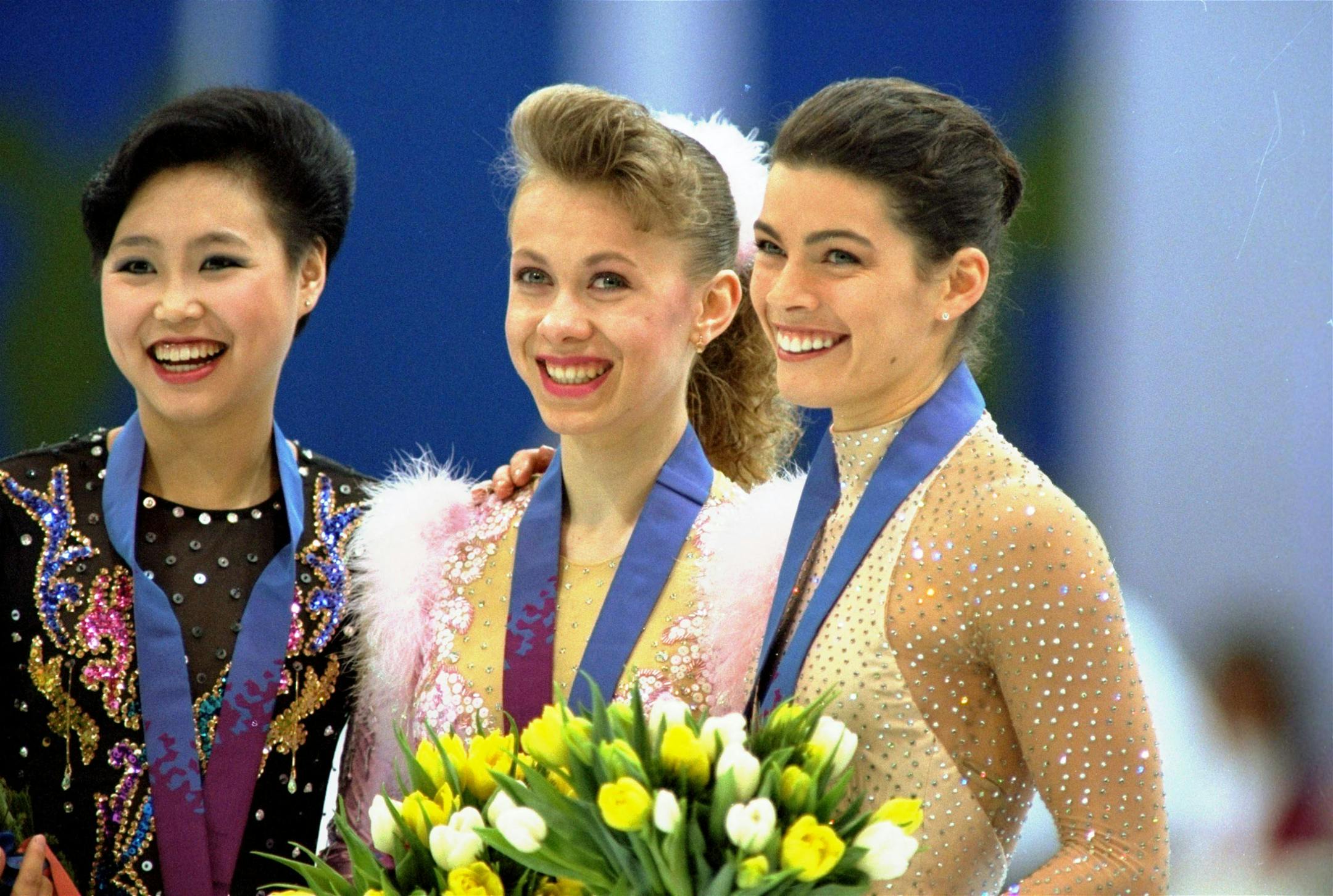
The ladies' singles figure skating medalists at the 1994 Olympics. Bronze medalist Chen Lu of China, left, gold medal winner Oksana Baiul of Ukraine, center, and silver medalist American Nancy Kerrigan. (DENIS PAQUIN/The Associated Press)

There were a couple of English-language publications that reported for visitors at the Winter Olympics centered in Lillehammer, Norway, in February 1994. Bob Ford from the Philadelphia Inquirer was taken by a small item in one of these updates.

More frequent railroad traffic to transport fans from Lillehammer north toward competition areas was taking a toll on the “elg” population. First, Ford discovered an “elg” was what we call a moose in the USA. But the intriguing part was that to keep the large beasts safer, the Norskis were spreading wolf urine near the tracks.

Ford looked across a work area in the media room and said: “I have to find out. Where do they get the wolf urine?”

He made numerous calls, and finally got a number for a wildlife official connected to the Olympics and asked that key question: Where does the wolf urine come from?

To which the man in his thick Norwegian accent responded: “From de wooolfs.”

Another small highlight: Halfway through the competition, there was a headline in a local publication that included “Norski, Svenska and Fiji.”

I asked a Norwegian reporter to give me the English interpretation and he said: “Norway leads Olympics in medals; Swedes tied with Fiji.”

The opportunity to poke fun at the rivals across the southern arm of the North Sea never gets old. And it was accurate: Rusiate Rogoyawa, the overweight Fijian cross-country skier, and the entirety of the Swedish delegation had at that point the same number of medals. Zero.

ADVERTISEMENT

In the true spirit of Norway, there were more than 100,00 spectators scattered across the hilltop on the day of the men’s 10-kilometer race. They saw local hero Bjorn Daehlie win, and the masses also gave a thunderous cheer to Rogoyawa as he waddled home in last place, 88th overall.

I have not been an Olympic warrior, as were Jay Weiner and Rachel Blount for the Star Tribune. I covered a couple for the St. Paul Pioneer Press (Los Angeles-Summer 1984; Calgary-Winter 1988); and four for the Strib (Barcelona-Summer 1992; Lillehammer-Winter 1994; Sydney-Summer 2000; and Salt Lake City-Winter 2002).

When you’re not there, and with all the ridiculous events that have been added to the schedule, I leave the Olympics more than I take them. But when you’re in attendance, rushing about … the Olympics do burn memories into a brain.

In Barcelona, I didn’t have one of the precious media passes to get inside the stadium for the Olympic opening ceremony.

I was walking on a street down below the hill on which the stadium sat. There was a Spanish family there, gathered around, cooking on a fire, with a tremendously long extension cord plugged into a small TV.

I sat there for a time, and when archer Antonio Rebello shot the arrow to light the cauldron in the stadium above … a number of my companions wept with Spanish pride.

Dream Team, folks. The Games that started the Olympics on the competitive journey from the best amateurs in the world to the best athletes in the world.

And even that can’t top Lillehammer, because the Norskis were fabulous as spectators, and because we had Nancy Kerrigan vs. Tonya Harding, and Tonya’s tears over broken skate laces, and Oksana Baiul stealing the gold, and a fabulous moment of which I was reminded this week.

The featured event on a Saturday was the women’s downhill at the Kvitfjell ski resort, a hour-plus north of Lillehammer. Olympic officials had tried to get the women skiers to contest the downhill at the easier Hafjell ski resort.

U.S. star Picabo Street was among the leaders of the charge to ski the tougher hill. “Women are tired of being back in the shadow of men’s competition,” she said. “We watch the men’s skiers on that mountain and say, ‘Wow, that was hot.’ … We’re doing the same amazing things."

A group of reporters was in the media bullpen at the bottom of the hill. Before Street’s run, the Washington Post’s Angus Phillips and I started talking to a small fellow who turned out to be Picabo’s father, universally called Stubby.

We heard the tale of Stubby and Picabo’s mother Dee deciding they would let their daughter go unnamed until she could choose a name for herself, and how their nomadic existence included frequent winter drives from Idaho to Mexico. When the daughter needed a name for a passport at age three, they went with Picabo, either because there was small town near them in Idaho named Picabo, or because she was an exceptional peek-a-boo player from a very young age.

Picabo then came flying down Kvitfjell to win the silver medal. She would add a gold in 1998 in Nagano, Japan, in the super-G.

Much later, Picabo and Stubby had an altercation that made news, with Dee saying it was based on her husband’s messed-up meds.

And later still, 16 years after the great Post-man Phillips left his outdoors duties at the paper, the Washington Post announced it was shutting down its sports section.

Sad for sure, but the Post-man and I always will have that manna from Olympic heaven after Picabo finished her silver run at the bottom of a mountain in Norway, a place where they use wolf urine as protection for their moose.

about the writer

about the writer

Patrick Reusse

Columnist

Patrick Reusse is a sports columnist who writes three columns per week.

See Moreicon

More from Olympics

See More
card image
Ben Curtis/The Associated Press

Lindsey Vonn’s return to the Cortina downhill course is among Friday’s highlights leading into the opening ceremony in Milan.

card image